
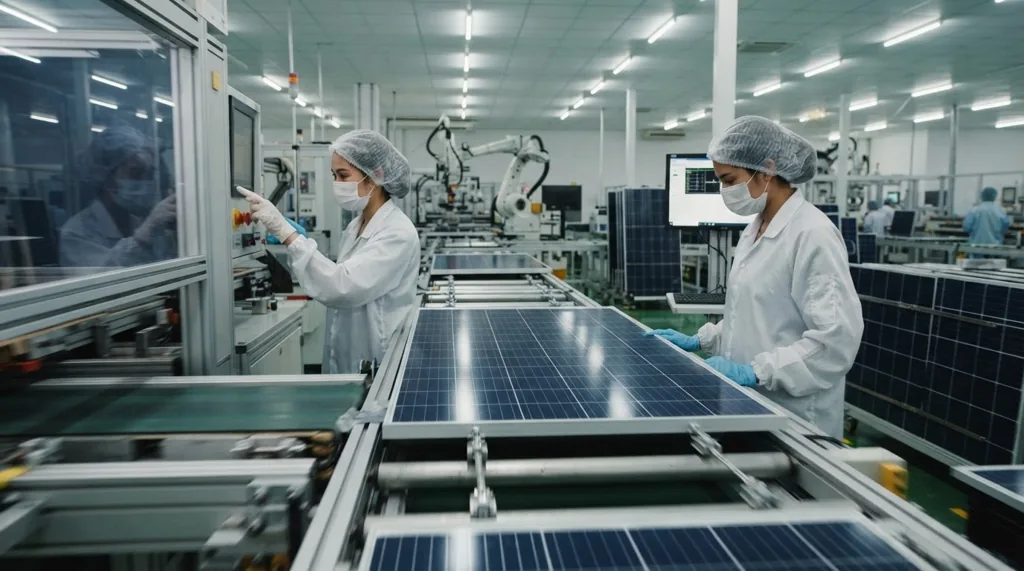
Thailand has updated its technical barriers to trade framework governing crystalline silicon photovoltaic (PV) products through both a comprehensive revision and subsequent addendum.
Thailand’s Thai Industrial Standards Institute (TISI) made a national safety standard compulsory for crystalline silicon solar panels from Oct. 30, 2026.
The rule is a Ministerial Regulation under the Ministry of Industry. Its title says crystalline silicon solar panels must conform to the standard, and it carries the year 2569 in the Thai calendar, which is 20261. TISI told importers that the rule takes effect on Oct. 30, 20262.
In short, a shipment of these solar panels can no longer enter Thailand freely. The maker or importer must first hold a TISI licence, and customs will check that licence through Thailand’s electronic border system2.
What is changing for solar panel imports?
Crystalline silicon solar panels now join Thailand’s list of products that must meet a Thai standard. TISI’s notice to importers says that once the rule is in force, a business must obtain a licence first before it can make or import the product2.
TISI links this control to the customs tariff code of the goods. The check runs through the National Single Window (NSW), Thailand’s online system that connects customs with other government agencies2. In practice, a declaration for these panels without a valid licence will not clear.
TISI asked importers to prepare for the change and to follow its official announcements2. The notice was published on Oct. 29, 2026, one day before the start date2.
Which solar panels does the Thai rule cover?
The rule covers solar panels made from crystalline silicon. TISI’s notice names one tariff line for the control: customs code 85414300-000/C622.
Thailand first told the World Trade Organization (WTO) about the plan in a notification on photovoltaic (PV) modules, the technical name for solar panels. The notice listed the goods under the international standards group for solar energy engineering, ICS 27.1603.
The title of the final rule names only the crystalline silicon type1. Makers of other panel types are not named in TISI’s notice to importers.
Which Thai standard must the panels meet?
The standard is TIS 61730 Part 2-2567 (2024), titled "Photovoltaic (PV) Module Safety Qualification – Part 2: Requirements for Testing"3. TIS stands for Thai Industrial Standard. The year 2567 in the Thai calendar is 2024.
What crystalline silicon solar panels must meet
| Requirement | Standard / Details |
|---|---|
| Thai standard | TIS 61730 Part 2-2567 (2024) |
| International match | IEC 61730-2, Edition 3.0 |
| Testing laboratory | Works to ISO/IEC 17025 |
| Factory quality | ISO 9001 quality management standard |
| Import permission | TISI licence before making or importing |
The Thai standard follows an international one. Thailand’s WTO notice lists IEC 61730-2, Edition 3.0, from September 2023, as the related document3. The International Electrotechnical Commission (IEC) writes global standards for electrical goods. The standard is about safety, not about how much power a panel makes. Thailand gave its reason in the WTO notice as protection of human health or safety3. The tests in the standard look at electric shock and fire risks, as the next section shows.
How does TISI check the panels?
TISI has published specific rules for checking products before it grants a licence under TIS 61730 Part 2-25674. These rules set out which tests a laboratory must run on sample panels.
The tests named in the criteria include4:
- Insulation test, a check that the panel keeps electric current inside.
- Continuity test of equipotential bonding, a check of the panel’s earth connections.
- Wet leakage current test, an insulation check on a wet panel.
- Fire test, a check of how the panel behaves in a fire.
- Bypass diode thermal test, a heat check on the panel’s bypass diodes.
- Reverse current overload test, a check when current flows the wrong way.
The criteria say the testing laboratory must work to IEC 61730-2 Edition 3 and to ISO/IEC 17025, the international standard for testing laboratories4. The insulation test and the earth connection test are named as routine checks as well4.
How do the criteria group different panel designs?
TISI’s criteria sort panels into groups so that one test can cover similar models4. They separate monofacial modules, which collect light on one side, from bifacial modules, which collect light on both sides4.
The criteria also use the electrical protection classes in the standard: Class 0, Class II and Class III4. They refer to how the cells are wired, in series, in series-parallel or in parallel-series4. A maker that changes the design, specification or materials of a panel is pointed to IEC TS 62915, an international guide on when changed panels must be tested again4.
For the factory side, the criteria refer to the ISO 9001 quality management standard4. They also mention a Letter of Conformance for a registered manufacturer and a supplier’s declaration of conformity (SDoC), a written statement by the supplier that the goods meet the standard4. TISI also lists E-Surveillance, its online system for following products after they are licensed4.
How did the rule reach this point?
Thailand used the WTO process for technical rules on goods. Under that process, a country tells other WTO members about a draft rule and gives them time to comment.
From draft to border control
On July 27, 2026, Thailand circulated a revised notice, numbered G/TBT/N/THA/791/Rev.13. TISI, under the Ministry of Industry, was named as the agency responsible3. The draft was 12 pages long and written in Thai3.
The revised notice gave other countries until Aug. 26, 2026 to send comments, 30 days from the notice3. It left the date of adoption open and said the rule would start on the day it is published in the Government Gazette3. TISI then announced the final Ministerial Regulation on Oct. 29, 20261.
Who is affected by the solar panel licence?
Importers carry the main change. Each shipment of crystalline silicon solar panels now needs a TISI licence in place before it is declared to customs2. A shipment without one can be held at the border because customs sees the TISI control through the NSW link.
Who has to act
Panel makers abroad must have their products tested to TIS 61730 Part 2-2567 by a laboratory that meets the criteria4. Factories may also face quality system checks against ISO 90014.
Thai manufacturers fall under the same rule. TISI’s notice says a licence is needed before anyone can make or import the product2.
Customs brokers declare the goods under the tariff code that triggers the check. The control sits on code 85414300-000/C62, so a wrong code can stop a declaration2.
Buyers and installers in Thailand will see only panels that meet the safety standard on sale as new shipments arrive under the licence.
Key points on Thailand’s solar panel standard
The table below sums up the main facts of the rule.
| Question | Answer |
|---|---|
| What changed? | Solar panels must meet a Thai safety standard |
| Who issued it? | Thai Industrial Standards Institute (TISI), Ministry of Industry |
| Which goods? | Crystalline silicon solar panels |
| Customs code | 85414300-000/C62 |
| Which standard? | TIS 61730 Part 2-2567 (2024) |
| International match | IEC 61730-2, Edition 3.0 |
| Why? | Protection of human health or safety |
| Who must act? | Importers and makers, before making or importing |
| What is needed? | A TISI licence |
| How is it checked? | National Single Window (NSW) customs link |
| WTO comment deadline | Aug. 26, 2026 |
| Start date | Oct. 30, 2026 |
From Oct. 30, 2026, every shipment of crystalline silicon solar panels entering Thailand needs a TISI licence behind it2. Panels tested only to older or different standards will not clear until their makers hold a licence under TIS 61730 Part 2-2567.
Sources
- ↩ กฎกระทรวง กำหนดให้ผลิตภัณฑ์อุตสาหกรรมแผงเซลล์แสงอาทิตย์ชนิดผลึกซิลิคอน ต้องเป็นไปตามมาตรฐาน พ.ศ. 2569 – สำนักงานมาตรฐานผลิตภัณฑ์อุตสาหกรรม (สมอ.) https://pr.tisi.go.th/news_29-10-69_2/
- ↩ TISI https://www.tisi.go.th/news/1144
- ↩ NOTIFICATION https://www.knowtbt.kr/mrim/rsti/download?tbtNotiSeq=730057&fileMasterSeq=278518&fileSeq=622430
- ↩ pr-1164.pdf https://appdb.tisi.go.th/tis_devs/p12/file_pr/pr-1164.pdf