
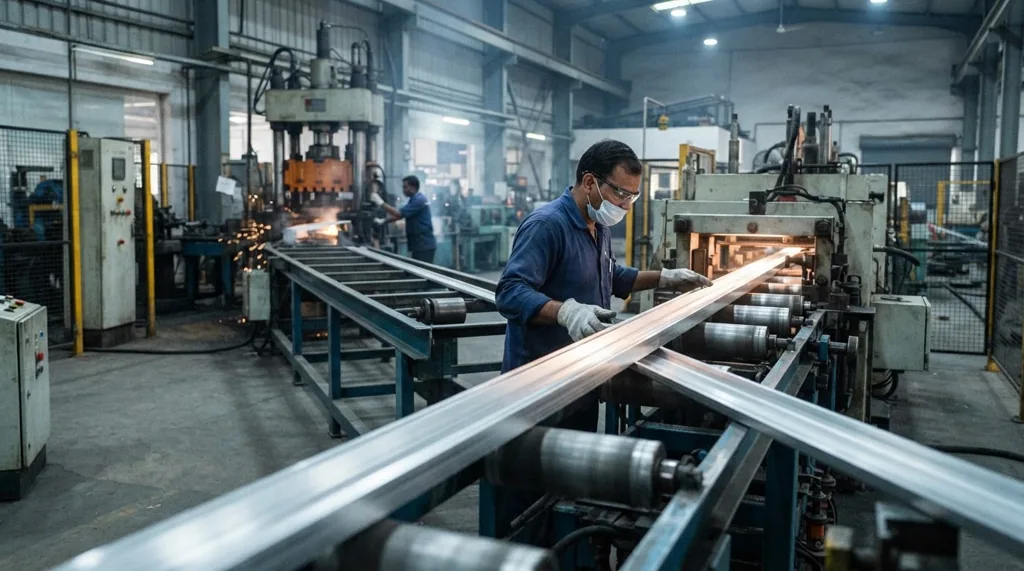
India opened an investigation on Nov. 9, 2026 that could add extra duties on aluminium extrusions from China, Malaysia, Vietnam and Thailand.
India’s Directorate General of Trade Remedies opened an anti-dumping investigation on Nov. 9, 2026 into aluminium extrusions from China, Malaysia, Vietnam and Thailand.
The goods range from plain aluminium profiles, bars and tubes to finished doors, windows, ladders, heat sinks and solar mounting frames1. The investigation covers imports from China, Malaysia, Vietnam and Thailand, which together supplied about 90% of India’s imports of these goods1.
In short, no new duty applies to a shipment yet. The investigation could lead to an anti-dumping duty, an extra import tax on goods sold abroad below their normal price, on a very wide range of aluminium goods from these four countries.
Who opened the aluminium extrusion case?
The Directorate General of Trade Remedies (DGTR) is part of India’s Ministry of Commerce and Industry1. It runs anti-dumping, anti-subsidy and safeguard investigations and recommends measures to the government2. Its notice, dated Nov. 9, 2026, is to be published in the Gazette of India, the official record of government decisions1.
The case number on DGTR’s online filing system is AD/OI/079/20261. That system is called SETU, short for System for Ensuring Fair Trade through Unified Digital Platform, and it was launched on Oct. 24, 20252. It handles online filing, submissions and messages for domestic producers, exporters, importers and foreign governments2.
DGTR opened this case on its own initiative, which the law calls "suo motu"1. It did not act on a formal application. Instead, it acted under Rule 5(4) of India’s 1995 anti-dumping rules1. That rule lets the authority start a case when information from customs or "any other source" shows enough evidence of dumping and harm1.
Why did India act on aluminium imports?
The information came from the Aluminium Extrusion Manufacturers Association of India (ALEMAI)1. The association represents 228 manufacturers of these goods1. It told DGTR that Indian makers are being hurt by a sharp rise in low-priced imports from the four countries1.
Nine member companies also asked for an anti-dumping duty and sent their financial statements1. On Nov. 4, 2026, three member companies sent summary cost figures and estimates of dumping and harm1. ALEMAI said most of its members are small firms, known in India as micro, small and medium enterprises (MSMEs)1.
DGTR checked these claims against trade data from the Department of Commerce’s Trade Intelligence and Analytics portal1. The data showed that imports from the four countries rose during the period studied1. Together the four countries supplied about 90% of total imports of these goods into India1.
What harm does the Indian industry report?
ALEMAI says import volumes from the four countries rose sharply1. It also says the imports were sold below Indian makers’ prices, which in trade law is called "price undercutting"1.
According to the notice, the Indian industry has seen:
- falling profits, and it is now making losses;
- lower cash profits and lower returns on the money invested in plants;
- large unused production capacity in its factories.
DGTR says it does not yet have full figures on these points1. Even so, it found enough early evidence that dumped imports harmed Indian producers1. It also found early evidence that the dumping margins, the gap between normal price and export price, are above the minimum level that counts1.
Which aluminium goods are covered?
The investigation is titled "Aluminium Extrusion Profiles, Structures and Articles thereof"1. Extrusion means pushing heated aluminium through a shaped opening, called a die, to make a long piece with a fixed cross-section1. The goods may be pure aluminium or an alloy1.
What the aluminium extrusion case covers
| Item | What the notice says |
|---|---|
| Basic shapes | Profiles, bars, rods (not wire rods), tubes and pipes |
| Building structures | Doors, windows, curtain walls, railings, partitions |
| Finished articles | Heat sinks, solar mounting structures, ladders, furniture, bicycle parts |
| Finishes | Plain or anodised, powder coated, painted, polished |
| Countries | China, Malaysia, Vietnam, Thailand |
The scope includes five groups of goods1:
- Extruded profiles for building, industrial, transport, electrical and general engineering uses, whether solid, hollow or semi-hollow.
- Bars and rods, but not wire rods.
- Tubes and pipes, with or without a seam, and whether or not later drawn.
- Building structures such as doors, windows and frames, curtain walls and façades, partitions, louvres, railings and balustrades.
- Other finished articles made mainly from extrusions, such as heat sinks, LED and lighting profiles, T-slot framing, solar mounting structures, ladders, furniture, kitchen and wardrobe profiles, bicycle parts and formwork.
The goods are covered whether sold plain ("mill finish") or with a surface treatment1. Treatments named include anodising, powder coating, liquid paint, electrophoretic coating, wood-grain or sublimation finish, polishing and brushing1. Goods that have been cut, drilled, punched, bent, welded, machined or threaded are also covered1.
Why are finished doors and ladders included?
DGTR explains why finished goods are in the case. ALEMAI argued that profiles, structures and articles are all forms of one product1. All are made from aluminium billet, a solid log cast from primary aluminium or scrap1. All pass through the same hydraulic press, and a hollow and a solid profile differ only in the die1.
DGTR agreed for now. It said that cutting, machining, welding or joining profiles into structures is a small extra step1. No new raw material, plant or main process is needed1. The scope will be examined again after comments from interested parties1.
This matters for buyers of finished goods. An importer of solar mounting frames or aluminium furniture from these countries could face the same duty as an importer of plain profiles.
Which tariff codes are listed?
The notice places the goods in Chapter 76 of India’s Customs Tariff1. It lists these 14 tariff items1:
- 7604 10 20, 7604 10 31, 7604 10 39, 7604 21 00, 7604 29 30 and 7604 29 90 (bars, rods and profiles);
- 7608 10 00 and 7608 20 00 (tubes and pipes);
- 7610 10 00, 7610 90 10, 7610 90 20, 7610 90 30 and 7610 90 90 (structures);
- 7616 99 90 (other aluminium articles).
The list is indicative only1. The codes do not limit the scope, so goods under another code can still be covered if they match the product description1. The quantity unit for the case is the metric tonne1.
How does the case affect solar panel frames?
India already charges an anti-dumping duty on anodised aluminium frames for solar panels from China1. That duty was set by Customs Notification No. 16/2024-Customs (ADD) of Sept. 27, 20243. It covers tariff items 7610 90 10, 7610 90 30 and 7616 99 903.
Current duty on Chinese solar panel frames, USD per tonne
Under that notification, named Chinese makers pay between USD 403 and USD 511 per tonne3. All other Chinese makers pay USD 577 per tonne3. The same USD 577 rate applies to frames shipped from China that were made in another country3. The duty runs for five years from its publication3.
DGTR says it will decide during the new case how these solar frames are treated1. Interested parties may comment on this point1.
How will DGTR measure dumping?
Dumping means selling goods abroad below their "normal value", usually the price or cost in the home market1. For China, DGTR does not accept Chinese prices unless Chinese makers show that market conditions apply in their industry1.
For now, DGTR built the normal value for all four countries from the costs of three Indian producers1. It added a reasonable profit and selling and general costs1. For Malaysia, Vietnam and Thailand, it had no home-market price or cost data1.
The export price comes from shipment-by-shipment import data1. DGTR adjusted it for port costs, bank charges, inland freight and commission to get a factory-gate price1. On this basis, normal value is higher than the export price, which points to dumping1.
What period does the investigation cover?
The main period studied is April 1, 2025 to June 30, 2026, which is 15 months1. To judge harm, DGTR will also look at the three financial years from April 2022 to March 20251.
The rules normally call for a 12-month period1. DGTR chose 15 months because most producers are small firms that keep accounts by financial year1. A July 2025 to June 2026 period would have caused practical problems for them1.
How will DGTR check so many small producers?
The industry is spread across many small firms1. So DGTR is using Trade Notice 09/2021 of July 29, 2021, a simpler procedure for such industries1. Under that notice, an association can file on behalf of producers with at least 50% of domestic output4.
Each producer files only basic information on a short form4. This covers capacity, output, sales, costs, profits, staff and stock over the period4. DGTR then picks a sample of producers using a statistical method4. Only the sampled producers file full cost and injury data4.
DGTR says all producers’ data will count in judging harm1. The "non-injurious price" and injury margin, which set any duty level, will use sampled producers only1. DGTR said in June 2026 that this procedure has made trade remedy cases easier for small producers2.
What must exporters and importers do, and by when?
Every party must register on the SETU portal and file under case ID AD/OI/079/20261. DGTR is writing directly to known foreign makers, the four governments’ embassies, Indian importers and users, and Indian producers1.
Filing in case AD/OI/079/2026
The deadlines run from the date DGTR sends these letters, not from Nov. 91. They are:
- Comments on the product scope and on product codes for comparing models are due within 15 days1.
- Questionnaire replies and all other information are due within 37 days1.
- Any request for more time must reach SETU at least one day before the deadline1.
The two periods run at the same time1. If DGTR later changes the product scope in a new way, parties get 15 more days1. Further extensions are normally refused except in exceptional cases1.
Each filing needs a confidential version and a non-confidential version, marked at the top of each page1. A filing without these markings is treated as non-confidential and other parties may see it1. If a party sends nothing or sends incomplete data, DGTR may decide on the facts it has1.
What happens after the aluminium investigation?
DGTR will gather replies, check data, hold hearings, share its main facts and then issue final findings2. It will recommend a duty only if it confirms dumping, harm and a link between them1.
DGTR follows the "lesser duty rule", so it recommends only the duty needed to remove the harm2. It also says it considers the interests of user industries and consumers2. In the solar frame case, the Ministry of Finance imposed the duty about three months after DGTR’s final findings3.
Key points on the aluminium extrusion investigation
This table sums up the case as the notice describes it.
| Question | Answer |
|---|---|
| What happened? | Anti-dumping investigation opened |
| Who acted? | Directorate General of Trade Remedies (DGTR) |
| When? | Nov. 9, 2026 |
| Which goods? | Aluminium profiles, bars, tubes, structures and articles |
| Which countries? | China, Malaysia, Vietnam, Thailand |
| Share of imports | About 90% |
| Tariff codes | 14 items in Chapter 76, indicative only |
| Period studied | April 1, 2025 to June 30, 2026 |
| Case ID | AD/OI/079/2026 on SETU |
| Scope comments due | Within 15 days of DGTR’s letters |
| Replies due | Within 37 days of DGTR’s letters |
| Duty now? | None yet from this case |
For now, shipments from the four countries clear customs without a new duty. Exporters, importers and buyers have 37 days from DGTR’s letters to file their data, and any duty depends on the final findings1.
Sources
- ↩ Eng Initiation Notification Aluminium Extrusion 09.11.2026.pdf https://dgtr.gov.in/sites/default/files/2026-11/Eng%20Initiation%20Notification%20Aluminium%20Extrusion%2009.11.2026.pdf
- ↩ Press Release Page | Press Information Bureau https://www.pib.gov.in/PressReleasePage.aspx?PRID=2271060
- ↩ 257556.pdf https://egazette.gov.in/WriteReadData/2024/257556.pdf
- ↩ Trade Notice 09_2021_Simplification of procedure for fragmented industries.pdf https://dgtr.gov.in/sites/default/files/2024-06/Trade%20Notice%2009_2021_Simplification%20of%20procedure%20for%20fragmented%20industries.pdf