
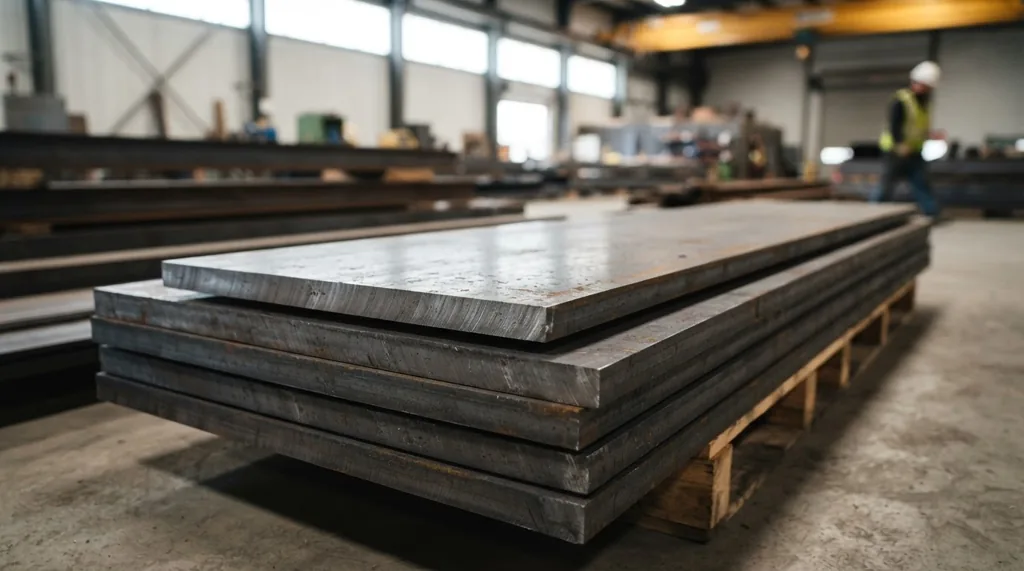
Canada kept extra import duties on heavy steel plate from Chinese Taipei and Germany on Nov. 10, 2026, excluding some products.
Canada’s trade tribunal on Nov. 10, 2026 kept anti-dumping duties on heavy steel plate from Chinese Taipei and Germany, with some products excluded1.
The Canadian International Trade Tribunal (CITT) finished an expiry review, a check on whether old duties are still needed. It continued its findings of Feb. 5, 2021, and said certain products are excluded as described in its order1.
In short, heavy steel plate from these two places still pays extra duty when it enters Canada. The Canada Border Services Agency (CBSA), Canada’s customs service, will keep collecting the duty1.
What did the tribunal decide on heavy plate?
The Tribunal found that letting the findings expire was likely to cause injury, meaning harm to steel makers in Canada. For that reason it continued the findings1. The decision closes expiry review RR-2025-007, which began on Jan. 5, 20262.
An anti-dumping duty is an extra import tax on goods sold abroad below their normal price. The original case, inquiry NQ-2020-001, found in 2021 that dumped heavy plate from Chinese Taipei and Germany had harmed Canadian industry3. The duties have applied since then.
The Tribunal’s press release says some products are excluded, as described in the Tribunal’s order1. The order and the reasons are listed on the Tribunal’s case page with the date Nov. 10, 20264.
How did the two-step heavy plate review work?
Canada’s Special Import Measures Act (SIMA) is the law behind these duties. Under it, an expiry review has two steps, run by two different bodies5. The steps were:
- The Tribunal started the review on Jan. 5, 20262.
- The CBSA opened its own investigation on Jan. 6, 2026, and sent questionnaires to producers, importers and exporters6.
- The CBSA decided on June 4, 2026 that dumping was likely to continue or resume without duties3.
- The Tribunal held a public hearing on Aug. 31, 20264.
- The Tribunal ruled on Nov. 10, 2026 that the dumping was likely to cause injury1.
The heavy plate expiry review
The CBSA step looks only at prices. The Tribunal step asks whether those prices would harm the Canadian industry5. Both answers had to be yes for the duties to stay.
Answers to the CBSA questionnaires were due by Feb. 12, 20266. The CBSA closed its record on Feb. 25, 20263. It refused late papers that Algoma Steel asked to file on March 4, 20263.
Which steel plate goods do the duties cover?
The duties cover hot-rolled plate cut into flat sheets, made of carbon steel or of high-strength low-alloy steel7. The plate may be heat-treated or not, but it is not worked further than hot rolling7.
Size decides whether plate is covered. The goods are plate wider than 72 inches up to 152 inches (about 1,829 mm to 3,860 mm)7. Thickness must be from 0.375 inches to 4.5 inches (about 9.5 mm to 114.3 mm)7.
Two kinds of plate are outside the product definition itself7:
- plate in coil form, which is rolled up rather than cut to length
- floor plate, which has a raised pattern rolled into the surface at regular intervals
Plate with more alloy than industry standards require is still covered. This applies unless it meets the standards for alloy-grade steel plate7.
Which plate products were excluded before?
The Tribunal’s new order is the text that describes the excluded products1. The CBSA’s "measures in force" page, last updated on Dec. 23, 2025, lists the exclusions under the 2021 finding7. These were:
- Pressure vessel plate for sour service in the oil and gas sector, made to named ASME or ASTM grades. It must be heat-treated, vacuum degassed, and very low in sulphur and phosphorus7.
- Thick grade 70 plate, meaning ASME SA-516 or ASTM A-516 Grade 70 plate, heat-treated and thicker than 3.28 inches7.
- Large plate in three grades (SA-516, SA-299 and SA-537, normalized) in certain sizes. These include plate over 3.28 inches thick of any width7.
- Plate for one ship project, imported by Irving Shipbuilding Inc. for the Arctic and Offshore Patrol Ships project7.
The limits on the sour-service plate are 0.003% sulphur and 0.017% phosphorus or less7. The press release does not say whether the new order keeps this list unchanged. The order itself is the text that governs1.
Which tariff codes does customs check?
The CBSA says the covered plate normally enters under codes in headings 7208.51 and 7208.52 of the Canadian customs tariff7. The page lists 34 tariff classification numbers in total7.
The CBSA warns that the list is only a guide. Some goods under these codes are not covered. Covered goods may also come in under codes that are not listed7. The product definition decides, not the code7.
Why did Canada keep the heavy plate duties?
The CBSA gave several reasons for Chinese Taipei. They include price-driven trade in plate, high fixed costs in steel mills, and excess production capacity in Chinese Taipei3. It also pointed to continued sales into Canada during the review period3.
For Germany, the CBSA also cited excess capacity and a strong export focus. It found German producers could not compete in Canada at fair, non-dumped prices3.
Trade barriers elsewhere played a role. The CBSA said United States steel tariffs rose to 50% in June 20253. It said the European Union (EU) plans to raise its over-quota steel duty from 25% to 50%3. In its view, these steps push surplus plate toward Canada3.
How much heavy plate came from the two sources?
Imports from Chinese Taipei and Germany peaked in 20233. That year Canada imported 35,073 tonnes from the two places, worth about CAD 45.9 million3. In 2022 the figure was 9,151 tonnes, and in 2024 it fell to 4,093 tonnes3.
Heavy plate imports from Chinese Taipei and Germany, tonnes
Plate from all other countries was far larger, at 277,548 tonnes in 20243. The CBSA collected more than $300,000 in anti-dumping duty during the review period, from January 2022 to September 20253. The largest yearly amount was $272,902, in 20233.
Who is affected by the decision?
Algoma Steel is the only steel mill in Canada that makes heavy plate3. Service centres that cut plate from coil, such as Janco Steel and Russel Metals, are also part of the Canadian industry3. Algoma argued for keeping the duties, and Janco sent a letter of support3.
No foreign exporter answered the CBSA questionnaire. No importer argued for ending the duties3. One importer, Hepburn Engineering Inc., did answer the questionnaire3.
Two exporters have their own normal values, a CBSA-set reference price7:
- China Steel Corporation of Chinese Taipei
- AG der Dillinger Hüttenwerke of Germany
For shipments from these two firms, importers get duty details from the exporter7. Other exporters face a fixed rate. It is 80.6% of the export price for Chinese Taipei and 68.6% for Germany7.
What must importers put on customs papers?
The CBSA asks for detailed import documents for this product. Missing information can lead to fines under its penalty system7. The papers must show7:
- whether the plate is subject to anti-dumping duty
- the exporter’s ID, the producer and the mill
- the country of origin and the country of export
- the grade, specification, thickness, width and length
- whether the plate is heat-treated or vacuum degassed
- the selling price, currency and terms of sale
What the import papers must show
| Item | What to state |
|---|---|
| Duty status | Whether the plate is subject to anti-dumping duty |
| Who made it | Exporter ID, producer and mill |
| Origin | Country of origin and country of export |
| Product details | Grade, specification, thickness, width, length, heat treatment, vacuum degassing |
| Sale terms | Selling price, currency and terms of sale |
These facts let customs check the plate against the product definition and the exclusions7. Thickness, width and grade decide whether a shipment pays duty.
Key points on Canada’s heavy plate duties
The decision keeps duties that have applied since 2021.
| Question | Answer |
|---|---|
| What changed? | Duties continued after expiry review |
| Who decided? | Canadian International Trade Tribunal |
| When? | Nov. 10, 2026 |
| Which goods? | Hot-rolled heavy steel plate |
| From where? | Chinese Taipei and Germany |
| Size covered | 72 to 152 inches wide, 0.375 to 4.5 inches thick |
| Tariff headings | 7208.51 and 7208.52 |
| Rate for other exporters | 80.6% (Chinese Taipei), 68.6% (Germany) |
| Who collects the duty? | Canada Border Services Agency |
| Exclusions | Products described in the Tribunal’s order |
| Original finding | Feb. 5, 2021 |
Heavy plate from Chinese Taipei and Germany will keep paying anti-dumping duty at the Canadian border1. Whether a special grade stays duty-free now depends on the exclusions in the Tribunal’s new order1.
Sources
- ↩ Tribunal Continues Findings—Heavy Plate from Chinese Taipei and Germany – Canada.ca https://www.canada.ca/en/international-trade-tribunal/news/2026/11/tribunal-continues-findingsheavy-plate-from-chinese-taipei-and-germany.html
- ↩ Tribunal Initiates Expiry Review—Heavy Plate from Chinese Taipei and Germany – Canada.ca https://www.canada.ca/en/international-trade-tribunal/news/2026/01/tribunal-initiates-expiry-reviewheavy-plate-from-chinese-taipei-and-germany.html
- ↩ Statement of Reasons—Expiry review determination: Heavy Plate (HP 2026 ER) https://www.cbsa-asfc.gc.ca/sima-lmsi/er-rre/hp2026/hp2026-de-eng.html
- ↩ Active dumping and subsidizing cases – Canadian International Trade Tribunal https://www.citt-tcce.gc.ca/en/anti-dumping-injury-inquiries/active-dumping-and-subsidizing-cases
- ↩ Canada Gazette, Part 1, Volume 160, Number 3: COMMISSIONS https://gazette.gc.ca/rp-pr/p1/2026/2026-01-17/html/commis-eng.html
- ↩ Notice of initiation of expiry review investigation: Heavy Plate (HP 2026 ER) https://www.cbsa-asfc.gc.ca/sima-lmsi/er-rre/hp2026/hp2026-ni-eng.html
- ↩ Heavy plate: Measures in force https://www.cbsa-asfc.gc.ca/sima-lmsi/mif-mev/hp-eng.html