
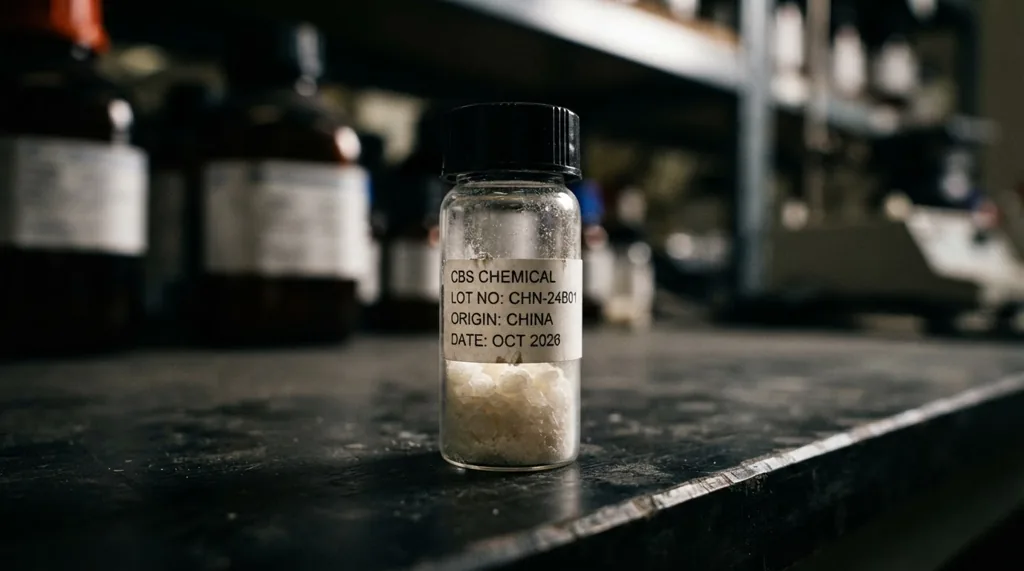
United States customs must collect a 281.69% cash deposit on CBS chemical imports from China from Nov. 6, 2026.
The U.S. Department of Commerce set a preliminary 281.69% cash deposit on Chinese CBS chemical imports, applicable from Nov. 6, 20261.
The chemical is N-cyclohexylbenzothiazole-2-sulfenamide, known in trade as CBS or Accelerator CZ1. Commerce found that it is being sold in the United States at less than fair value, a practice called dumping1.
In short, every shipment of CBS from China entering U.S. customs now needs a large cash deposit. Importers pay it at the border, and the final duty is settled later.
What did Commerce decide on CBS from China?
Commerce published its preliminary finding in the Federal Register on Nov. 6, 20261. The notice was signed on Oct. 28, 20261. It says Chinese CBS is being, or is likely to be, sold in the U.S. at less than fair value1.
An anti-dumping duty is an extra import tax on goods sold abroad below their normal price. Commerce compares the price in the U.S. with a "normal value" for the goods. The gap between the two, as a share of the price, is called the dumping margin.
Commerce set a dumping margin of 285.94% for all Chinese producers and exporters, grouped as the "China-wide entity"1. The cash deposit is slightly lower, at 281.69%, after an adjustment for subsidies1. Commerce also found "critical circumstances," which means the deposits reach back to some earlier shipments1.
How high is the deposit, and why is it lower?
The deposit is lower than the margin because of a second case on the same goods. In that case Commerce is looking at subsidies paid by the Chinese government2. A duty against subsidies is called a countervailing duty.
Preliminary rates on Chinese CBS, %
Commerce normally cuts the dumping deposit by the part of the subsidy duty that covers export subsidies1. This avoids charging twice for the same unfair price. The difference here is 4.25 percentage points, the gap between 285.94% and 281.69%.
The subsidy case already has its own deposit. On Oct. 8, 2026, Commerce set a preliminary subsidy rate of 107.57% for Chinese CBS2. The rate applies to the named companies and to all other producers and exporters2.
Taken together, a Chinese CBS shipment now faces two separate deposits. By simple addition, they come to about 389% of the goods’ value.
There is one more rule. If the subsidy case’s temporary deposits end before the dumping case’s deposits, the dumping deposit changes1. Customs would then collect the full 285.94% margin, without the subsidy adjustment1.
Why did no Chinese company get its own rate?
Commerce treats China as a non-market economy, so it does not use Chinese prices to judge normal value3. A Chinese company gets its own rate, called a separate rate, only if it qualifies for one.
No respondent qualified for a separate rate in this case1. So Commerce did not calculate rates for pairs of producers and exporters1. Every Chinese supplier gets the same China-wide rate.
Commerce said some companies did not answer its questions. These included its quantity and value questionnaire, its separate rate application and its first questionnaire1. It therefore used "facts available with adverse inferences," meaning it chose figures that are unfavourable to the companies1.
The rate comes only from the petition, the complaint filed by the U.S. industry1. For that reason, Commerce said there are no calculations to share with the parties1. It also said the main companies withdrew and did not cooperate, so it will not visit them to check their data1.
Which companies does the subsidy case name?
The subsidy notice names the Chinese companies that Commerce examined or that did not reply2. Each received the same preliminary subsidy rate of 107.57%2:
- Shandong Derek New Materials Co., Ltd, examined by Commerce
- Shandong Yanggu Huatai International Co., Ltd, examined by Commerce
- Alchemy Trading Shanghai Limited, did not reply
- Kemai Chemical Company Limited, did not reply
- SAIC Motor Corporation Limited, did not reply
- Shandong Sunsine Chemical Co., Ltd., did not reply
- Yingtai International Trading Co., did not reply
Commerce said these companies did not act to the best of their ability to answer its requests2. All other producers and exporters received the same rate as an "all-others" rate2.
Which goods are covered by the CBS duties?
The goods are N-cyclohexylbenzothiazole-2-sulfenamide (CBS), an organic compound1. The notice lists other names under which it may be sold. These include Accelerator CZ, CBTS, Thiohexam, HIP4, Curax, DURAX, Conaca, Conach, Conacs and Celacs1.
How to identify covered CBS
| Feature | Details |
|---|---|
| Other names | Accelerator CZ, CBTS, Thiohexam, Curax, DURAX |
| Registry number | CAS 95-33-0 |
| Chemical formula | C13H16N2S2 |
| Form | Powder, oiled powder, granule or solution |
| Main tariff code | 2934.20.8000, also 3812.10.1000 and 3812.10.5000 |
CBS is most often an off-white or light gray powder, oiled powder or granule1. CBS in another colour or form is also covered1. It may also be imported dissolved in benzene, ethanol or acetone1.
Commerce gives some technical details to help identify the chemical:
- CAS number 95-33-0, its chemical registry number
- Chemical formula C13H16N2S2
- a purity most often between 94% and 99%
- a melting point of 90 to 110°C
- a molecular weight of 264.4 g/mol
The scope also covers CBS mixed with CBS from other sources1. So Chinese CBS blended with CBS from another country is still covered.
Customs usually classifies CBS powder, oiled powder and granules under tariff code 2934.20.8000 of the U.S. tariff schedule1. Some imports may also fall under 3812.10.1000 and 3812.10.50001. The written description decides coverage, not the tariff code1. No party commented on the scope, and Commerce did not change it1.
How will customs collect the deposit?
Commerce will instruct U.S. Customs and Border Protection (CBP), the border agency, to act in two ways1. The steps are:
- CBP suspends liquidation, which means it does not close the final duty bill on each entry.
- CBP requires a cash deposit at the China-wide rate on each covered entry.
- The final duty is set later, when the case ends, and the deposit is settled against it.
How customs handles a CBS entry
These rules apply to goods entered, or taken out of a warehouse for sale, on or after Nov. 6, 20261. They stay in force until further notice1.
Shipping through a third country does not avoid the deposit. A third-country exporter pays the rate of the Chinese company that supplied it1.
Why do earlier shipments of CBS also pay?
Commerce found critical circumstances for the China-wide entity1. In such cases, the law lets the deposit reach back to shipments that came in before the notice.
The suspension covers entries made 90 days before Nov. 6, 20261. The law sets the start at the later of two dates: 90 days before suspension, or the date the case started1. Here Commerce applied the 90-day rule1.
The subsidy case has the same rule. Its deposits reach back 90 days before Oct. 8, 2026, for all Chinese producers and exporters2. So importers that already cleared CBS in the late summer may face bills on those shipments.
Who asked for the CBS investigation?
LANXESS Corporation, a U.S. maker of CBS based in Pittsburgh, filed the complaints on May 7, 20264. It filed both the dumping and the subsidy petitions at the same time3.
The company said U.S. producers were being hurt by Chinese imports3. It pointed to rising import volumes, lost market share and lost sales3. It also cited lower prices, falling production and job losses3.
Commerce started the dumping case on June 2, 20263. The period it studied runs from Oct. 1, 2025, to March 31, 20261. The subsidy case studied the full year 20252.
To estimate a normal value for China, the petitioner used prices from Brazil, Malaysia and Mexico3. Commerce accepted these three countries as comparison points when it opened the case3.
The U.S. International Trade Commission (ITC), which judges harm to U.S. industry, also acted early. On June 22, 2026, it found a reasonable sign that Chinese CBS was hurting U.S. producers4.
What happens next in the CBS case?
Parties can send written comments to Commerce within 14 days of Nov. 6, 20261. Replies to those comments may follow five days later1. A party that wants a hearing must ask within 30 days of the notice1.
Next dates in the CBS case
| Date | Agency | What happens |
|---|---|---|
| Dec. 29, 2026 | ITC | Staff report on private record |
| Jan. 7, 2027 | ITC | Prehearing briefs due |
| Jan. 11, 2027 | Commerce | Final decisions due, unless postponed |
| Jan. 14, 2027 | ITC | Hearing starts |
| Feb. 9, 2027 | ITC | Final comments due |
Commerce will make its final dumping decision within 75 days of its Oct. 28 signature1. The subsidy notice says both final decisions are due by Jan. 11, 2027, unless postponed2.
The ITC has already set its timetable for the final stage5:
- its staff report goes on the private record on Dec. 29, 2026
- prehearing briefs are due on Jan. 7, 2027
- requests to appear at the hearing are due by Jan. 8, 2027
- the hearing starts at 9:30 a.m. on Jan. 14, 2027
- posthearing briefs are due on Jan. 21, 2027
- final comments are due by Feb. 9, 2027
If Commerce’s final finding is positive, the ITC then decides whether U.S. industry is hurt1. It must do so by the later of 120 days after the preliminary finding or 45 days after the final one1.
Key points on the CBS duty finding
The table below sums up the preliminary dumping finding.
| Question | Answer |
|---|---|
| What changed? | Preliminary dumping finding with cash deposits |
| Who issued it? | U.S. Department of Commerce |
| Which goods? | CBS chemical, also called Accelerator CZ |
| From where? | China |
| Main tariff code | 2934.20.8000 |
| Dumping margin | 285.94% |
| Cash deposit rate | 281.69% |
| Separate subsidy deposit | 107.57% |
| Who collects it? | U.S. Customs and Border Protection |
| Start date | Nov. 6, 2026 |
| Earlier shipments | Entries from 90 days before Nov. 6 |
| Final decision due | Jan. 11, 2027, unless postponed |
Chinese CBS now carries two deposits at the U.S. border, from the dumping and subsidy cases. Commerce’s final decisions are due by Jan. 11, 20272. The ITC hearing opens three days later, on Jan. 14, 20275.
Sources
- ↩ Federal Register :: N-Cyclohexylbenzothiazole-2-Sulfenamide From the People’s Republic of China: Preliminary Affirmative Determination of Sales at Less Than Fair Value and Preliminary Affirmative Determination of Critical Circumstances https://www.federalregister.gov/documents/2026/11/06/2026-22710/n-cyclohexylbenzothiazole-2-sulfenamide-from-the-peoples-republic-of-china-preliminary-affirmative
- ↩ Federal Register :: N-Cyclohexylbenzothiazole-2-Sulfenamide From the People’s Republic of China: Preliminary Affirmative Countervailing Duty Determination, Preliminary Affirmative Critical Circumstances Determination, and Alignment of Final Determination With Final Antidumping Duty Determination https://www.federalregister.gov/documents/2026/10/08/2026-20692/n-cyclohexylbenzothiazole-2-sulfenamide-from-the-peoples-republic-of-china-preliminary-affirmative
- ↩ Federal Register :: N-Cyclohexylbenzothiazole-2-Sulfenamide From the People’s Republic of China: Initiation of Less-Than-Fair-Value Investigation https://www.google.com/goto?url=CAES1gEBxCJF18veTlXlzlI-5LWBliXfXb3wLYW2j4e-63qzzrADJYIVgCyUWw6UuIXsyaG1cn7fGyTyKiBNbD1JHHJ6vMNG6–avIFGbxkwvcQOzr-Ak9eAXuGLHgF79aji_q8kjLf7NSOm9iHqMOPwhSyFHnDq-QbV-dCA2wwyOl5Mks8OYLc7UJA6tLMf-zdy0hd5LprSV9rdJsGdQvWXRQU0GJ8WjZm_A-sG8CvqgXjzwMkGr8y1d0YMIQLNnKMKKKzwUAqUkOZRyX4SRHwBUm8TWxSsedsm
- ↩ Federal Register :: N-Cyclohexylbenzothiazole-2-Sulfenamide (“CBS”) From China; Determinations https://www.federalregister.gov/documents/2026/06/25/2026-12777/n-cyclohexylbenzothiazole-2-sulfenamide-cbs-from-china-determinations
- ↩ Federal Register, Volume 91 Issue 199 (Friday, October 16, 2026) https://www.govinfo.gov/content/pkg/FR-2026-10-16/html/2026-21143.htm