
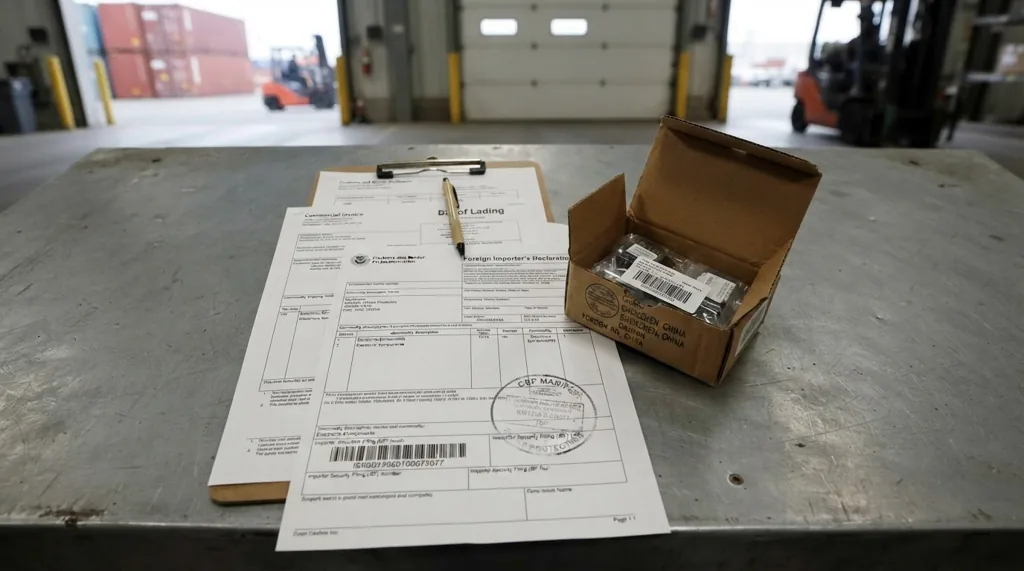
United States customs will let unapproved foreign importers clear goods only through approved trusted-trader brokers from Jan. 5, 2027.
U.S. Customs and Border Protection (CBP) will stop foreign importers from clearing goods themselves from Jan. 5, 2027, unless they pass a security check.
CBP published the interim final rule, a rule that takes effect before public comments are reviewed, in the Federal Register on Nov. 6, 20261. The rule sets new requirements for foreign importers of record (IORs), the parties legally responsible for an import, and new duties for licensed customs brokers1.
In short, a foreign company that is not checked and approved by CBP can no longer file its own import entries. Its goods will clear only if a CBP-approved customs broker files the entry for it.
What changes for foreign importers of record?
From the effective date, a foreign IOR may enter goods on its own behalf only if it is CTPAT validated2. CTPAT is the Customs Trade Partnership Against Terrorism, CBP’s trusted trader program for supply chain security. Validation is the final step, in which CBP checks a member’s security processes2.
The rule covers both kinds of entry. A foreign IOR without validation may not file an informal entry, the simpler process for low-value shipments2. It also may not file a formal entry on its own2.
There is one way to keep importing without validation. The foreign party must name a licensed customs broker who is CTPAT validated to file the entry for it2. If the foreign party does not own or buy the goods, that broker must act as the importer of record itself2.
Which shipments does the rule cover?
The rule applies to goods entered for consumption, meaning goods brought in for sale or use in the United States2. It covers informal entries for which a CBP Form 3461 or 7501 must be filed2. These are the two standard customs entry forms.
Shipment value decides the type of entry. Formal entry generally applies to shipments worth more than $2,5002. Informal entry covers shipments worth $2,500 or less, with fewer forms and steps2.
The rule is not limited to one product. It applies to every type of goods a foreign IOR brings in, from consumer products to industrial parts. What matters is who the importer of record is, not what is in the box.
Who counts as a foreign importer?
The definitions come from Executive Order 14411, "Strengthening Customs Enforcement," signed on June 3, 20263. A person counts as a U.S. IOR only as a U.S. citizen or lawful permanent resident3. A company counts as a U.S. IOR if it meets one of two tests3:
- Organized and located in the United States, with controlling owners who are U.S. citizens or permanent residents at all times.
- Owning a significant amount of real property (land and buildings) in the United States, as decided by the Secretary of Homeland Security.
What a company needs to be “located in the United States”
| Requirement | Standard / Details |
|---|---|
| Place of business | Main place of business in the United States |
| Physical presence | A site where significant business takes place |
| Assets | Enough tangible U.S. assets for the size of operations |
Every other importer of record is a foreign IOR under the order3. To be "located in the United States," a company needs at least three things3:
- its main place of business in the United States
- a physical site where significant business takes place
- enough tangible assets in the country for the size of its operations
The order says the guidance must stop companies from using shell companies or sham deals to pass as U.S. importers3. A U.S. mailing address alone will not make a foreign company a U.S. importer.
Why is CBP acting on foreign importers?
CBP says it struggles to collect money owed by foreign IORs1. Their assets and key people are mostly outside the United States1. CBP also says it cannot easily check that they follow U.S. customs law1.
Share of audited lost revenue CBP recovered, %
The rule gives figures for the gap. From October 2020 to early February 2026, the unpaid bill per entry was $29.16 for foreign IORs2. For U.S. IORs, it was $22.572. As of Feb. 6, 2026, foreign IORs outside CTPAT owed $1.01 billion in unpaid bills opened since Oct. 1, 20202.
Audits show a bigger problem. CBP found $1.16 billion in lost revenue from foreign IORs between Jan. 1, 2020, and Aug. 27, 20262. It recovered only $35.7 million, a collection rate of 3.1%2. For U.S. IORs, the collection rate was 15.2%2.
How do shell companies avoid duties today?
At present, a foreign person or company can become an IOR simply by filing CBP Form 51062. This form requests a CBP importer number. A foreign company can also use a tax number from the Internal Revenue Service (IRS)2. Both routes give CBP only basic contact and business details2.
Many foreign IORs list a U.S. address, which may belong to an agent or be a post office box2. CBP says these firms often have no physical presence or assets in the country2. It calls them shell companies2.
CBP describes a repeating pattern. When it detects a problem, it can demand duties before releasing goods2. The shell company may then ship the goods out rather than pay2. It can later try to bring the same goods in under a new shell company2.
CBP links these firms to wrong product codes, low declared values and other ways of dodging duties2. It also names fake brand-name goods and chemicals used to make illegal drugs as risks2.
What must customs brokers now check?
Brokers take on a new checking role. From Jan. 5, 2027, a broker must check each client that declares itself a U.S. IOR4. The check must happen before the broker files an entry or entry summary4. The client must meet the rule’s test for a U.S. IOR in section 110.2 of the CBP regulations4.
CBP’s Office of Trade explained the change in the agency’s announcement. Brokers are "now responsible for verifying that their clients meet the qualifications of a U.S. IOR before filing entries on their behalf," it said5. The rule also sets record-keeping duties for brokers on these checks4.
The rule sets consequences for foreign IORs and brokers who break the new requirements1. It changes CBP’s penalty rules in Part 171 of its regulations1. CBP’s guidance page says brokers must carry out greater checks on clients6. It adds that brokers may face higher penalties for breaking the rules or repeated violations6.
Can brokers get more time to comply?
Yes, but only for the U.S. IOR checks and record-keeping4. A licensed broker can request a delayed compliance period until May 6, 20274. CBP says no further extensions will be granted beyond that date4.
Key dates for foreign importers and brokers
| Date | Who it catches | What falls due |
|---|---|---|
| Jan. 5, 2027 | Foreign importers and brokers | Rule takes effect; delay requests and comments due |
| May 6, 2027 | Brokers granted a delay | Full U.S. IOR checks and record-keeping |
To apply, a broker must follow two steps4:
- Complete the Broker Delayed Compliance Request Form.
- Email it to CBP’s delayed compliance mailbox no later than Jan. 5, 2027, with the broker’s license number in the subject line.
The form asks for the broker’s license details and the license holder’s certification4. It also asks for the approximate number of employees and of clients that may claim U.S. IOR status4. The broker must explain why it needs more time4.
The extra time applies only when three things happen4:
- The broker sends a valid, complete and timely request.
- CBP confirms that it has received the request.
- CBP does not send a notice that the broker is not eligible.
Which brokers cannot get the delay?
CBP lists brokers who will not be eligible4. They include brokers removed from CTPAT and not reinstated4. Brokers whose Form 5106 filing rights are revoked are also excluded4. So are brokers whose entry filer code is suspended, or who face CBP action to revoke their license4.
A request can also fail on form. A late request, a missing field, a wrong email address or a wrong subject line makes it invalid4. A request sent by someone other than the broker’s license holder is also refused4.
During the delay, CBP may contact the broker at any time to check progress4. The broker must keep working to find out whether its active clients qualify as U.S. IORs4. False statements may lead to criminal penalties and suspension or loss of the broker’s license4.
Who is affected and what changes for each?
Foreign sellers that import in their own name face the biggest change. Without CTPAT validation, they will need a validated broker for every entry from Jan. 5, 20272. Their goods will not clear through an unvalidated broker.
Customs brokers face more work and more risk. Brokers outside CTPAT can no longer file entries for unvalidated foreign clients2. All brokers must check clients that claim U.S. status4.
U.S. buyers of goods from foreign sellers depend on the seller’s choice of broker. A shipment filed through an unvalidated broker for an unvalidated foreign IOR cannot clear by that route after Jan. 5. CBP says the rule will level the playing field for U.S. IORs2.
Low-value shipments are also in view. Foreign IORs may still use informal entry if they are validated or use a validated broker1. CBP says it will watch these entries after the rule takes effect1. If it finds risks to revenue, security or public safety, it will fully bar foreign IORs from informal entry1.
What comes next for the foreign importer rule?
The public may comment until Jan. 5, 2027, through the federal rulemaking portal under docket USCBP-2026-13875. CBP will use the comments to decide whether to change, confirm or withdraw the rule5.
The rule is part of a wider program under Executive Order 144116. CBP has also proposed requiring bonds for all informal entries, with comments due Dec. 7, 20266. A separate request for input on supply chain information closes on Dec. 1, 20266.
Key points on the foreign importer of record rule
The table below sums up the main facts of the rule.
| Question | Answer |
|---|---|
| Who issued it? | U.S. Customs and Border Protection |
| What type of rule? | Interim final rule, CBP Dec. 26-19 |
| When was it published? | Nov. 6, 2026 |
| When does it take effect? | Jan. 5, 2027 |
| Who is covered? | Foreign importers of record |
| What do they need? | CTPAT validation or a CTPAT validated broker |
| Which entries? | Formal and informal entries |
| What must brokers do? | Check clients claiming U.S. IOR status |
| Broker delay deadline | Request by Jan. 5, 2027 |
| Final broker deadline | May 6, 2027 |
| Comment deadline | Jan. 5, 2027 |
| Why? | 3.1% collection rate on lost revenue |
From Jan. 5, 2027, a shipment entered by a foreign importer without CTPAT validation will clear only through a CTPAT validated broker. Brokers that asked for more time must finish their U.S. IOR checks by May 6, 20274.
Sources
- ↩ Federal Register :: Heightened Requirements for Foreign Importers of Record https://www.federalregister.gov/documents/2026/11/06/2026-22735/heightened-requirements-for-foreign-importers-of-record
- ↩ AGENCY: https://www.federalregister.gov/documents/full_text/html/2026/11/06/2026-22735.html
- ↩ Federal Register :: Strengthening Customs Enforcement https://www.federalregister.gov/documents/2026/06/10/2026-11595/strengthening-customs-enforcement
- ↩ Delayed Compliance | U.S. Customs and Border Protection https://www.cbp.gov/trade/strengthening-customs-enforcement/delayed-compliance
- ↩ CBP announces heightened requirements for Foreign Importers of Record | U.S. Customs and Border Protection https://www.cbp.gov/newsroom/national-media-release/cbp-announces-heightened-requirements-foreign-importers-record
- ↩ Strengthening Customs Enforcement | U.S. Customs and Border Protection https://www.cbp.gov/trade/strengthening-customs-enforcement