
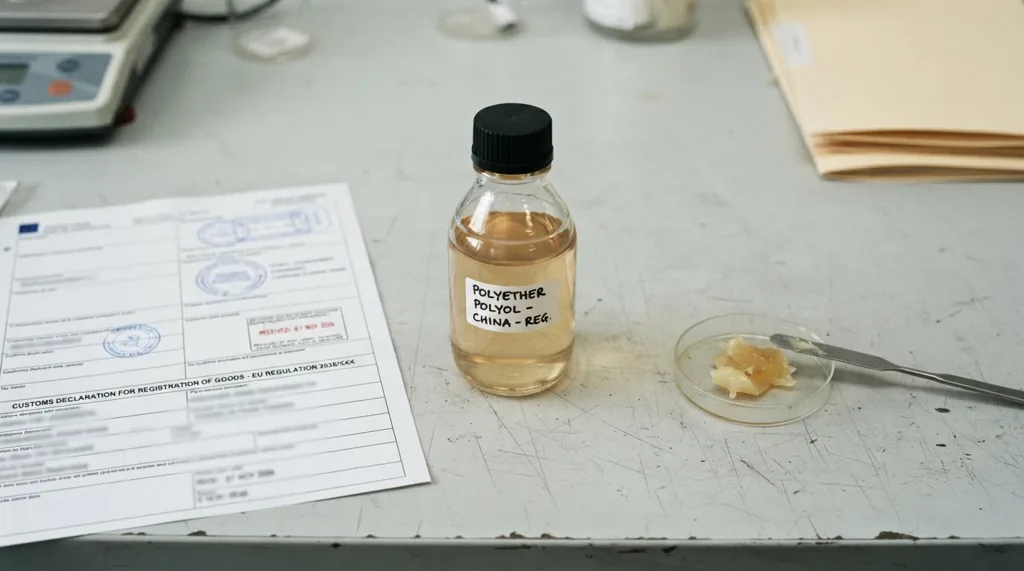
European Union customs must register Chinese polyether polyol imports from Nov. 7, 2026, so later anti-dumping duties could apply backwards.
The European Commission has ordered customs across the European Union (EU) to register imports of Chinese polyether polyols from Nov. 7, 2026.
The order is Commission Implementing Regulation (EU) 2026/2409, dated Nov. 5, 2026 and published on Nov. 6, 20261.
In short, Chinese polyols still enter the EU without a new duty for now. But customs will record each shipment, so that a later anti-dumping duty could be charged on those same shipments.
Why is the EU registering polyol imports from China?
Registration follows an anti-dumping case that the Commission opened on June 30, 20261. An anti-dumping duty is an extra import tax on goods sold abroad below their normal price. The case asks whether Chinese polyols are sold in the EU at such low prices and whether this harms European makers.
The case started with a complaint lodged on June 8, 20262. Five European producers filed it: BASF, Covestro, PCC Rokita, Shell and Chimcomplex. Together they represent more than 25% of EU production of these polyols1.
The Commission decided to register imports on its own initiative1. It did not wait for a request from the industry. The legal basis is Article 14(5) of the EU’s basic anti-dumping law, Regulation (EU) 2016/10361.
What does registration mean for a polyol shipment?
Registration is a record-keeping step at the border. Customs authorities in every EU country must note each import of the covered polyols from China1. No extra duty is paid at import because of the registration itself.
The purpose is to allow duties to be charged backwards in time. If the case ends with duties, the EU could also collect them on goods that entered during registration1. The regulation calls this levying duties "retroactively".
This is not automatic. The Commission says the conditions for collecting duties backwards will be checked in the later regulation that sets final duties1. Any future bill would come from the findings of the investigation1.
For a buyer in the EU, this means a shipment cleared today may still carry a cost later. The price paid to the Chinese seller may not be the final cost of the goods.
Which polyether polyols are covered?
The order covers certain polyether polyols. These are plastics-type chemicals (organic polymers) with many ether links and free hydroxyl groups1. Their hydroxyl number is between 10 and 520, a lab measure of how many hydroxyl groups they carry1.
What the registration covers
| Point | Rule |
|---|---|
| Goods | Certain polyether polyols from China |
| Hydroxyl number | Between 10 and 520 |
| Customs codes | TARIC 3907 29 20 35 and 3907 29 20 90 |
| Blends | At least 50% pure polyol by weight |
| Excluded | Polyethylene glycols, CN 3907 29 11 |
They are made by reacting a starting chemical with ethylene oxide, propylene oxide, or both1. Customs classifies them under CN code ex 3907 29 201. The "ex" means only part of that tariff heading is covered. The Combined Nomenclature (CN) is the EU’s list of customs codes.
Two detailed TARIC codes, the EU’s integrated tariff codes, mark the covered goods1:
- 3907 29 20 35
- 3907 29 20 90
The initiation notice says these codes are given for information only2. The written description of the product decides what is covered, not the code alone.
Are blends and mixtures of polyols included?
Yes. The order covers pure polyether polyols and several kinds of blends1. A "pure" polyol here is a single polyol that is at least 90% polyether polyol by weight and comes from China1.
The blends covered are1:
- single pure polyols with solid particles spread through them (dispersed polymer particles);
- mixtures of two or more pure polyols, with or without such particles;
- formulations with additives or catalysts, such as flame retardants, surfactants or stabilisers, with or without particles.
A blend is covered only when at least 50% of its weight is pure polyether polyol1. Antioxidants do not count as additives under this definition1.
Polyols listed as "no-longer-polymers" under the EU chemicals law, REACH, are also covered1. REACH is the EU’s rule for registering and testing chemicals.
Which products are left out?
Polyethylene glycols (PEGs) are excluded1. These sit under a separate code, CN code 3907 29 11, and customs will not register them under this order1.
Polyols with a hydroxyl number outside the 10 to 520 range fall outside the description1. So do blends where pure polyols make up less than half the weight1. Polyols that do not originate in China are also not covered by this case1.
How large could a future duty be?
The Commission gives figures from the complaint, but only for information1. The complaint estimates a dumping margin of 101% for the period from Oct. 1, 2024 to Sept. 30, 20251. A dumping margin is how far the export price falls below the normal price.
Estimates in the complaint, %
The complaint also estimates an injury elimination level of 60%1. This is the price gap the complainants say would remove the harm to EU makers. Under EU rules, a duty is normally set at the lower of these two levels1.
There is an exception. The complaint says China distorts the price of a key raw material2. If the Commission finds such distortions, the duty could be set at the full dumping margin1. That would apply only if a lower duty would not be enough to remove the harm1.
The Commission stresses that it cannot yet estimate the final amount1. The complaint’s figures "cannot create any expectations" about the real level of duty1.
What does the complaint say about China’s prices?
The complainants argue that Chinese domestic prices and costs cannot be used to judge fair prices2. They point to what EU law calls "significant distortions" in China’s economy2. They cite a Commission staff report on China dated April 10, 2024, and several Chinese industrial plans2.
So the complaint built a "normal value" from undistorted costs instead2. It proposed Mexico as the comparison country for those costs2. The complainants say the resulting dumping margins are significant2.
The complaint also names propylene oxide, a main raw material. It says this chemical makes up more than 17% of the cost of making polyols2. In China, according to the complaint, exports of propylene oxide lose a tax refund (a value-added tax, or VAT, refund)2. The complaint says this pushes Chinese raw material prices well below world prices2.
The complainants also say Chinese imports have grown in volume and market share2. They report harm to EU sales, prices, profits and jobs2.
Who is affected by the registration?
Several groups feel the change:
- EU importers of Chinese polyols face the risk of a later duty bill on shipments they bring in now.
- EU manufacturers that buy Chinese polyols may see higher costs if duties follow.
- Chinese exporting producers may be chosen for a sample to answer the Commission’s questions2.
- Customs brokers must declare these goods under the correct TARIC codes so that the record is accurate.
Chinese exporters had to send company details to the Commission within 7 days of the June 30 notice2. Sampled exporters must return a full questionnaire within 30 days of being told they were chosen2. Non-sampled exporters who cooperate may ask for their own duty rate2.
When does registration start and end?
The regulation enters into force on the day after publication1. It was published on Nov. 6, 2026, so registration starts on Nov. 7, 20261.
Key dates in the polyol case
Registration ends nine months after it enters into force1. Customs will stop recording these imports at that point unless other measures replace it.
The investigation itself looks at the period from April 1, 2025 to March 31, 20262. Trends for the harm assessment cover Jan. 1, 2022 to the end of that period2.
What happens next in the polyol case?
The Commission continues its investigation into dumping and harm2. If it finds both, it must also decide whether duties serve the wider EU interest2. It will also check whether raw material distortions justify a duty at the full dumping margin2.
If final duties are set, that regulation will decide whether duties apply backwards to registered goods1. Until then, importers carry an open risk on each registered shipment.
Key points on the Chinese polyether polyol registration
The main facts of the order are below.
| Question | Answer |
|---|---|
| What changed? | Customs must register Chinese polyol imports |
| Who issued it? | European Commission |
| Legal act | Implementing Regulation (EU) 2026/2409 |
| Which goods? | Certain polyether polyols and their blends |
| Customs codes | TARIC 3907 29 20 35 and 3907 29 20 90 |
| What is excluded? | Polyethylene glycols, CN 3907 29 11 |
| Blend threshold | At least 50% pure polyol by weight |
| Dumping margin claimed | 101% |
| Injury level claimed | 60% |
| Start date | Nov. 7, 2026 |
| How long? | Nine months |
| What comes next? | Possible duties, which may apply backwards |
Registration begins on Nov. 7, 2026 and lasts nine months. Every Chinese polyol shipment cleared in that time could later face anti-dumping duties if the Commission sets them and the conditions are met1.
Sources
- ↩ L_202602409EN.000101.fmx.xml https://eur-lex.europa.eu/legal-content/EN/TXT/HTML/?uri=CELEX:32026R2409
- ↩ EUR-Lex – 52026XC03478 – EN – EUR-Lex http://data.europa.eu/eli/C/2026/3478/oj