
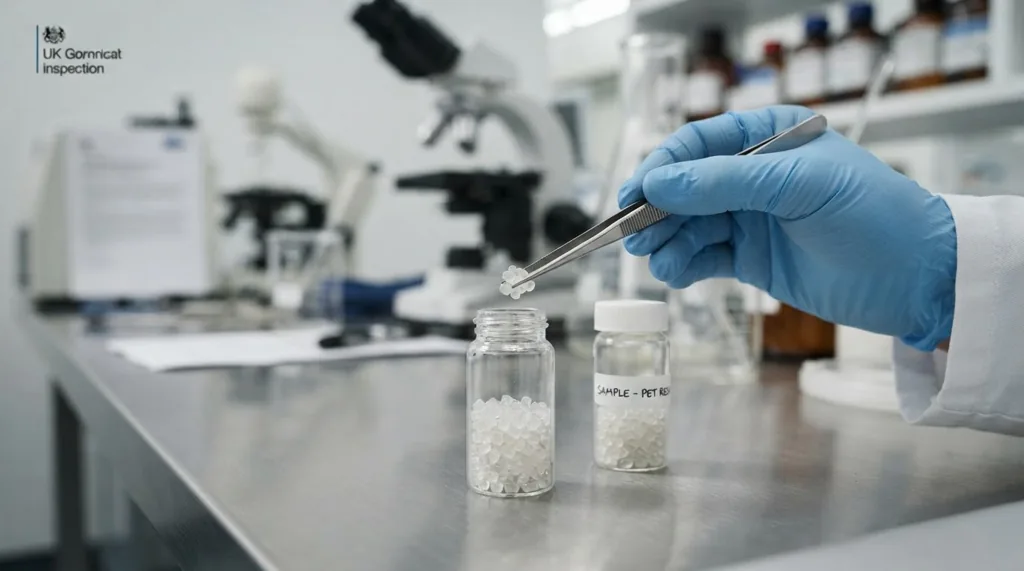
United Kingdom has launched a safeguard investigation targeting Poly(ethylene Terephthalate) (PET) products, with both provisional measures notification and investigation initiation underway affecting trade with Ireland.
The UK Trade Remedies Authority (TRA) on Oct. 23, 2026 recommended an import quota and a 65% extra duty on PET plastic resin.
The recommendation follows a safeguard investigation that the TRA opened on Aug. 5, 20261. The TRA has now made a provisional finding: rising imports have seriously harmed UK production of the plastic2.
In short, the UK could soon let in a fixed amount of PET at the normal duty. Shipments above that amount would pay an extra 65% duty, but only if the government accepts the plan.
What did the TRA decide on Oct. 23?
The TRA published its provisional affirmative determination, a first finding that the case for action is met, on 23 October 20262. It found that PET has been imported into the UK in increased quantities. It also found that these imports have caused or are causing serious injury to UK producers2.
The TRA recommends a tariff rate quota, a set amount of imports that pays a lower duty, with a higher duty on anything above it2. It sent this recommendation to the Secretary of State for Business, Innovation, Science and Trade, the minister who makes the final decision2.
The TRA said the temporary quota is needed to prevent serious injury that would be hard to repair during the investigation2. It also found that the quota passes its economic interest test, a check of whether the measure is in the wider UK interest2.
Which PET goods does the safeguard cover?
PET is a plastic used to make drinks bottles, food packaging and clothing fabrics1. In 2025, UK imports of PET were worth over £300 million1.
What the PET safeguard covers
| Point | Detail |
|---|---|
| Goods | PET resin, viscosity number 74 ml/g or higher |
| New plastic | Virgin PET (vPET) included |
| Recycled plastic | Recycled PET (rPET) included for now |
| Commodity codes | 3907 6100 and 3907 6900 |
The case covers PET resin with a viscosity number of 74 ml/g or higher2. Viscosity number is a lab measure of how thick the melted plastic is. Both new plastic, called virgin PET (vPET), and recycled PET (rPET) of the same range are included2.
The goods fall under these UK commodity codes, given for information only2:
- 3907 6100
- 3907 6900
Several companies asked the TRA to leave recycled PET out of the case. They argued it uses different raw materials, is made differently and is bought for environmental reasons2. Other parties, including some overseas makers, supported the full scope2.
The TRA kept recycled PET inside the case for now. It found that recycled and new PET share the same basic structure, have similar uses and compete in the same UK market2.
How would the PET quota and 65% duty work?
The TRA recommends a provisional in-quota amount of 192,963 tonnes2. Imports inside the quota would pay a lower duty rate. Imports outside it would pay an out-of-quota duty of 65%2.
PET quota by origin, Dec. 1, 2026 to Feb. 28, 2027, tonnes
The quota would be shared out by origin. The European Union (EU) gets the largest part, at 77.6%2. Mexico, Indonesia and Vietnam each get their own share. All other countries draw on a shared "residual" share of 10.2%2.
The quota is split into periods of three months. The first runs from Dec. 1, 2026 to Feb. 28, 2027. The second runs from March 1, 2027 to May 31, 20272.
The quota for each origin in the first period would be2:
- European Union: 36,926.83 tonnes
- Mexico: 2,571.70 tonnes
- Indonesia: 1,779.59 tonnes
- Vietnam: 1,475.27 tonnes
- All other countries: 4,826.57 tonnes
Each amount rises slightly in the second period. The EU share, for example, goes to 37,747.43 tonnes2.
How long would the PET measure last?
The TRA recommends that the provisional quota ends 200 days after the day following publication of a Taxation Notice2. A Taxation Notice is the government’s official notice that puts the duty into effect.
The quota would end sooner if a final measure is put in place first2. A safeguard is an emergency and temporary action against a sudden rise in imports1.
Why did the TRA act on PET imports?
The case began with an application from Alpek Polyester, a polyester maker based in Redcar1. The TRA received it on June 19, 20262. Alpek says it is the only UK maker of new PET. No party challenged this claim2.
The TRA looked at the five years from Jan. 1, 2021 to Dec. 31, 20252. Customs data from HMRC, the UK tax and customs authority, showed PET imports rose by 68% over that time2.
Imports dipped between 2022 and 2023 but stayed above their 2021 level. They then rose sharply between 2024 and 20252.
UK production fell at the same time. On an index where 2021 equals 100, UK output fell to 59 by 20252. Imports compared with UK output rose on the same index from 100 to 2842.
The TRA found there are UK makers of recycled PET, including Clean Tech UK (Plastipak), Esterpet (Biffa) and Jayplas2. None of them took part in the investigation2.
Who is affected by the PET safeguard?
A safeguard applies to imports from all countries, with some exceptions such as certain developing countries1. The TRA’s report includes a list of developing countries that are exempt. It also lists exemptions under trade deals called Economic Partnership Agreements2.
UK importers of new and recycled PET resin would face the clearest change. Once their origin’s quota is used up, each further tonne would pay the 65% duty.
Makers of bottles, food packaging and textiles in the UK buy this plastic. They could face higher costs on imports above the quota. Exporters in the EU, Mexico, Indonesia and Vietnam would compete for their own fixed share of the UK market.
What happens next in the PET case?
The TRA wants comments on its findings before any provisional measure is applied2. Interested parties can send comments through the online Trade Remedies Service by 22 November 2026 at 23:59 GMT2.
Key dates in the PET case
Each submission must come with a non-confidential version that other parties can read2. The TRA will answer comments in its Statement of Intended Final Determination, its draft final decision2.
If the minister accepts the recommendation, the government will publish a Taxation Notice. That notice will start the provisional quota2.
The UK told the WTO’s Committee on Safeguards about the investigation on Aug. 5, 2026, in notification G/SG/N/6/GBR/23. Under WTO rules, a member may limit imports for a time only if rising imports cause or threaten serious injury3. The case file, numbered SG0094, was last updated on Oct. 23, 20264.
Key points on the UK PET safeguard
The main facts of the TRA’s recommendation are below.
| Question | Answer |
|---|---|
| What changed? | Provisional finding of serious injury |
| Who issued it? | UK Trade Remedies Authority |
| When? | Oct. 23, 2026 |
| Which goods? | Virgin and recycled PET resin |
| Commodity codes | 3907 6100 and 3907 6900 |
| Proposed measure | Tariff rate quota |
| Quota amount | 192,963 tonnes |
| Duty above quota | 65% |
| Largest share | European Union, 77.6% |
| First quota period | Dec. 1, 2026 to Feb. 28, 2027 |
| Comment deadline | 22 November 2026 |
| Who decides? | The Secretary of State (trade minister) |
No duty applies yet. The next date is the 22 November 2026 comment deadline. The quota starts only when the government publishes a Taxation Notice2.
Sources
- ↩ TRA opens new safeguard investigation into PET – GOV.UK https://www.gov.uk/government/news/tra-opens-new-safeguard-investigation-into-pet
- ↩ CD-01801_SG0094, Provisional Affirmative Determination, PET Safeguard.pdf https://trav.gov.vn/data/00195410-a87c-4a80-989d-83a83a4e020d/userfiles/files/CD-01801_SG0094,%20Provisional%20Affirmative%20Determination,%20PET%20Safeguard.pdf
- ↩ WTO | 2026 News items – United Kingdom launches safeguard investigation on polyethylene terephthalate https://www.wto.org/english/news_e/news26_e/safe_gbr_05aug26_472_e.htm
- ↩ Trade Remedies Authority | SG0094 https://public-file.trade-remedies.service.gov.uk/case/sg0094