
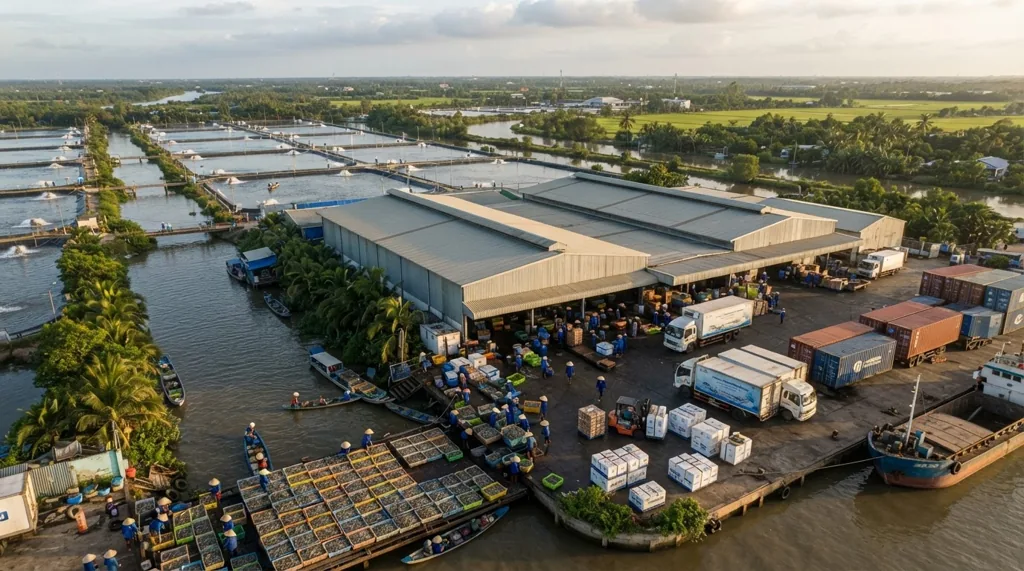
United States sets final anti-dumping deposits of 6.36% to 10.71% on Vietnamese frozen shrimp from Nov. 6, 2026.
The U.S. Department of Commerce set final anti-dumping rates of 6.36% to 10.71% on frozen shrimp from Vietnam, applying from Nov. 6, 2026.
The decision closes the yearly review of the long-running anti-dumping order on frozen warmwater shrimp from Vietnam. It covers shrimp that entered the United States between Feb. 1, 2024, and Jan. 31, 20251.
In short, a U.S. importer now pays a cash deposit of 6.36%, 7.59% or 10.71% of the shipment’s value, depending on the Vietnamese exporter. Shrimp from exporters without their own rate pays 25.76%1.
What did Commerce decide on Vietnamese shrimp?
Commerce found that the Vietnamese exporters it examined sold frozen shrimp in the United States below normal value. In plain words, they sold it at prices lower than Commerce’s estimate of a fair price for the shrimp1. The price gap is called the dumping margin, and it becomes the extra import tax, or anti-dumping duty.
Final anti-dumping rates on Vietnamese frozen shrimp, %
The notice is called the final results of the antidumping duty administrative review for 2024-2025. It was signed on Nov. 2, 2026, by Scot Fullerton, Acting Deputy Assistant Secretary for Antidumping and Countervailing Duty Operations1. It appeared in the Federal Register, the U.S. government’s daily journal of rules and notices, on Nov. 6, 20262.
The final rates are:
- Fimex Group: 10.71%. This group is Sao Ta Foods Joint Stock Company, FIMEX VN, Sao Ta Seafood Factory and Khang An Foods Joint Stock Company.
- STAPIMEX: 6.36%. This is Soc Trang Seafood Joint Stock Company.
- Other separate-rate companies: 7.59%. These are the exporters not examined one by one but given their own rate.
- Vietnam-wide rate: 25.76%. This applies to exporters that did not qualify for a separate rate.
Commerce lists these rates in the final notice1. The Vietnam-wide rate did not change, because nobody asked Commerce to review it1.
How do the final rates differ from May?
Commerce published preliminary, or first-draft, results on May 13, 2026, and invited comments1. In May, it set the Fimex Group at 10.76% and STAPIMEX at 6.30%3. The other separate-rate companies received 7.56%3.
Shrimp rates, May draft and final
| Exporter | May 13, 2026 | Nov. 6, 2026 |
|---|---|---|
| Fimex Group | 10.76% | 10.71% |
| STAPIMEX | 6.30% | 6.36% |
| Other separate-rate companies | 7.56% | 7.59% |
| Vietnam-wide rate | 25.76% | 25.76%, unchanged |
The final numbers moved only a little. Fimex Group fell by 0.05 percentage points to 10.71%. STAPIMEX rose by 0.06 points to 6.36%, and the other companies rose by 0.03 points to 7.59%1.
Commerce said it changed the margins after reviewing the record and the comments from interested parties1. The full reasons are in a separate Issues and Decision Memorandum, which the notice adopts1.
Why did Commerce penalise STAPIMEX?
Commerce said STAPIMEX did not fully answer its questions. The company did not give proper descriptions of some chemicals it used to process shrimp1. Commerce called this a failure to cooperate "to the best of its abilities"1.
So Commerce used adverse facts available for part of the STAPIMEX calculation. This means Commerce chose an unfavourable figure in place of the missing information1. For five chemicals with poor descriptions, it used the highest chemical price on the record1.
Vietnam is treated as a non-market economy under U.S. trade law, so Commerce uses a special method to set normal value3. It prices each input, such as raw shrimp, feed and chemicals, with a substitute figure called a surrogate value1.
What did the companies argue?
The notice lists seven issues that parties raised in their written comments1. Commerce answered each one in its decision memorandum:
- Shrimp feed price: whether to revise the price used for shrimp feed.
- Fimex calculation method: whether to compare average prices with average prices for the Fimex Group.
- Raw shrimp price: whether to correct an error in the Fimex Group’s raw shrimp figure.
- STAPIMEX chemicals: whether to use partial facts available for some of its chemicals.
- By-product credit: whether STAPIMEX should get a credit for by-products.
- Export subsidy offset: whether to revise a reduction made for export subsidies.
- Khang An Foods: whether this company belongs to the Vietnam-wide group.
These topics come from Appendix I of the final notice1. The notice does not say in detail how Commerce settled each point.
Which Vietnamese exporters get which rate?
Commerce found 29 companies eligible for a separate rate. This count includes the Fimex Group and STAPIMEX1. The other 27 companies receive the 7.59% average of the two examined rates1.
Commerce said it based this method on the rule used for the "all-others" rate in a first investigation1. The 27 companies include, among others:
- Bac Lieu Fisheries Joint Stock Company
- Camimex Group Joint Stock Company
- Cantho Import Export Fishery Limited Company (CAFISH)
- Minh Hai Joint-Stock Seafoods Processing Company
- Seavina Joint Stock Company
- Thuan Phuoc Seafoods and Trading Corporation
- Viet I-Mei Frozen Foods Co., Ltd.
- Nha Trang Seafoods – F89 Joint Stock Company
- Quang Minh Seafood Limited Liability Company
- Viet Shrimp Corporation
The full list is in Appendix II of the final notice1. It includes several name variations for some companies1.
Which companies pay the 25.76% rate?
Commerce placed 131 companies in the Vietnam-wide entity. These companies did not show they were eligible for a separate rate1. In May, the list had 132 names1.
The one change is Khang An Foods Joint Stock Company. Commerce now treats it as part of the Fimex Group, not the Vietnam-wide group1. Commerce said in May that Khang An is linked to Sao Ta Foods and forms one company with it1.
Shrimp from the 131 companies that entered during the review year will be charged 25.76% of its value1. The list in Appendix III starts with names such as AFoods, Amanda Seafood Co., Ltd. and Anh Khoa Seafood1.
What changes for U.S. importers of Vietnamese shrimp?
Two kinds of payment change. The first is the cash deposit paid at the border on new shipments. The second is the final duty on shrimp that entered during the review year.
New cash deposits apply to shrimp entered on or after Nov. 6, 20261. Shrimp taken out of a bonded warehouse for sale from that date is covered too1. The deposit rules work as follows:
- Shrimp from the Fimex Group, STAPIMEX or the 27 other listed companies pays the new rate for that exporter.
- Shrimp from an exporter that got a separate rate in an earlier review, but is not listed now, keeps its existing rate.
- Shrimp shipped by a company outside Vietnam without its own rate pays the rate of its Vietnamese supplier.
- Shrimp from any other Vietnamese exporter pays the 25.76% Vietnam-wide rate.
These steps are set out in the final notice1. The deposits stay in force until Commerce gives further notice1.
The cash deposit is an estimate. The final duty is fixed later, at the end of a review like this one, when U.S. Customs and Border Protection (CBP) closes the entry. This last step is called liquidation.
How will customs collect duties on past shipments?
For the Fimex Group and STAPIMEX, Commerce will work out a separate rate for each U.S. importer1. It divides the dumping found on that importer’s sales by the value of those sales1.
When the value of a sale is missing, Commerce will charge a fixed amount per unit of shrimp instead1. A rate below 0.50% counts as too small to charge, and is called de minimis1. The two examined margins are above that level, so duties apply1.
Some shrimp sales were not reported by the two examined companies. CBP will charge those entries the 25.76% Vietnam-wide rate1. The same rate applies when a maker did not know its shrimp was going to the United States and the trading company has no rate of its own1.
Importers also face a paperwork rule. Each importer must file a certificate on reimbursement before liquidation. It states whether the exporter paid back the importer’s anti-dumping duties1. Without it, Commerce may assume the duties were repaid. The importer could then pay double anti-dumping duties1.
When do the shrimp duty instructions go to customs?
Commerce plans to send its instructions to CBP no earlier than 35 days after Nov. 6, 20261. That is Dec. 11, 2026, at the earliest.
Next dates for Vietnamese shrimp duties
A party may challenge the results at the U.S. Court of International Trade. If it files a timely summons there, CBP will not liquidate the affected entries until the time to request a court order has passed1. That period is within 90 days of publication1.
Commerce first planned final results within 120 days of the May notice3. On Aug. 18, 2026, it extended the deadline by 53 days, to Nov. 2, 20261.
How did this shrimp review begin?
The anti-dumping order on frozen warmwater shrimp from Vietnam dates from Feb. 1, 20053. Commerce opened this review on March 28, 2025, after requests from interested parties3. The review first covered 177 companies, counting name variations3.
Three U.S. groups asked for reviews in February 2025: the US Shrimpers Coalition, the American Shrimp Processors Association and the Ad Hoc Shrimp Trade Action Committee1. Commerce chose the Fimex Group and STAPIMEX for full examination on May 22, 20253.
The work was delayed by the U.S. government shutdown in late 2025. Commerce pushed back all case deadlines by 47 days, and then by another 21 days3. In May 2026, it also ended the review for 8 companies that had no shipments to review3.
Key points on the Vietnamese shrimp duties
The table sums up the final results.
| Question | Answer |
|---|---|
| What changed? | Final anti-dumping rates for 2024-2025 |
| Who issued it? | U.S. Department of Commerce |
| Which goods? | Frozen warmwater shrimp from Vietnam |
| Review period | Feb. 1, 2024, to Jan. 31, 2025 |
| Fimex Group rate | 10.71% |
| STAPIMEX rate | 6.36% |
| Other 27 separate-rate companies | 7.59% |
| Vietnam-wide rate | 25.76%, unchanged |
| Companies at Vietnam-wide rate | 131 |
| New deposits start | Nov. 6, 2026 |
| Who must act? | U.S. importers pay deposits and file reimbursement certificates |
| Next step | Instructions to customs from Dec. 11, 2026 at the earliest |
From Nov. 6, 2026, every new shipment of Vietnamese frozen shrimp pays a deposit set by its exporter’s rate. Customs can begin closing entries from the review year no earlier than 35 days after publication1.
Sources
- ↩ 2026-22660.pdf https://public-inspection.federalregister.gov/2026-22660.pdf
- ↩ Federal Register :: Certain Frozen Warmwater Shrimp From the Socialist Republic of Vietnam: Final Results of Antidumping Duty Administrative Review; 2024-2025 https://www.federalregister.gov/documents/2026/11/06/2026-22660/certain-frozen-warmwater-shrimp-from-the-socialist-republic-of-vietnam-final-results-of-antidumping
- ↩ 2026-09465.pdf https://public-inspection.federalregister.gov/2026-09465.pdf