
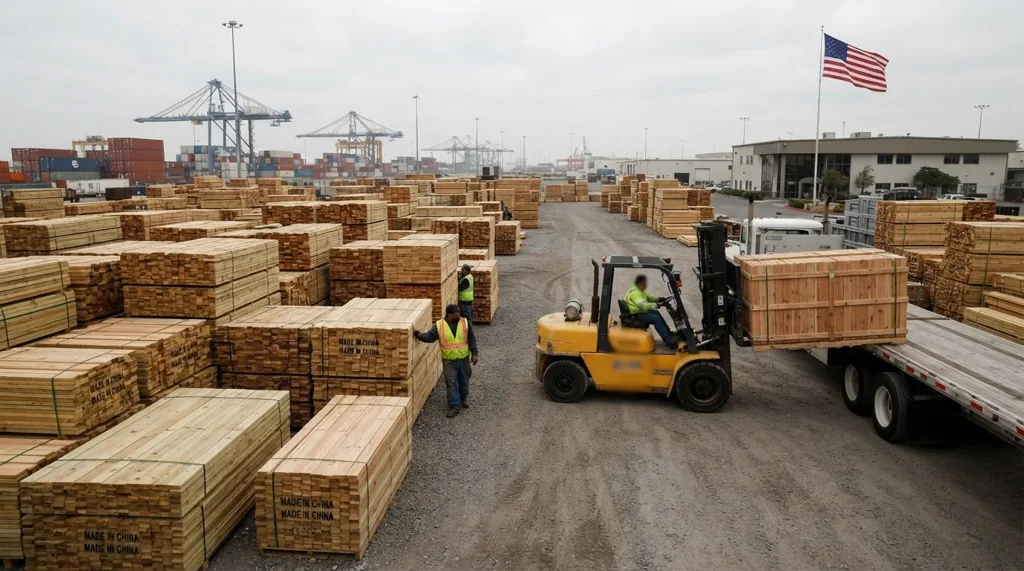
The United States opened an anti-subsidy investigation into Chinese wooden fence components, applicable from Nov. 3, 2026, which could lead to extra duties.
The U.S. Department of Commerce opened an anti-subsidy investigation into wooden fence components from China, applicable from Nov. 3, 20261.
The case could lead to a countervailing duty, an extra import tax that cancels out help a foreign government gives its makers. Commerce opened a separate anti-dumping case on the same goods at the same time2.
In short, no new duty is charged on Chinese fence parts yet. But if both U.S. agencies find against the imports, buyers in the United States could later pay extra duties on every shipment.
Who asked for the fence case?
The request came from the American Alliance of Wooden Fence Producers, a group of U.S. fence makers1. Its members are Alta Forest Products of Chehalis, Washington, Sierra Pacific Industries of Anderson, California, and Mendocino Forest Products of Santa Rosa, California3.
The group filed its petition, a formal request for duties, on Sept. 24, 20261. It filed one request about subsidies and a second one about dumping, which means selling goods abroad below their normal price1.
The group says the Government of China gives subsidies to Chinese makers of wooden fence components. It also says these imports are hurting, or threaten to hurt, U.S. producers1.
Why did Commerce accept the request?
The U.S. fence makers pointed to several signs of harm. They named a large rise in imports from China and a bigger market share for those imports1. They also named lower U.S. prices, lost sales, weaker profits, and falling output and jobs1.
Commerce checked this evidence and said it meets the legal test for starting a case1. It also found that the request has enough support from the U.S. industry. Under U.S. law, supporters must make at least 25% of U.S. production of the product1. In this case, supporters made more than 50% of total U.S. production, so Commerce did not need to poll the industry1.
Commerce had first given itself 20 more days, on Oct. 13, 2026, to check this industry support1. It moved its deadline for opening the case to Nov. 3, 20264.
Which wooden fence goods are covered?
The case covers "certain wooden fence components" from China1. The case was first called "wooden fence pickets"4. Commerce changed the product name to "components" on Nov. 3, 2026, after the petitioner asked for the change1.
The full product list sits in an appendix to the Commerce notice. The U.S. International Trade Commission (ITC), the agency that judges harm to U.S. industry, listed the goods under three U.S. tariff subheadings3:
- 4404.10.00
- 4407.19.00
- 4421.99.70
Commerce’s own fact sheet gives four more detailed import codes for its trade figures: 4404.10.0040, 4407.19.0092, 4421.99.7020 and 4421.99.70402. It warns that some of these codes also include goods outside the case2. So the tariff code alone does not decide whether a shipment is covered. The product description in the scope does.
How large is the fence trade with China?
U.S. imports of these goods from China were worth $76,667,656 in 20232. The value rose to $92,688,825 in 20242. It then fell to $56,269,724 in 20252.
U.S. imports of the fence goods from China, USD
Commerce gives values only, not volumes. It says the goods are reported in different units, so a total tonnage or count cannot be added up2.
How high could the duties be?
The petitioner claims dumping margins of 109.01% to 232.23% for China2. A dumping margin measures how far below their normal price the goods are said to sell. These figures belong to the separate anti-dumping case, case A-570-2432.
For the subsidy case, C-570-244, the petitioner claims a subsidy rate "above de minimis"2. De minimis means a level too small to count. Commerce sets it at less than 1% for developed countries and less than 2% for developing countries2.
These are the petitioner’s claims, not Commerce’s findings. Commerce will work out its own rates during the investigation.
Which subsidies will Commerce examine?
Commerce found enough information to investigate 37 subsidy programs that the petitioner named1. The full list is in the initiation checklist, a document Commerce keeps on its electronic filing system1.
The subsidy case at a glance
| Point | Detail |
|---|---|
| Case number | C-570-244 |
| Subsidy programs examined | 37 |
| Period examined | Jan. 1, 2025, to Dec. 31, 2025 |
| Chinese companies named | 80 |
| Claimed subsidy rate | Above de minimis |
Commerce will look at a one-year window, from Jan. 1, 2025, to Dec. 31, 20251. This is called the period of investigation.
Commerce invited the Chinese government to talk about the petition. The Chinese government sent written comments instead, on Oct. 13, 20261.
Which Chinese companies could be examined?
The petition names 80 companies in China1. Commerce plans to set a separate subsidy rate for each company it examines1.
If there are too many companies to check one by one, Commerce will choose a smaller group. It will pick these companies using import data from U.S. Customs and Border Protection (CBP), the border agency1. Commerce released that customs data to approved parties on Nov. 3, 20261.
Parties that want to comment on the customs data or the choice of companies have three days after the notice is published1. Commerce will not accept replies to those comments1. A copy of the public petition went to the Chinese government. Commerce will also try to send it to each exporter named in the petition1.
What happens to importers and buyers now?
Importers keep bringing in Chinese fence parts as before for now. The initiation notice does not set any duty or deposit.
The risk comes later. If Commerce finds subsidies, its preliminary decision could lead to duties on these goods. For U.S. buyers, the cost of Chinese fence parts could then rise sharply. Exporters in China face the same risk, and the companies Commerce picks will need to answer its questions.
Anyone with a view on which goods the case should cover can comment. Scope comments are due by 5:00 p.m. Eastern Time on Nov. 23, 20261. Replies to those comments are due by 5:00 p.m. Eastern Time on Dec. 3, 20261. The same comments must be filed in both the subsidy case and the dumping case1.
All filings go through ACCESS, Commerce’s online filing system for these cases1.
When will the ITC and Commerce decide?
The ITC goes first. It must decide within 25 days of hearing from Commerce whether U.S. industry is likely being hurt1. Commerce expects that decision on or around Nov. 30, 20262.
Coming dates in the fence case
| Date | Who | What happens |
|---|---|---|
| Nov. 23, 2026 | Interested parties | Scope comments due |
| Nov. 30, 2026 | ITC | Preliminary harm decision, on or around this date |
| Dec. 3, 2026 | Interested parties | Replies to scope comments due |
| Jan. 8, 2027 | Commerce | Preliminary subsidy decision |
| March 24, 2027 | Commerce | Preliminary dumping decision |
If the ITC finds no harm, the case ends1. If it finds harm, the case goes on.
Commerce would then announce its preliminary subsidy decision on Jan. 8, 20272. Its preliminary dumping decision would follow on March 24, 20272. Commerce says these dates can be extended under U.S. law2.
The ITC first planned its decision for Nov. 9, 20263. It revised its schedule after Commerce moved its own deadline4.
Key points on the Chinese wooden fence components case
The table below sums up the main facts of the subsidy case.
| Question | Answer |
|---|---|
| What changed? | Commerce opened an anti-subsidy investigation |
| Who issued it? | U.S. Department of Commerce |
| Which goods? | Certain wooden fence components from China |
| Case numbers | C-570-244 (subsidy), A-570-243 (dumping) |
| Tariff subheadings | 4404.10.00, 4407.19.00, 4421.99.70 |
| Who asked? | American Alliance of Wooden Fence Producers |
| Claimed dumping margins | 109.01% to 232.23% |
| Subsidy programs examined | 37 |
| Chinese companies named | 80 |
| Applicable from | Nov. 3, 2026 |
| Scope comments due | Nov. 23, 2026 |
| Next decisions | ITC around Nov. 30, 2026; Commerce Jan. 8, 2027 |
The next step is the ITC’s harm decision, expected on or around Nov. 30, 20262. If it goes against the imports, Commerce’s preliminary subsidy decision follows on Jan. 8, 20272.
Sources
- ↩ 2026-22764.pdf https://public-inspection.federalregister.gov/2026-22764.pdf
- ↩ Initiation of AD CVD Investigations of Certain Wooden Fence Components from the People’s Republic of China https://www.trade.gov/initiation-ad-cvd-investigations-certain-wooden-fence-components-peoples-republic-china
- ↩ 701_807_notice09242026sgl.pdf https://www.usitc.gov/sites/default/files/secretary/fed_reg_notices/701_731/701_807_notice09242026sgl.pdf
- ↩ 2026-21504.pdf https://public-inspection.federalregister.gov/2026-21504.pdf