
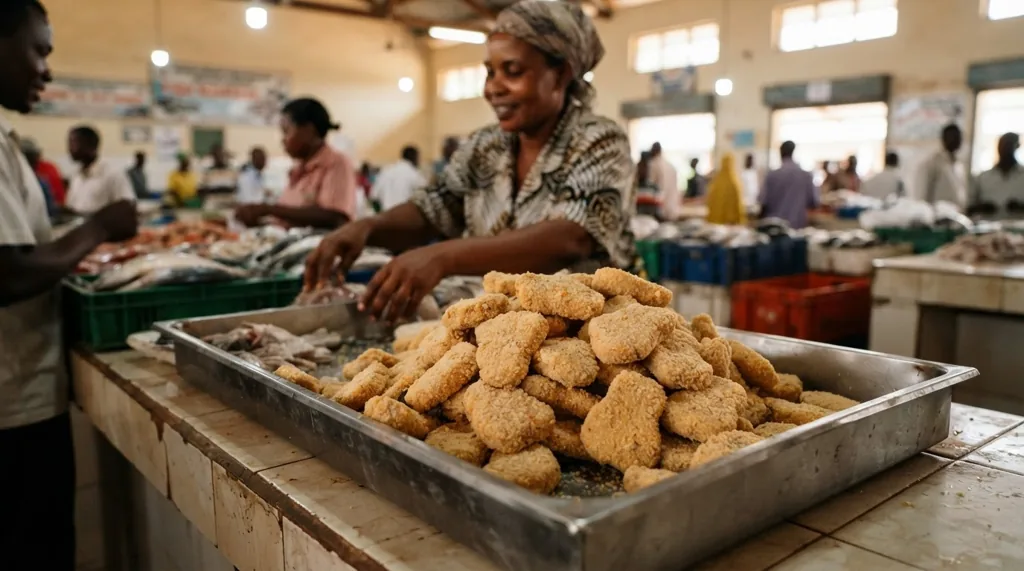
Tanzania has introduced new specifications for fish nuggets to ensure quality, safety, and consumer protection in the production and sale of prepared fish products.
Tanzania has notified the World Trade Organization of a draft standard for fish nuggets, DARS 1779:2026, which sets fish content, fat, bacteria and heavy metal limits for nuggets sold for people to eat1.
The draft is an African standard written by ARSO, the African Organisation for Standardisation, and its first edition is dated 20261. Tanzania sent the same text to two WTO committees: the one on technical rules for goods and the one on food safety and animal and plant health2.
In short, Tanzania is proposing one set of rules for bite-sized coated fish products. A shipment of fish nuggets would need a minimum share of fish, a fat limit, clean test results and a label that tells buyers how the product was cooked.
What is Tanzania’s fish nuggets notice?
The Estonian standards body’s list of WTO notices records Tanzania’s filing as G/TBT/N/TZA/1662, with the product given as fish nuggets3. It lists the notice under the date Sept. 28, 20263.
A notice of this kind tells other WTO members about a rule before it is final. That gives trading partners time to read the text and comment. The document itself is marked as a draft African standard throughout1.
The draft is not finished. Its list of reference documents still carries the note "align the references in the document", and two references are given only as "ARS XXXX"1. The heavy metal table carries an editor’s note asking for its units to be checked1.
Who wrote the fish nuggets standard?
ARSO describes itself as an African intergovernmental body set up in 1977 by the UN Economic Commission for Africa and the Organization of African Unity1. Its stated task is to develop and harmonize African standards to boost trade inside Africa and make African goods more competitive1.
The fish nuggets draft was prepared by ARSO/TC 03, ARSO’s technical committee for fish, fisheries and aquaculture1. Member bodies vote on draft standards, and a standard needs approval from at least 75% of the members that cast a vote1.
For a trader, this matters because the same text can serve as the rule in more than one African market. Tanzania’s notice is the step that puts it in front of WTO members.
Which fish products does the draft cover?
The draft covers fish nuggets intended for human consumption1. It applies to products that need final cooking or reheating before eating and are not meant for further processing in a factory1.
The draft defines fish nuggets as small, bite-sized pieces made from fish fillets, minced fish flesh or a mix of both1. They are coated in batter, breading or both, and may or may not be fried first1. Each nugget must be at least 9.5 mm thick1.
Two kinds of product are left out:
- Fish sticks or fish fingers, which the draft defines as pieces of 20 g to 50 g that are at least three times as long as they are wide.
- Ready-to-eat or breaded whole fish and whole fish fillets.
Shape decides where a product falls. Round, square, triangular or other bite-sized shapes count as nuggets1. A piece whose longest side is more than three times its shortest side counts as a fish stick and falls outside the standard1.
How must the nuggets be cooked and coated?
Nuggets may be sold in one of three states: fresh, partly fried or fully fried1. Partly fried nuggets, called par-fried or semi-fried in the draft, have been fried just long enough to set the coating and must be fully cooked before eating1. Fully fried, or pre-fried, nuggets need only reheating1.
Rules by cooking state
| Question | Raw | Partly fried | Fully fried |
|---|---|---|---|
| Cooking needed | Full cooking | Full cooking | Reheating only |
| Fish content, breaded | At least 60% | At least 50% | At least 50% |
| Fish content, battered | Not permitted | At least 40% | At least 40% |
| Maximum fat | 8% | 12% | 15% |
Any of these forms is allowed if the product meets the standard and the label describes it clearly, so that buyers are not misled1.
The coating has its own rules. It must be spread evenly, stick to the fish without gaps or bare spots, and stay whole through processing, storage and cooking1. It must be free from rancid smells, insects and mould1.
What fish content and fat limits apply?
The draft sets a minimum share of fish that depends on the cooking state and the coating1. Raw breaded nuggets must be at least 60% fish by weight1. Partly fried and fully fried nuggets must be at least 50% fish when breaded and at least 40% fish when battered1.
Maximum fat content by cooking state, %
Raw nuggets in batter are not permitted at all1. The draft explains that frozen raw battered nuggets look the same as fully fried battered ones. A buyer could then undercook them, so makers of raw nuggets must use breading, which shows clearly that the product is uncooked1.
Fat also has a ceiling for each state1:
- Raw nuggets: no more than 8% fat by weight.
- Partly fried nuggets: no more than 12%.
- Fully fried nuggets: no more than 15%.
The draft says the higher limits for fried products allow for oil soaked up during frying1. When nuggets are sold by count, each piece may differ by no more than 15% from the declared average weight1.
What ingredients and quality rules apply?
All ingredients must be sound and fit for people to eat1. The fish must come from edible species, and minced fish must be free from too much connective tissue and from bone fragments1.
Water used must meet the World Health Organization’s drinking-water guidelines1. Flour may be wheat, corn, rice or a mix, and vegetable oils may be used only in fried products1. Spices, seasonings and salt are allowed, and food additives must follow the Codex General Standard for Food Additives (CXS 192)1.
Nuggets sold as boneless must be free from skin, from bones longer than 5 mm in any direction, and from guts, blood and parasites that can be seen by eye1. They must also be of even size and free from bad smells, off-flavours and foreign matter1.
What cold storage do frozen nuggets need?
Frozen nuggets must reach minus 18°C at the centre of the product1. They must be stored and moved at minus 18°C or colder1.
Storage must not exceed 360 days, unless a tested shelf-life study supports a longer period1. Chilled nuggets are defined as kept at no more than 4°C through the supply chain without being frozen1.
These temperatures also set how inspectors measure the product. Weight, size and thickness are checked at minus 18°C for frozen nuggets, at 4°C or below for chilled ones and at room temperature for fresh ones1.
What safety tests would shipments face?
The draft sets limits for germs, each with an international test method1:
- Salmonella: none found in a 25 g sample.
- E. coli: no more than 10 colony-forming units per gram, a count of live bacteria.
- Staphylococcus aureus: no more than 1,000 per gram.
- Total bacteria count: no more than 1 million per gram.
- Vibrio parahaemolyticus: no more than 100 per gram.
What would fail a batch of fish nuggets
Nuggets made from fish families that can form histamine, such as Clupeidae and Scombridae, face a histamine limit of 200 mg/kg1. The draft sets the test for this as method AOAC 977.131.
For heavy metals, the draft sets 0.1 mg/kg for inorganic arsenic and 0.5 mg/kg for mercury in non-predatory fish1. Products must also meet the Codex General Standard for Contaminants and Toxins in Food (CXS 193)1. The nuggets must be made in clean premises approved or licensed by the regulators1.
Who would the fish nuggets rules affect?
Fish processors in Tanzania and abroad would need to check their recipes against the fish content and fat limits. A maker of raw battered nuggets would need to switch to breading or stop selling that product under the standard.
Exporters to Tanzania would need laboratory results that match the germ, histamine and metal limits. Cold-chain operators would need to hold frozen shipments at minus 18°C or colder. Retail labels would need to state the cooking state clearly, since the draft ties every form to a clear description1.
The draft’s contents list also includes sections on packaging, labelling of retail and bulk containers, sampling and lot acceptance2. Every product form must be labelled so that buyers are not misled about it2.
Key points on Tanzania’s fish nuggets standard
The table below sums up the draft as notified.
| Question | Answer |
|---|---|
| What is proposed? | A fish nuggets standard |
| Which document? | DARS 1779:2026, first edition |
| Who notified it? | Tanzania, to the WTO |
| Notice number | G/TBT/N/TZA/1662 |
| Notice date | Sept. 28, 2026 |
| Who wrote it? | ARSO technical committee TC 03 |
| Which goods? | Coated bite-sized fish pieces |
| Which goods are out? | Fish sticks, whole fish and fillets |
| Minimum fish content | 40% to 60%, by type |
| Fat limit | 8% raw to 15% fully fried |
| What is banned? | Raw nuggets in batter |
| Frozen storage | Minus 18°C, up to 360 days |
The draft is still open for review, and the notice gives WTO members a chance to comment before it is adopted. Until then, the 60% fish rule for raw breaded nuggets and the ban on raw battered nuggets are the changes most likely to force recipe changes for makers selling into Tanzania1.
Sources
- ↩ 26_05031_00_e.pdf https://members.wto.org/crnattachments/2026/TBT/TZA/26_05031_00_e.pdf
- ↩ 26_05032_00_e.pdf https://members.wto.org/crnattachments/2026/SPS/TZA/26_05032_00_e.pdf
- ↩ TBT notifications – EVS standard evs.ee | en https://www.evs.ee/en/wtonotifications/tbtnotifications