
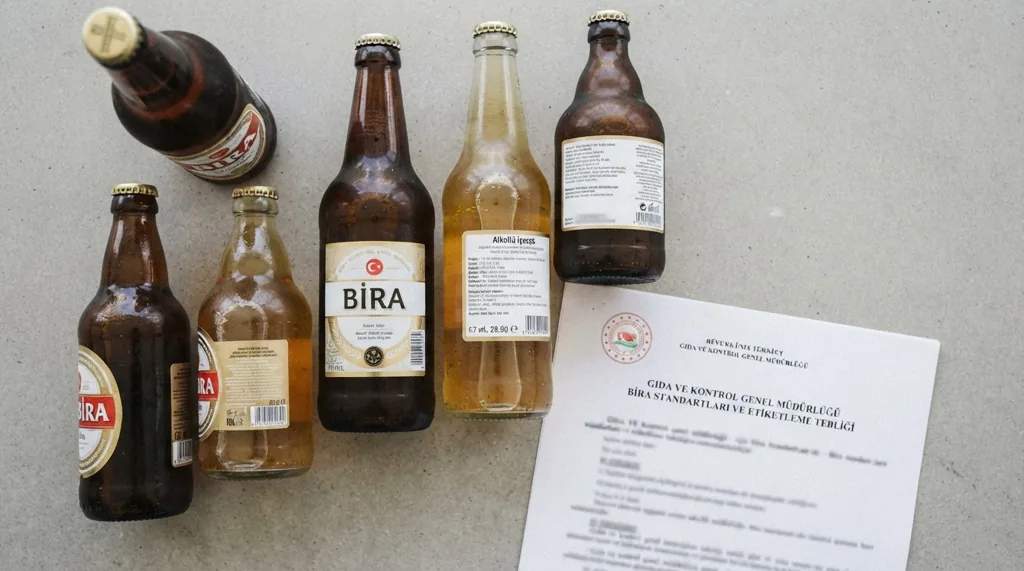
Turkey has issued updated food code regulations for beer, establishing mandatory safety, labeling, and production standards to protect consumers in Türkiye.
Türkiye’s Ministry of Agriculture and Forestry has proposed a new rulebook for beer and flavoured beer sold in the country, listed as a World Trade Organization notification on Sept. 29, 2026, with comments open until Nov. 28, 2026.
The draft is the Turkish Food Codex Communiqué on Beer, draft number 2026/231. It would replace the beer rules Türkiye has used since 20062.
In short, every beer sold in Türkiye, made at home or imported, would have to meet fixed limits on alcohol, acidity, colour, fizz and malt content, with no added sugar for sweetness. Labels would have to show the alcohol content and use set names, and existing businesses would have until Sept. 1, 2027 to adjust.
What is Türkiye proposing for beer?
The ministry’s draft sets out how beer must be made, stored, transported and kept, and the conditions for selling it1. It covers beer and flavoured beer. It does not cover malt drinks.
The draft rests on the Turkish Food Codex Regulation, published in the Official Gazette on Feb. 19, 2020, issue 310441. The Turkish Food Codex is the country’s set of food standards. A communiqué is a detailed rule issued under it for one food.
Türkiye’s Ministry of Trade lists the draft on its portal for technical barriers to trade as notification G/TBT/N/TUR/2403. A technical barrier to trade is a product rule, such as a standard or a label requirement, that can affect imports. The portal gives the products as "beer and flavoured beer", the date added as Sept. 29, 2026, and the last day for comments as Nov. 28, 20263.
Why does the ministry want new beer rules?
The ministry gives its reasons in a comparison table published with the draft1. It says it changed the definitions and product rules to support food safety, to stop consumers being misled, and to prevent unfair competition1.
Beer rules, 2006 and the draft
| Question | 2006 rule | 2026 draft |
|---|---|---|
| Alcohol classes | Four, incl. non-alcoholic | Three, from over 0.5% |
| pH range | Over 3.8 up to 4.8 | 2.8 to 4.8 |
| Water | “The relevant law” | Drinking water rules of 2005 |
| Time to comply | 1 year | Until Sept. 1, 2027 |
The same table names three main changes in the product rules. Adding sugar for sweetness is banned. Making dark beer by colouring light beer is banned. Pectin, a plant-based thickener, is allowed as a processing aid1.
The table also explains other edits. Some new product definitions were added because they were needed, some were removed, and some were made clearer1. The definition of non-alcoholic beer was removed. Many references to other food laws were updated to their current dates and numbers1.
How strong, sour and dark may beer be?
The draft sorts beer into three classes by alcohol content, measured as a percentage of volume at 20°C1. Annex 1 of the draft sets the classes:
- Low-alcohol beer: more than 0.5% and up to 3%.
- Beer: more than 3% and up to 6%.
- High-alcohol beer: more than 6% and up to 10%.
Highest alcohol allowed in each class, % by volume
The 2006 rule had a fourth class, non-alcoholic beer, at 0.5% or less2. That class does not appear in the draft’s annex1.
Acidity is measured by pH, a scale on which lower numbers mean more acid. The draft says the pH of all covered products must be between 2.8 and 4.81. The 2006 rule set more than 3.8 and up to 4.8 for beer, with a separate range for flavoured beer2.
Colour is measured in EBC units, a scale published by the European Brewery Convention1. Annex 2 of the draft sets three colour groups: light beer below 15, dark beer from 15 to 40, and black beer above 401.
What must go into the glass?
The draft sets fixed recipe rules. Carbon dioxide, the gas that makes beer fizzy, must be at least 0.3% by weight1. Malt must make up at least 60% of the raw materials1. Malt is grain, mainly barley, that has been sprouted in water, dried and roasted1.
What brewers may not do
Three practices would be forbidden1:
- Sugar for sweetening: sugar may not be added to make beer sweet.
- Coloured light beer: dark beer may not be made by colouring light beer.
- Fruit juice after fermentation: fruit juice or fruit juice concentrate may not be added as a sugar source after fermentation.
Water used in beer must meet Türkiye’s rules on drinking water, published on Feb. 17, 2005, in issue 257301. The 2006 rule only said water had to meet "the relevant law"2.
Hops, the plant that gives beer its bitter taste and aroma (Humulus lupulus), may be used together with hop extract1. Hop extract may only be added to the wort, the sugary liquid made from malt, before or during boiling1.
Which aids and flavours may brewers use?
Brewers may clear beer only with agents that work mechanically or by absorption and can be removed almost entirely1. Only small traces that cannot technically be avoided may remain.
The draft lists the processing aids allowed1. They include protein-based clearing agents (isinglass, gelatin and casein), tannate, kieselguhr, silica gel, carrageenan, PVPP, bentonite, cellulose, perlite and enzymes. Phosphoric, lactic and citric acid are also on the list, as are calcium, magnesium and zinc salts1. Gelatin, casein and tannate do not appear in the 2006 list, which named isinglass among the clearing agents2.
Food additives must follow Türkiye’s Food Additives Regulation of Oct. 13, 20231. Flavourings must follow the regulation on flavourings of Dec. 29, 20111. Flavoured beers may also contain herbs, seeds, plant parts, spices and plant mixes added for flavour, raw or processed1.
The draft defines flavoured beer as beer in which other flavourings may be used instead of hops or alongside them1. It also adds new definitions for bottom-fermented beer, top-fermented beer and brewer’s yeast. The yeasts named include Saccharomyces cerevisiae, Saccharomyces monacensis and Saccharomyces carlsbergensis, as well as other yeast types1.
Beers registered with a geographical indication or a traditional product name may be sold according to the features in their registration1. A geographical indication is a protected name tied to a place. This applies only as long as the beer does not break Türkiye’s general food rules.
What must a beer label show?
Labels must follow Türkiye’s Food Labelling and Consumer Information Regulation of Jan. 26, 20171. The draft then adds rules just for beer1:
- Alcohol by volume must be on the label.
- Extract ingredients used in making the beer must be listed. These include added grain, malt or beer concentrate, sugar, maltose and maltodextrin.
- The product name must follow the alcohol classes in Annex 1 and the colour groups in Annex 2.
- Other grain malts must appear in the name when they make up at least 25% alongside barley malt.
- Grain beers must be called "… Grain Beer", with the name of the grain.
- Flavoured beers must carry the word "flavoured" or the name of the flavour with the product name.
Some words are optional. Low-alcohol beers with at least 30% less energy may be called "light" or a similar word1. Descriptions of taste and smell may appear on the back label1.
What changes for keg beer?
Beer sold in kegs or other large packs must show its trade mark or trade name on the package1. The gas that touches beer when it is served from a keg must be carbon dioxide or another gas allowed for food use1.
Pressurised gas cylinders may be filled only at sites that meet the relevant technical rules1. This touches bars and restaurants as well as brewers.
How will Türkiye check beer on the market?
Packaging that touches beer must meet Türkiye’s rules on food-contact materials of April 5, 20181. Storage and transport must follow the Turkish Food Codex Regulation1. Limits on contaminants and pesticide residues come from Türkiye’s general regulations on those subjects, and hygiene rules from the Food Hygiene Regulation1.
Inspectors would take samples under Türkiye’s regulation on official food and feed controls1. Samples would be tested with nationally or internationally accepted methods1.
Anyone who breaks the communiqué would face penalties under Law 5996, Türkiye’s 2010 law on veterinary services, plant health, food and feed1. The draft makes no separate rule for imported beer. Because it covers every beer sold in Türkiye, a foreign brewer’s beer would have to meet the same limits and labels as a Turkish one.
Who is affected, and when?
The draft would enter into force on the day it is published in the Official Gazette1. It does not give that date. It would repeal the 2006 Beer Communiqué, number 2006/33, published on July 7, 2006, in issue 262211.
Dates for Türkiye’s beer rules
Food businesses already operating before publication would have until Sept. 1, 2027 to comply1. Until they do, the 2006 rules would keep applying to them1. Beer those businesses sold before publication may stay on shelves until the end of its shelf life1.
That is a longer and fixed date compared with 2006. The 2006 rule gave producers and sellers 1 year to comply2. The 2006 rule also said businesses had to follow it during registration, import procedures and inspections2.
Those affected include Turkish brewers, foreign brewers who sell into Türkiye, and importers and distributors. Importers would need labels that show alcohol content and use the new names. Brewers who sweeten beer with sugar, or colour light beer to make it dark, would need to change their recipes.
Key points on Türkiye’s draft beer rules
The table sums up the draft communiqué.
| Question | Answer |
|---|---|
| What is proposed? | New Turkish Food Codex Communiqué on Beer |
| Who issued it? | Ministry of Agriculture and Forestry |
| Draft number | 2026/23 |
| WTO notification | G/TBT/N/TUR/240, Sept. 29, 2026 |
| Comment deadline | Nov. 28, 2026 |
| Goods covered | Beer and flavoured beer, not malt drinks |
| Alcohol classes | Over 0.5% up to 10% by volume |
| Minimum malt | 60% of raw materials |
| Minimum carbon dioxide | 0.3% by weight |
| Banned practices | Sweetening sugar, colouring light beer |
| Label must show | Alcohol by volume and set product name |
| Deadline for existing firms | Sept. 1, 2027 |
The next date in the documents is Nov. 28, 2026, the last day for comments on the WTO notification3. After the final text is published, beer from existing businesses must meet the new limits and labels by Sept. 1, 20271.
Sources
- ↩ 8738.html https://www.gaib.org.tr/tr/site/download-file/8738.html?class=AnnouncementFiles
- ↩ 12 Haziran 2006 PAZARTESİ https://www.resmigazete.gov.tr/eskiler/2006/07/20060707-13.htm
- ↩ T.C. Ticaret Bakanlığı Ticarette Teknik Engeller Bilgi Ve Bildirim Merkezi https://teknikengel.ticaret.gov.tr/bildirimler