


 Jul 16,2026
  By Alice
CDs may sound obsolete with the intervention of USB sticks and cloud storage. It is bulky, and many electronic device manufacturers have rooted out CD players from their priority. This forced us to adapt and forget their existence. However, the 2020s are different for global market players. CDs and other similar types of storage, such as DVDs, made a silent comeback. How is that possible, and what can we learn from it? We will examine this phenomenon and the HS code for CD.
What is the definition of CD?
CD is the short form of compact disc, an optical device used to store audio, visual, or other digital data. CD is a flat circular disc with a 1.2 mm thickness made of a polycarbonate plastic base. The diameter of the disc is around 120 mm. The CD has a hole in the center, which is usually as big as 15 mm. Those are common sizes and shapes of CDs; there were many innovations during the height of the sales years ago, such as mini CDs (around 80 mm) and shaped CDs (rectangles and other custom shapes).
CD saves digital data into a microscopic spiral track on the reflective layer of aluminium (gold or silver can be used as well), added with an acrylic coat as a protector. When you store data on a CD, there will be physical signs on it, which are known as pits and lands. However, those bumps are not remarkable with the naked eye. The CD surface will seem and feel completely flat.
CD was popular back then. Musicians, filmmakers, and even software developers used CDs to distribute their works. The CD manufacturers even sell blank versions for regular people who also need storage space for their digital data. Despite being called analog technology, CDs marked the shift from analog to digital as they store digital data in physical media, when cloud storage had not been introduced yet.
CD is bulky and less practical, but it has several strengths that may explain the comeback. CD has unmatched durability. Cloud storage has promising features such as easy access and automatic backup, but there are still potential risks such as account loss, cyberattacks, and issues with privacy control. Disc rot may be the biggest fear for the data owner, but the prevalence is generally low. As long as you store CDs properly, the data will be securely intact for decades, even centuries. CD likes many
Differences among CD, DVD, and Blu-ray
When handling CDs, you may hear other terms such as DVD and Blu-ray. What are those? In general, they are all optical data storage with a similar circular shape and thickness. The differences are located in the capacity and type of laser they used to “burn” or save the data.
- CD (Compact Disc) is the oldest type of optical disc that can be used to store data between 650 and 700 megabytes (MB). To store data on a CD, an infrared laser is needed.
- DVD (Digital Versatile Disc) is the second generation of optical data discs that can hold more data, which can be up to 4.7 gigabytes (GB). For the dual-layer version (dual-layer DVD), 8.5 GB of data can be contained, reducing the necessity to flip or switch between discs. Unlike CDs, DVDs are burned with a red laser.
- Blu-ray term is adapted from the blue-violet laser used in the burning process. A single Blu-ray disc can contain up to 25 GB of data. That is why Blu-ray is often used to store videos in high definition, even 4K resolution videos.
Classifying CD to determine the HS code
Despite the differences, CDs, DVDs, and Blu-rays are categorized as discs in general. If you are considering trading them, here are some tips to classify and determine the HS code for CDs. CDs or discs in general are regulated under Chapter 85 of the World Customs Organization (WCO) document. This chapter covers electrical machinery, equipment, and parts. This also includes audio and visual recorders and reproducers, which accurately describe CDs.
HS code for CDs is mostly under heading 8523. For more details, check the table below.
| HS code | Product category | Product examples |
| 852341 | Unrecorded optical media | blank discs or CDs, DVDs, Blu-ray |
| 852349 | Other optical media | recorded discs, discs that contain music, film, or software |
Headings 8523 also mentioned other types of data storage, such as magnetic card and semiconductor media (smart card, chip card, integrated circuit card). In case of CDs, rest assured that you only need to pay attention to optical media with HS code for CD 852341 and 852349.
Top actors in CD export-import
While blank CDs are not on most people’s shopping lists, recorded CDs, on the other hand, experience surging sales. As part of physical media, CDs containing music and film (HS code for CD 852349) are now on the rise. Who are the lead actors in this market?
Exporters of recorded CDs
| Country | Trade Value (USD) |
| United States of America | 912,884,187 |
| Germany | 728,902,878 |
| Ireland | 653,005,622 |
| Czechia | 585,176,415 |
| South Korea | 484,192,904 |
Source: UN Comtrade 2024, accessed 6th July 2026
As expected, the United States dominates the world’s recorded CD trade. It can be projected from their entertainment industries, either music or film. Germany, Ireland, and Czechia have always been the global powerhouses in the optical storage industry. South Korea is an interesting entity here as it started to compete with the US entertainment industry. Both now see physical releases as a potential commercial artwork distribution medium as well as one of the main income sources.
Importers of recorded CDs
| Country | Trade Value (USD) |
| China | 2,396,991,178 |
| Germany | 649,619,150 |
| United States of America | 562,354,888 |
| France | 426,345,496 |
| Canada | 364,256,301 |
Source: UN Comtrade 2024, accessed 6th July 2026
This data shows an intriguing pattern of Chinese consumers. With the regional internet restriction, they see physical media such as recorded CDs (HS code for CD 852349) as an alternative way to consume global entertainment content. The existence of Germany, the US, France, and Canada as the largest recorded CD importers also shows the tradition of great power purchase, meaning their locals have disposable income to keep buying physical media despite economic pressures and the rise of streaming services.
How to classify the HS code for a CD
Classifying the HS code for CS might not be that complicated because most of the recorded CDs fall under the HS code 852349. However, the challenging part is not the 6-digit HS code, but finding the accurate national-level HS code, which is an extension of the international standard HS code regulated by each country.
In this part, we will try together with the new feature from HSCodeMatch called AI Agent to find the accurate HS code for CD. Let’s check the step-by-step instructions for classifying the accurate HS code for a CD with an AI Agent from HSCodeMatch below.
Step 1: Open the AI Chatbot Agent on HSCodeMatch
Click app.hscodematch.com on your browser and open your HSCodeMatch account. It will display its main feature, AI Chatbot Agent, on the front page.

Step 2: Ask the AI Agent about the HS code for the CD
For this example, we can use the trade route between the two major exporters and importers from the analysis above, such as Ireland and China. Just type “What is the HS code for CDs from Ireland to China?” and it will show the full results along with the list of HS codes and a summary.

Step 3: Choose HS Code Search to see the details
After choosing the HS Code Search on Suggested Pages, you are allowed to get to know the details of the HS code, tariff, and product regulations by clicking the Full Details button. For example, we can choose CD under the code 8523.49.10.10 in China.

Step 4: Check tariff rate, regulation, and ask AI Chatbot Assistant
In HS Code Details, you can easily get the complete insights about tariffs and regulations for exporting CDs under code 8523491020 from Ireland to China. If you encounter any ambiguity in finding specific regulations or tariffs about CDs, just ask the AI Chatbot Assistant on the right side of the page.
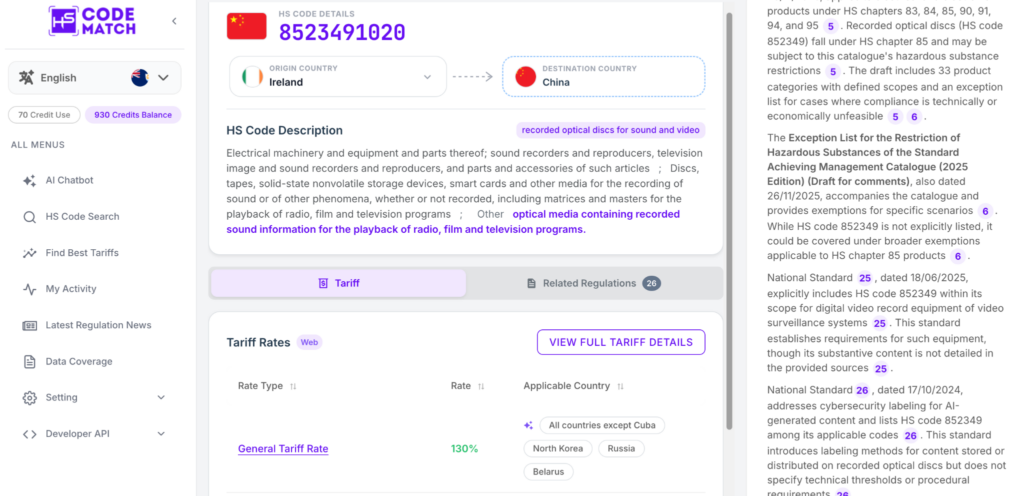
To get to know more about the AI Chatbot Assistant on HSCodeMatch, we will give you three examples of questions and answers for exporting CDs under HS code 8523491020 from Ireland to China below.
What is the applicable duty rate for exporting CDs under HS code 8523491020 from Ireland to China?
The tariff rate for exporting CDs under the HS code 8523491020 from Ireland to China may qualify for the Special Agreement 3 and 4 with a tariff rate of 10%. Exporters and importers must follow the specific criteria to meet those agreements in order to be eligible to get a preferential tariff, including rules of origin, product eligibility, documentation, and other requirements. If the exporters and importers fail to fulfill the requirement, they are likely to get higher tariff rates.
Are there any labeling requirements for exporting CDs under HS code 8523491020 from Ireland to China?
Yes, exporting CDs under HS code 8523491020 from Ireland to China requires a labeling standard. Those labels include hazardous substances from the China National Standard for Electrical Products, AI content labeling if required, and air cargo packaging labels if the CDs are shipped by plane. In addition, there is a conformity assessment, and clear documentation has become compulsory to prevent penalties and import delays. We recommend that the exporters should put the hazardous requirement substances first and be specific regarding transportation before shipment. The following table is the list of requirements.
| Regulation | Requirement | Deadline | Regulator |
| Domestic Air Transport Specification for Goods | Label for packaging using air cargo | At cargo shipping | CAAC |
| Restrictions on hazardous substances in electrical products | Hazardous substances labeling and conformity assessment | During import | MIT, CAAC |
| Cybersecurity Technology Labeling | Labelling of the possibility of AI-generated content on CDs | During import | Cybersecurity Authorities |
| Standard Achieving Management | Compliance with hazardous substance restrictions for HS Chapter 85 | During import | MIT |
What are the specific hazardous substances and concentration limits for CDs under HS code 8523491020?
The hazardous substances and concentration limits for CDs in China are regulated by China’s National Standard and Management for Electrical and Electronic Products. These regulations are developed to restrict the hazardous substances on imported CDs into China. The goal of these regulations is to promote safety and health as well as avoid potential environmental damage due to the importation of electronic products in China. Here is the regulatory requirement table for these regulations.
| Regulation | Requirement | Date | Government Bodies |
| Restricted hazardous substances on electrical and electronic products | Limitation of six hazardous substances in homogeneous materials | During production, sale, and import | Market Supervision Authorities |
| Standard Achieving Management Catalogue in 2025 | Applicable to hazardous substances for all products under HS Chapter 85, no exception to CDs | Effective since 26/11/2025 | MIT |
| Exception List Products in 2025 | Exemption of technical feasibility compliance for some products, including optical glass and solder. | Effective since 26/11/2025 | MIT |
Conclusion
It is interesting to see that despite the cloud software and storage invasion, physical media like CDs are not entirely extinct. In contrast to that belief, people see CDs as one of the most durable data storage devices. The tangibility and full ownership indeed influence the surge in CD demand on the market. Streaming services and SaaS may tempt you to ditch physical media until you realize the cost of monthly subscription fees you need to allocate to enjoy entertainment content and cloud services you never own.
Frequently Asked Questions (FAQ): HS Code for CD
1. Is the HS code for CDs containing music and film the same?
Yes, WCO does not classify CDs based on the types of data contained. As long as it is exported or imported with data recorded in it, the HS code for a CD is 852349. However, if you trade blank CDs, use HS code 852341 instead.
2. What if the CD contains educational media such as a lesson book?
It is still under HS code 852349. There are no specific measures for the data inside the CDs.However, there may be additional code digits based on the region or jurisdiction you intend to ship your CDs to, such as the US, who required you to add 4 additional digits to declare the specific content of your recorded CDs, whether it is audio, film, etc.
3. What about the HS code for DVD and Blu-ray? Are they the same as a regular CD?
Yes, the HS code for CDs, DVDs, and Blu-ray is the same. You only need to classify them based on the content. Determine if your CDs are blank or recorded; that is the key to having the most accurate HS code for CDs.
4. What are other tips to ensure the smooth process of shipping and selling CDs globally?
Some countries may ask you to add details of the CD’s content. It might be the compliance measures with their local policies, such as intellectual property and censorship/content laws.
5. What is the national-level HS code for movies and TV shows CDs in China?
The national level of HS code for recorded CDs for movies, TV shows, and mixed audio-visual content in China is under HS code 8523491020. Meanwhile, the HS code for CDs reproducing sound is under the HS code 8523491010.
Find and Match the Right HS Code for Your Products.
Try Our App

 Sep 10, 2026

