


 Jul 14,2026
  By Alice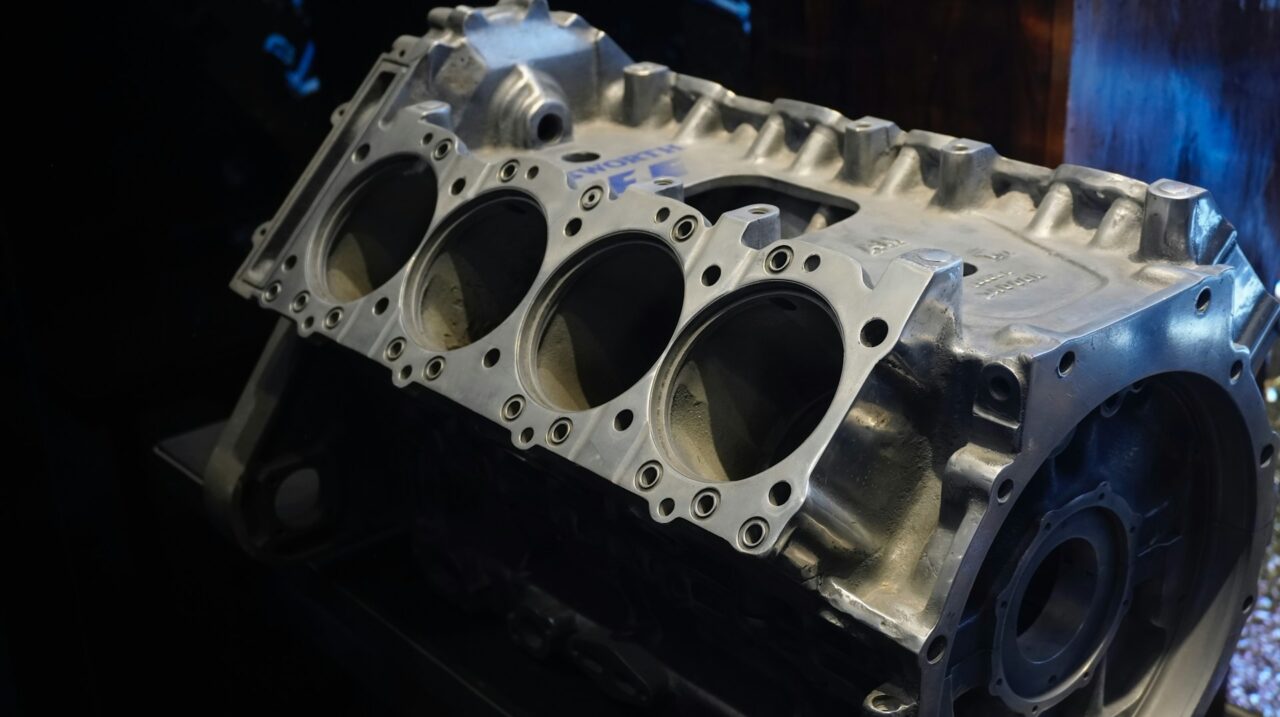
Gaskets may not be popular products and sound absurd to people who have never heard them, but they can actually be found everywhere. Gaskets are one of the critical components of machinery that are useful in all industrial sectors, including automotive. Therefore, gaskets have a consistent demand on the international market. In order to export gaskets across borders, the initial step is to declare an accurate HS code for gaskets. Through this article, we will explain the classification of HS codes for gaskets and similar products, major international partners of gaskets, as well as how to classify HS codes for gaskets accurately.
What are gaskets, and what are the types of gaskets?
Gaskets are mechanical components that are used to fill the microscopic surface gap between two objects. They have the main function as a sealant to reduce the potential leakage on the object’s joints. As we know, the leakage of fluid or gas on machinery is possible when the machines are under pressure, and this leads to dangerous consequences.
As a component for filling the space between two objects, gaskets are commonly made out of soft and malleable materials that are able to mold to fill the tiny gaps. The materials of the gaskets depend on the resistance needed, including chemical resistance, pressure resistance, temperature resistance, and others. To be more precise, let me explain the types of gaskets below.
1. Metal Gasket
A metal gasket is a quite common gasket made from copper, stainless steel, soft iron, carbon, aluminium, and other metals. A metal gasket is chosen when needed to endure the high temperature and pressure that cannot be achieved by softer materials.
2. Non-metal Gasket
Non-metal gaskets are also a common type of gasket that is made from non-metal materials, such as silicone, cork, rubber, graphite, and others. On the contrary of metal gasket, a non-metal gasket is mostly used for handling lower pressure and lower temperatures. Unlike metal, non-metal materials are chosen because they have flexibility and easily conform to the two objects.
3. Composite Gasket
Unlike metal and non-metal gaskets, composite gaskets are gaskets made from a combination of two or more materials. Composite gaskets can be a combination of metallic and non-metallic materials or can be multilayered to strengthen and endure high temperatures, high heat, and higher pressure, but make the gasket more adaptable at the same time, so that they can prevent leaks effectively. Examples of composite gaskets are PTFE, fiber-reinforced gaskets, and graphite composite gaskets.
List of HS codes for Mechanical Seal and Gaskets
After understanding the types of gaskets, we can now move to explain the classification of HS codes for gaskets. Harmonized System (HS) code is a standardized identification code for products, including gaskets, constructed by the World Customs Organization (WCO) to simplify the export and import process worldwide. Therefore, the declaration of the HS code has become a requirement for sending products across national borders, and it must be classified before the shipment.
HS codes for gaskets are not in the same umbrella, which makes it quite challenging to classify. According to the WCO’s publication, gaskets are classified solely based on their materials and finished products. Thus, the HS code for gaskets can be under Chapter 40 for rubber gaskets, Chapter 39 for silicone and plastics. Meanwhile, metal gaskets can be categorized under Chapters 73, 83, and 84. Let me explain the list of classifications of HS codes for gaskets depending on their materials below.
| Heading | HS Code | Description |
| 8484 | 8484.10 | Gaskets or similar joints made from metals |
| 8484.20 | Mechanical seals or gaskets | |
| 8484.90 | All types of gaskets, including a gasket kit | |
| 8409 | 8409.99 | Component of engines, including steel/elastomer gasket |
| 7616 | 7616.99 | Other articles of aluminum-made products include oil pan drain plug gaskets made of aluminum. |
| 7326 | 7326.90 | Other articles of iron and steel, including iron or steel gaskets. |
| 4016 | 4016.93 | Other articles of vulcanized rubber for gaskets or seals, including ethylene propylene diene monomer (EPDM) rubber gaskets. |
| 4016.10 | Other articles of vulcanized rubber, including rubber body seals for car doors. | |
| 4008 | 4008.11 | Rubber strip gaskets |
| 3926 | 3926.90 | Other articles for plastics, including silicone or plastic gaskets. |
For HS code for O-ring gaskets, they are classified based on materials. Thus, if the O-ring gaskets are made from vulcanized rubber, they fall under the HS code 4016.93, and if the O-ring gaskets are made from plastics or silicone, they fall under the HS code 3926.90.
Top gaskets trading partners
To get a better understanding of gaskets in international trade, we need to know the major trading players of gaskets. Most of the gaskets are made from vulcanized rubber; therefore, we choose rubber gaskets under the HS code 4016.93. The following table shows the largest rubber gasket exporters under HS code 4016.93 in the world in 2024.
| Country | Total Value (USD) |
| United States of America | 1,811,636,743 |
| Germany | 1,699,779,072 |
| China | 1,542,414,208 |
| Mexico | 693,543,235 |
| Poland | 670,622,975 |
Source: UN Comtrade Database, accessed July 1, 2026.
As shown in the table above, the biggest rubber gasket exporters are the United States, Germany, China, Mexico, and Poland. On the other hand, we provide the biggest rubber gasket importers in the table below.
| Country | Total Value (USD) |
| United States of America | 2,497,142,099 |
| Germany | 1,571,707,869 |
| China | 1,133,910,493 |
| Mexico | 973,603,830 |
| Canada | 534,137,068 |
Source: UN Comtrade Database, accessed July 1, 2026.
Interestingly, the biggest vulcanized rubber gasket importers are similar to exporters: the United States, Germany, China, and Mexico. The only difference is that Canada is placed as the fifth-largest buyer of rubber gaskets in the world.
How to classify HS code for gaskets
Once we know the HS codes for gaskets and the largest players of rubber gaskets in international trade, we can give you an explanation on how to classify the HS code for mechanical seals or gaskets. However, classifying the HS code for gaskets is indeed complicated due to the different types of materials or combinations of two materials in one product.
To simplify finding an accurate HS code for gasket kits or common gaskets, we recommend that you use HSCodeMatch. By typing only the product’s name, you can get results of an accurate HS code according to the AI assessment. We will teach you how to easily find the HS code for rubber gaskets with HSCodeMatch, using one of the largest exporters and importers, the United States and Canada.
Step 1: Find the HS code for gaskets on HS Code Search
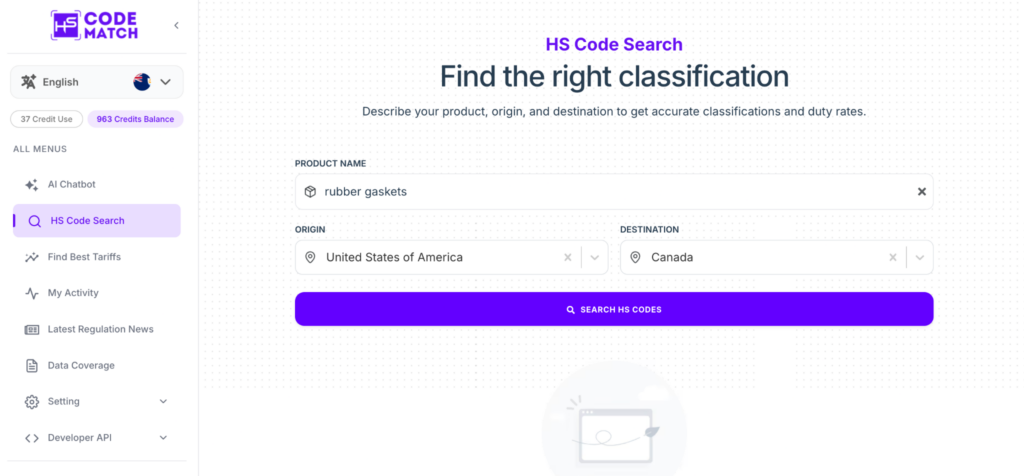
If you have an HSCodeMatch account, you can open your account on app.hscodematch.com. Choose HS Code Search on the sidebar and set the name, rubber gaskets, and the countries: United States as the origin country and Canada as the destination country.
Step 2: Get the quick results of the HS code for gaskets
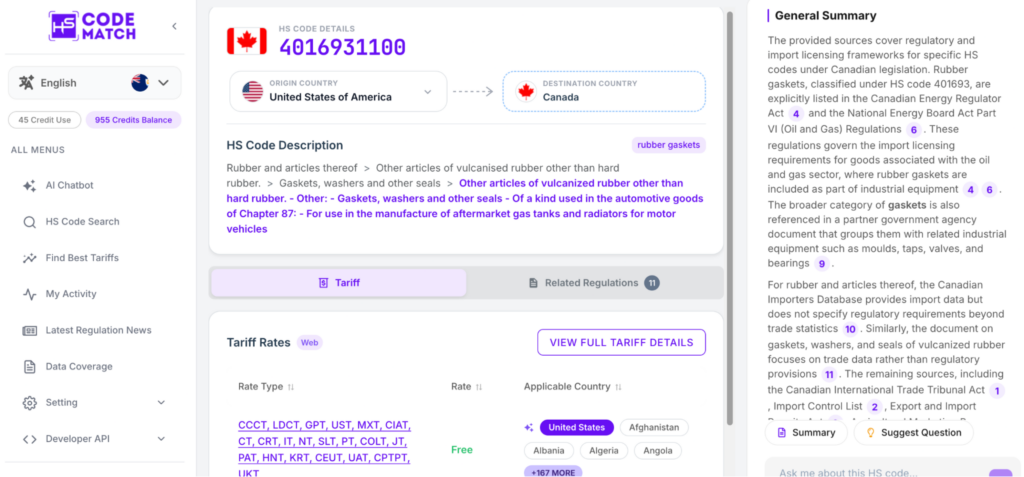
HSCodeMatch will assess the most relevant HS code based on your credentials and keywords in the product name. However, you need to check the HS code description to understand more about your product materials.

Step 3: Check the tariff and regulations of gaskets in Canada
Choose one of the most relevant HS codes for gaskets that align with your products and click the Full Details button. Thus, you can find a full description of HS code, tariffs, and related regulations of gaskets in Canada.
Step 4: Ask the AI Assistant to find the regulations and export/import procedures
If you encounter any problems finding relevant regulations or are keen to know more about the export and import procedure. Just ask the AI Chatbot Assistant to answer and help to solve your problems.
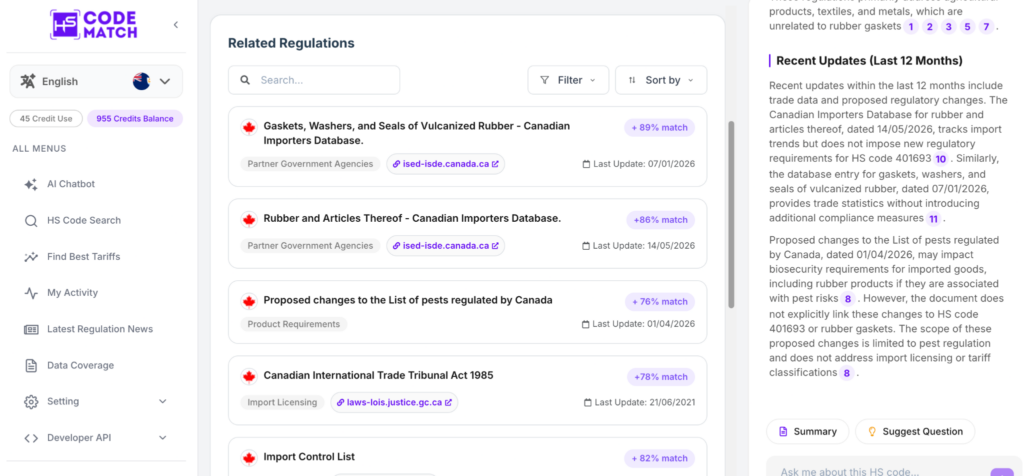
We will give three examples of questions and answers from the AI Chatbot Assistant on HSCodeMatch to export rubber gaskets for gas tanks from the United States to Canada.
What is the tariff for exporting gaskets under HS code 4016931100 from the US to Canada?
To export rubber gaskets under HS code 4016931100, follow the Customs Tariff Schedule in Canada. Up until now, there has been no tariff rate or 0% rate for vulcanized rubber gaskets under this code. Gasket products are also not part of the reciprocal tariff of 25% imposed by the Canadian government on some US products. So, if the products meet the origin requirements under CUSMA and are accurately classified under the HS code 4016931100, you do not need to pay a tariff.
What are the government bodies in Canada that check the rubber gaskets imports?
The government body that oversees the rubber gasket imports in Canada is the Canada Border Services Agency (CBSA). This is the customs body in Canada that enforces the code classification and reporting requirements according to the applicable HS code. If the importer is misclassifying the HS code for rubber gaskets, they may get penalties, shipping delays, or, in the worst-case scenario, even legal consequences.
What are the CUSMA Rules of Origin regulations for exporting rubber gaskets from the US to Canada?
For exporting rubber gaskets, exporters need to comply with the CUSMA Rules of Origin regulations to get preferential tariff treatment. This regulation has been established to set the threshold of regional value content on rubber gaskets from the countries under CUSMA, including Canada, the United States, and Mexico. Here is the detailed explanation of the CUSMA Rules of Origin Regulation (SOR/2020-155) for rubber gaskets.
| Regulation | Requirement | Threshold |
| CUSMA Rules of Origin Regulations, or known as SOR/2020 -155 | 40% Regional Value Content (RVC) for rubber gaskets under HS code 4016.93 | 40% minimum RVC |
| Rules of Origin for CUSMA products | <10% non-originating elastomeric materials by weight and <7% of all elastomeric content | Based on the products’ weights |
| Canada imposes a tariff rate of 25% for US products | Rubber gaskets are excluded from this tariff | Applies for exemption |
Conclusion
Classifying HS code for gaskets is quite complicated because it depends on the material composition. If the gaskets are made from aluminum, they can be classified under the specific aluminum code. Whereas, if the gaskets are made from vulcanized rubber, they must be categorized under the HS code for rubber. Thus, you need to be aware of the materials and be careful to find the HS code for gaskets. In particular, the gaskets or mechanical seals that are made from composite materials or two or more materials on one product.
Frequently Asked Questions (FAQs): HS Code for Gasket
1. What is the national variation of the HS code for rubber gaskets for gas tanks in Canada?
The national standard HS code for rubber gaskets for automotive gas tanks is 4016931100. This code is derived from the 6-digit HS code for rubber gaskets from the World Customs Organization (WCO), which is 4016.93.
2. What is the tariff rate for exporting rubber gaskets from the US to Canada?
The tariff rate for exporting rubber gaskets from the US to Canada is 0%, or this product is not subject to tariff. Therefore, the exporters and importers may not need to worry about exporting these products.
3. What is the national standard HS code for washers, seals, and rubber gaskets in Canada?
The national standard HS code for washer and seal rubber gaskets in Canada is 4016931990. Similar to other rubber gaskets, this national code is the extension of the international standard HS code from the WCO under subheading 4016.93.
4. How to define the 6-digit HS code for gaskets according to the WCO?
Determining the HS code for gaskets is tricky because it mostly depends on the component material of the gasket products. Therefore, you need to understand the materials of your products. However, if the gaskets are the finished products or as a set, they must be classified under HS code for gasket kit under subheading 8484.90.
5. What is the 6-digit HS code for O-ring gaskets?
Similar to other HS codes for gaskets, the HS code for O-ring gaskets hinges on the composition of the materials. If the O-ring gaskets are made from plastics, they can commonly be classified under 3926.90. While the Oring gaskets are made from vulcanized rubber, they usually can be classified under 4016.93.
Find and Match the Right HS Code for Your Products.
Try Our App

 Sep 10, 2026

