


 May 12,2026
  By Alice
Gloves might be one of the important products, yet it is often overlooked. These products are key players for protecting our hands from harmful chemical substances or other sharp objects. Gloves are commonly found in medical settings to ensure hygiene and sanitation during surgery or other medical procedures. No surprise that gloves are included among the most demanded products in international trade. All international trade parties need to understand the procedures and requirements for exporting gloves, including the declaration of the HS code. This article will help you identify the HS code for gloves and international players, and how to find the correct HS code for gloves.
What are gloves, and what type of gloves?
Gloves are protective equipment for individuals, and it includes as a piece of clothing. Gloves are commonly worn from the tips of the hands to the wrist to prevent the hands from contamination and sanitation risks. Gloves are widely used in human activities to protect hands from contamination or harmful substances in cooking, construction, or industrial work, as well as by athletes.
As they are used prevalently, gloves have many types depending on the materials and their functions. To develop your understanding of gloves, these are the explanations of the types of gloves based on their materials, and those materials also represent the common usage of the gloves.
1. Latex Gloves
Latex is actually a type of glove made partly from natural rubber. The main advantage of natural rubber latex is that it is stretchable and it has a solid surface when it is used for protecting the hands. Additionally, the natural rubber latex can protect the hand from ultraviolet radiation, light, or liquid chemical substances.
Latex gloves are popular because they are thin and easy to use. The common function of natural rubber latex gloves for disposable gloves for medical procedures. However, this glove cannot be used for protecting the hand from chemicals in the laboratory. This is because it has little protection and is very thin, and it can degrade within minutes.
2. Poly Gloves
Poly gloves have become one of the most renowned types of gloves and are easily found everywhere. This glove is commonly made from polyethylene (PE), also known as transparent plastic. They are gaining popularity due to being cheaper than other materials. PE gloves are also more recyclable than other synthetic materials for making gloves. In terms of usage, poly gloves are considered only for light-duty tasks, such as cleaning or cooking.
3. Vinyl Gloves
Vinyl gloves are manufactured from two materials, polyvinyl chloride (PVC) and polyvinyl alcohol (PVA). The two materials originate from petroleum. The PVC resists some chemical substances, such as mineral acids, caustics, alcohol, and others. Meanwhile, PVA resists some chemical substances, including petroleum solvents, chlorinated solvents, toluene, and aromatics.
4. Nitrile Gloves
Nitrile gloves might be one of the most popular gloves in the market and are similar to their latex counterparts. These gloves are manufactured from nitrile butadiene rubber or NBR. Although it resembles latex, nitrite gloves are actually latex-free and harmless for people who are allergic to latex. Nitrile gloves are durable and can endure petroleum-based oils, alcohols, ketones, and other chemical substances.
5. Leather Gloves
Leather gloves can be found in many types of industries, especially mining and construction. As its name suggests, leather gloves are made from leather materials. These gloves are specifically for protecting the hands from sharp or hard objects and are mostly cut-resistant. In addition, they also work to protect from the electricity. In spite of the resistance, it is not appropriate for chemical substances.
6. Norfoil Gloves
The most resistant glove is Norfoil gloves. These gloves are made from a laminate material with five layers, including polyethylene and ethylene vinyl alcohol. This glove has a specialty for preventing the dangerous and highly toxic chemical substances that can be absorbed easily into the human skin.
List of HS Codes for Gloves
After understanding the type of gloves, we shall move to the classification of gloves into the Harmonized Standard (HS) code. According to the World Customs Organization (WCO), there are classifications for gloves in the HS code lists. However, the classification of the HS code for gloves solely depends on the materials and function of the gloves.
The type of gloves above can represent the classification of the HS code for gloves. To get a better understanding of the HS code for gloves, we have assembled the list of HS codes for gloves, from the HS code for boxing gloves to medical gloves, below.
| HS code | Description |
| 3926.20 | Plastic-made gloves, including vinyl and PVC gloves, and disposable gloves from plastics. |
| 4015.11 | Latex or rubber gloves specifically for surgery and medical use procedures |
| 4015.19 | Other rubber gloves, including Nitrile gloves and Norfoil gloves. |
| 4203.21 | Gloves made of leather specifically for sports, including soccer, softball, basketball, and HS code for boxing gloves. |
| 4203.29 | Other leather gloves for industries and mining |
| 6116.92 | HS code for cotton gloves |
Top Major Gloves Trade Partners
To get a better grasp of the trade of gloves, we will provide the data about the largest exporters and importers. The gloves are made from various materials, and we can narrow it to sport or boxing gloves from leather under the HS code 420321. The following table shows the biggest sports glove-exporting countries in 2024.
| Country | Total Export Value (USD) |
| Indonesia | 122,490,006 |
| Pakistan | 58,981,964 |
| Thailand | 55,356,646 |
| Philippines | 52,062,737 |
| China | 49,523,938 |
Source: UN Comtrade Database, accessed April 20, 2026
The table demonstrates that Indonesia is the key player in the leather gloves for sports, with more than 122 million USD. The other remaining main players of leather gloves for sports are Pakistan, Thailand, the Philippines, and China.
| Country | Total Import Value (USD) |
| United States of America | 273,893,243 |
| South Korea | 41,440,153 |
| Japan | 32,207,233 |
| Canada | 31,364,899 |
| Australia | 19,959,491 |
Source: UN Comtrade Database, accessed April 20, 2026
On the other hand, the largest importer of sports leather gloves is the United States, with a total amount of more than 273 million USD. The other biggest buyers of sports leather gloves are South Korea, Japan, Canada, and Australia.
How to Find HS Code for Gloves
After knowing the largest exporters and importers of leather gloves for sports, let’s move on to how to find the HS code for gloves. As we know, finding the HS code for gloves or other products is indeed complicated due to the many materials in one product. If we declare an inaccurate HS code, it affects the business process and has great consequences.
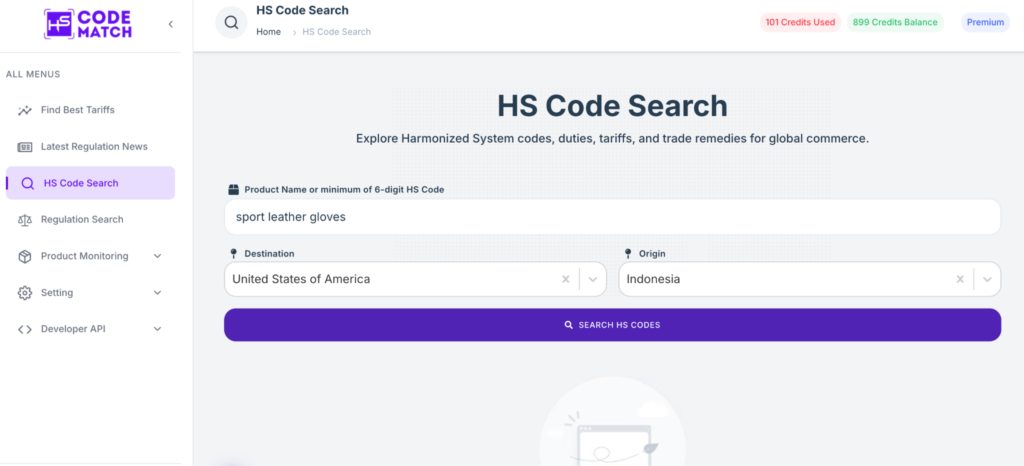
To address the challenges of finding HS codes, you can use HSCodeMatch. This application will help you find the HS code for gloves or other products instantly. Check this step-by-step guide for finding the HS code for sport or boxing gloves from Indonesia to the United States.
Step 1: Setting the product’s name and countries on the HSCodeMatch application
Before starting, you should open hscodematch.com to access the HSCodeMatch application. Then, open the HS Code Search tool to find the HS code for sports gloves from Indonesia to the United States.
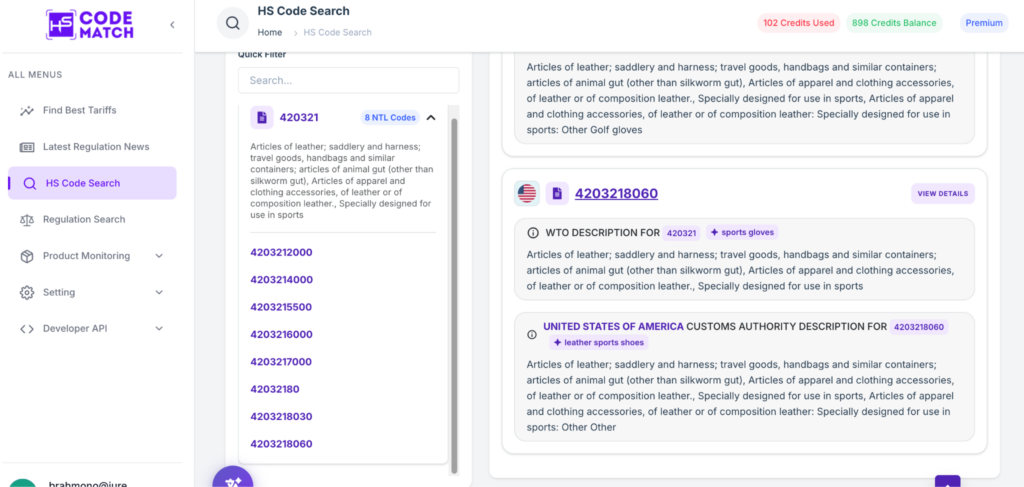
Step 2: Choose the most relevant HS code for gloves
Based on HTSUS, there are many HS codes for classification further based on the sports. For the boxing glove HS code, it can be included under HS code 4203218060 for other sports.
Step 3: Check the tariff and HS code description on HS Code Details
Click the View Details and find the HS code description on the HS Code Details page. You also can see the applicable tariff rate for gloves from Indonesia to the United States.
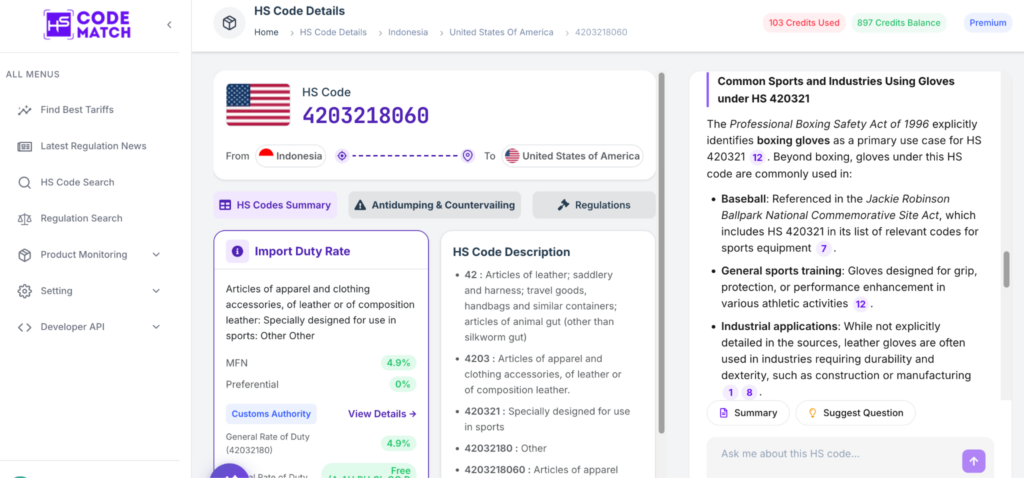
Step 4: Ask the AI Assistant to find the applicable regulations
In this page, you can find the antidumping and countervailing duties as well as the full covered regulation from the two countries. If you find any bemusement in order to find specific regulations and tariff rates, you can just ask the AI Assistant on HSCodeMatch for help.
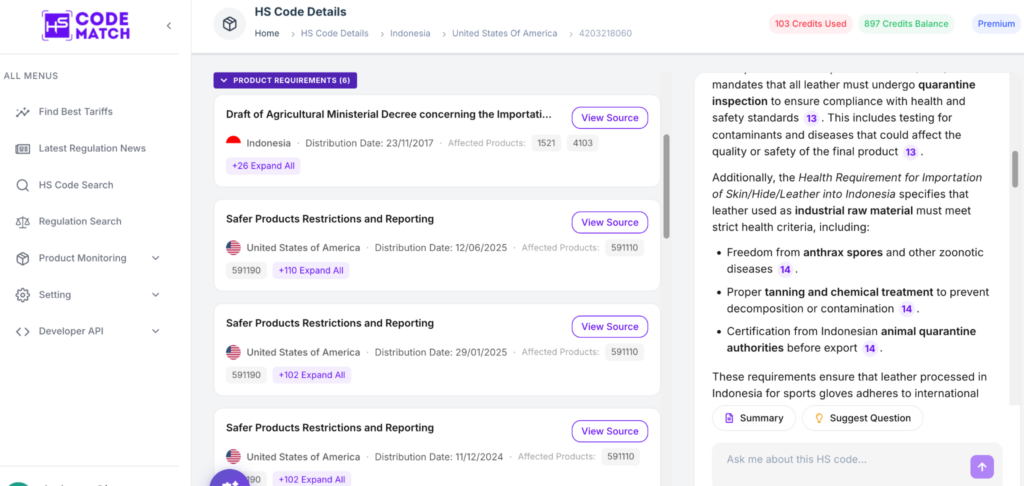
For reference, we can provide several examples of questions and answers from the AI Assistant. Kindly note that the AI Chatbot Assistant can only answer the relevant questions regarding the exportation of leather sports gloves from Indonesia to the United States.
Are there any additional tariffs for exporting leather sports gloves under the HS code 4203218060 from Indonesia to the US?
There are no additional tariffs for exporting leather sports gloves from Indonesia to the United States. The applicable tariff rate is 4.9% based on the Most Favoured Nation (MFN) because Indonesia and the United States do not have a Free Trade Agreement (FTA). Meanwhile, the United States has only FTAs with several countries in Latin America, the Middle East, and Asia. The following summary table will help you to understand the tariff rate for exporting leather sports gloves in the United States.
| Tariff Type | Applicable Country | Tariff for HS code 4203218060 |
| General Duty Rate | Most countries, including Indonesia | 4.9% |
| Preferential Duty Rate | Only for some countries that has FTA with the United States | Free |
| Column 2 Duty Rate | Non-market economy countries, including China and North Korea | 30% |
What are the license requirements for importing leather gloves from Indonesia to the United States?
For importing leather sports gloves under HS code 4203218060 from Indonesia to the United States, the importer must follow the regular standard labeling requirement. This is a mandate from the US Federal Trade Commission (FTC). The mandatory labeling will be inspected by the US Customs and Border Protection (CBP) to make sure that the products comply with the local regulations. The following text will explain the list of mandatory labeling from the FTC on leather sports gloves in the United States.
- Material Disclosure: This is the labeling requirement to disclose to consumers or potential buyers about the material composition of the leather products. For instance, the products are made from 100% leather or synthetic.
- Country of Origin: This is a requirement labeling to inform where the products come from. For example, the products from Indonesia should be labelled “Made In Indonesia”.
- Fiber Content: If the sports gloves are not entirely from leather, there must be a label to inform about the percentage of textile or fiber content in the product.
What are the specific priority chemicals restricted in leather gloves under Washington State’s Safer Products Rule?
For exporting leather gloves in the United States, you must comply with Washington State’s Safer Products Rule. The regulation is important to ensure that the restricted chemical products within the leather gloves do not exceed the standard. The prohibited chemical substances include per- and polyfluoroalkyl substances (PFAS). Based on the Department of Ecology, with the Department of Health, the criteria of toxic substances: bioaccumulative and toxic (PBT), carcinogenic, mutagenic, and toxic or reproductive (CMR), or highly toxic and has been found in human tissue, biota, and environment in the state of Washington.
Furthermore, leather gloves are tested to determine whether they contain toxic chemicals. They are tested using analytical methods from the Department of Ecology. The gloves must be tested in the chosen laboratory that is capable of testing for PFAS with specific techniques. Those techniques include liquid chromatography-mass spectrometry (LC-MS) or gas chromatography-mass spectrometry (GC-MS).
Conclusion
HS code for gloves identifies differently based on the materials and functions. Hence, the initial step before classifying on HS code, we should understand the materials of the glove products and what they are used for. If you are sure about the materials and function, then you can consider matching the products with the applicable HS code. On the WCO file, the classification of HS Heading for gloves is not that complicated. In spite of the ease, you must remember that it is only initial and you must categorize further into the national variant HS code for gloves to ensure the accuracy of the full code before shipping.
Frequently Asked Questions (FAQs) about HS Tariff Code for Gloves
1. What is the HS code for boxing gloves in the United States?
HS code for boxing gloves made from leather recognized internationally is 420321. Meanwhile, the national variation of HS code of boxing gloves to be exported in the United States or HTSUS is 4203218060.
2. What is the tariff rate for exporting boxing or leather sports gloves from Indonesia to the United States?
Tariff rate for exporting boxing gloves from Indonesia to the US is 4.9%, and it is applicable as a general tariff rate or a non-preferential tariff. This is because Indonesia and the US do not have an FTA.
3. Are there any preferential tariffs for exporting leather sports gloves to the United States?
Yes, obviously. For the countries that have FTAs with the United States, they can export leather sports gloves without the need to pay a tariff, or 0%.
4. What is the HS code for disposable gloves?
HS code for disposable gloves varies depending on the materials. HS code for disposable gloves made from plastics is 3926.90, and HS code for disposable gloves made from nitrile materials is 4015.19.
5. What are the main factors to determine the HS code for gloves?
Two main factors that define the HS tariff code classification for gloves are material and functions. Thus, most of the gloves are categorized in different chapters. If they are in the same heading, they can be classified further by the functions.
Find and Match the Right HS Code for Your Products.
Try Our App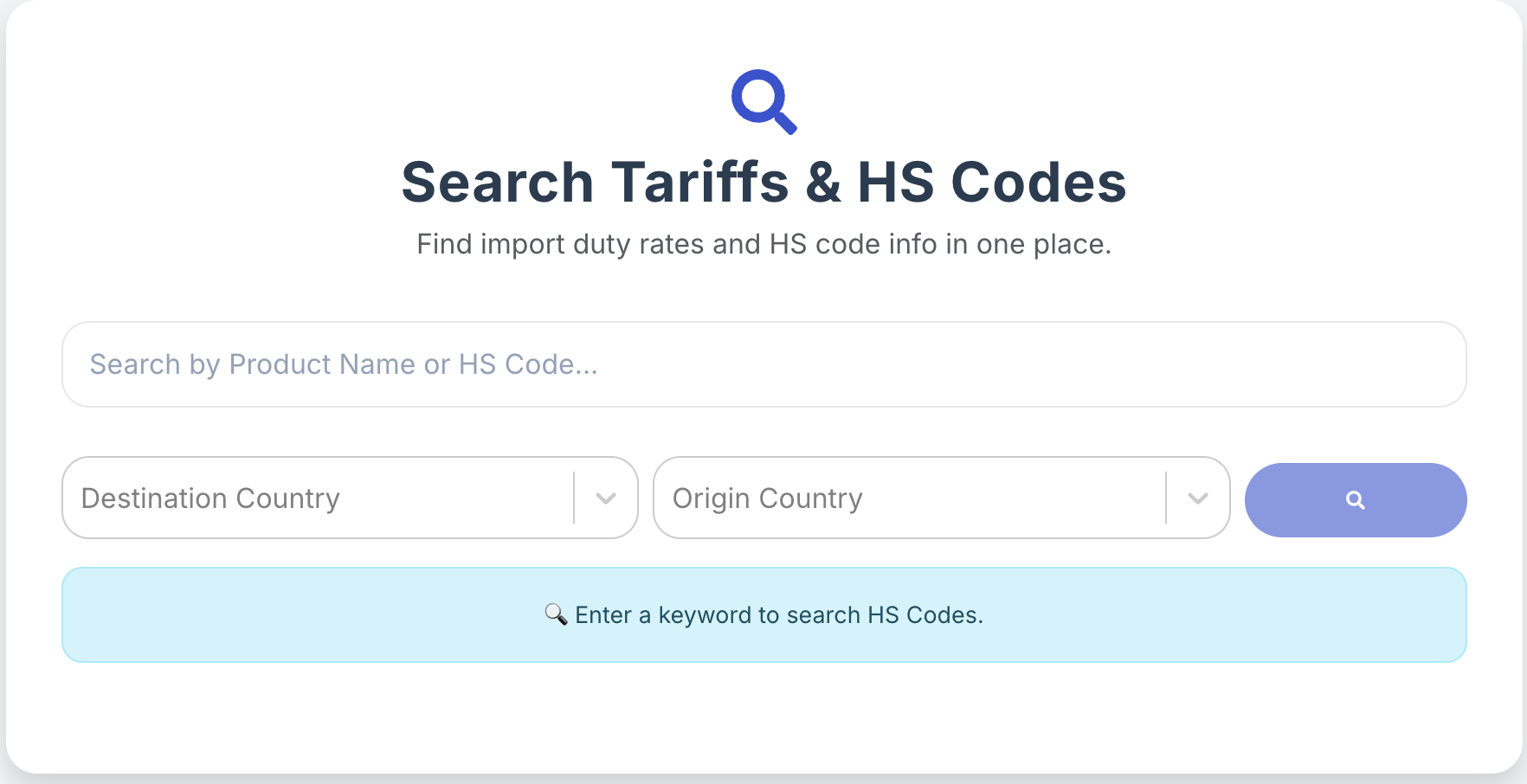

 Sep 10, 2026

