


 May 14,2026
  By Alice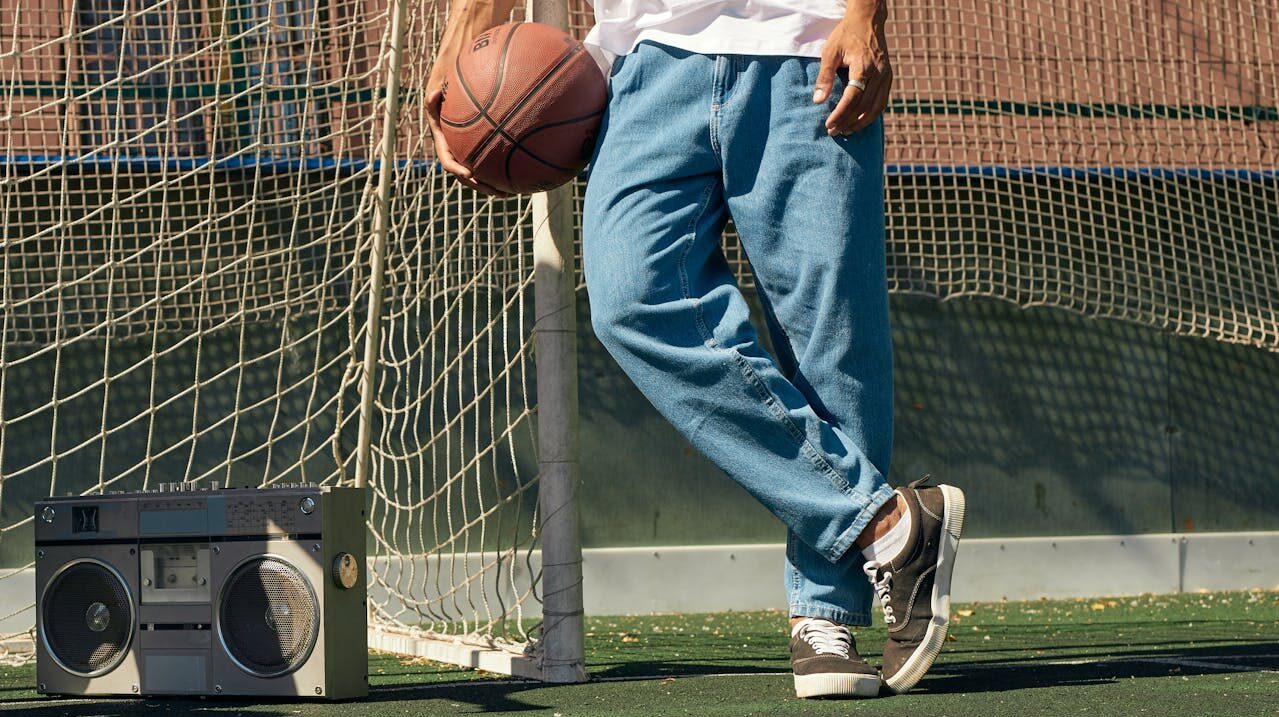
Pants are one of the complements of clothing or tops, including shirts, t-shirts, blouses, jackets, hoodies, etc. The terms of clothing always refer to tops and bottom wear, including pants, which are deemed as a primary product for humans. As a primary necessity, pants also become one of the most sought-after products in the international market. For international trade parties, they need to meticulously look at the product requirements before exporting products, including the HS code. This article will find out what the HS code for pants is, major international trade partners, and tips to find the accurate HS code for pants easily and quickly.
What are pants and trousers?
Pants are a type of garment covering the waist to the legs, commonly to the ankle. Pants are worn by men and women to protect the lower body in American English. There are various types of pants, including jeans, chinos, joggers, cargo, and others. In British English, pants are not an outer bottom wear; instead, it refers to underwear. However, pants are frequently referred to as trousers, the two terms are mostly interchangeable.
Pants are made from various materials. The type of fabric for pants determines how it affects the comfort, style, and purpose of a specific occasion, for example, formal pants, casual pants, or working pants. Type of materials, including cotton, linen, denim, wool, and fabric blends, sometimes a blend of cotton and polyester.
Lists of HS Codes for Pants (Non-Knitted)
You know what pants are now, let’s move on to the structure of the HS code for pants. As we know, the declaration of the Harmonized System (HS) code is a fundamental part of global trade. Without the declaration of the HS code, the products will be rejected, and they will be seized by the customs authority in the recipient country. The worst-case scenario of missing or inaccurate HS code is legal charges, which obviously lead to a huge loss for the business.
According to the World Customs Organization (WCO), pants and trousers fall under the HS Chapter 62, covering non-knitted apparel and clothing accessories. They can be classified further into clothing products for men and women. For men, it is included under HS Heading 6203, and under HS Heading 6204 for women. Then, trousers or pants can be subcategorized into more specific subheadings based on their materials, such as cotton, wool, synthetic fibers, and other fibers. We have assembled six lists of HS codes for pants. Check the list of HS codes for non-knitted pants below.
| HS code | Description |
| 6203.41 | Men’s trousers or pants made of wool or other animal hair |
| 6203.42 | Men’s trousers or pants made of cotton |
| 6203.43 | Men’s trousers or pants made of synthetic fibres |
| 6204.61 | Women’s trousers or pants made of wool or other animal hair |
| 6204.62 | Women’s trousers or pants made of cotton |
| 6204.63 | Women’s trousers or pants made of synthetic fibres |
For knitted pants, the code is actually similar, but the difference is only situated in the Chapter. For example, if you are looking for an HS code for sweatpants for men, knitted, and made of cotton, then the code is 6103.42.
Top 5 Biggest Exporters and Importers
For a better understanding of pants or trousers in global trade, we need to dig deeper into the largest players of these products. We have collected the data of the biggest men’s pants exporting and importing countries around the world from the International Trade Centre in 2024. However, we can focus on men’s trousers made of cotton under HS code 6203.42. Below are the biggest exporters of non-knitted men’s pants made of cotton in the world in 2024.
| Country | Total Export Value (USD) |
| Bangladesh | 6,429,908,000 |
| China | 4,418,491,000 |
| Germany | 2,329,985,000 |
| Italy | 1,117,841,000 |
| Turkiye | 948,796,946 |
Source: International Trade Centre, accessed April 29, 2026
As shown in the table above, we can see that China is certainly the largest exporter of men’s pants under HS code 6203.42, with an amount of more than 4.4 billion USD. The second largest men’s cotton pants importer is Germany, with more than 2.2 billion USD. The remaining biggest exporting countries are Italy, Turkiye, and Poland.
Opposite of export, we might need to know where the men’s trousers from those countries are destined. The following table shows the largest men’s trousers importing or buying countries in the world.
| Country | Total Import Value (USD) |
| United States of America | 4,425,846,422 |
| Germany | 2,856,071,000 |
| France | 1,343,467,000 |
| Netherlands | 1,125,250,417 |
| Italy | 1,035,354,000 |
Source: International Trade Centre, accessed April 29, 2026
As indicated in the table, the United States is undeniably the biggest buyer of men’s pants under HS code 6203.42, with a total amount of more than 4.4 billion USD. The second place is held by Germany with a total value of more than 2.7 billion USD. The rest of the biggest consumers of men’s pants are France, the Netherlands, and Poland.
How to Find HS Code for Pants
As stated previously, the HS code is a key element of foreign trade. Therefore, the declaration of this code cannot be neglected by all international trade parties. Hence, you must have a better grasp of the HS code structure for the products before sending them to the destination country.
In order to complete an understanding of the HS code for pants, we will teach you to learn how to find the HS code for pants. Instead of using a manual method to find the HS code for pants, you can use an application to ensure the accuracy of the HS code. One of the solutions is using HSCodeMatch, which can help you find the HS code for pants instantly.
These are the step-by-step guides for exporting pants using HSCodeMatch. For example, use the largest cotton trousers exporter, Bangladesh and the largest importer, Germany.
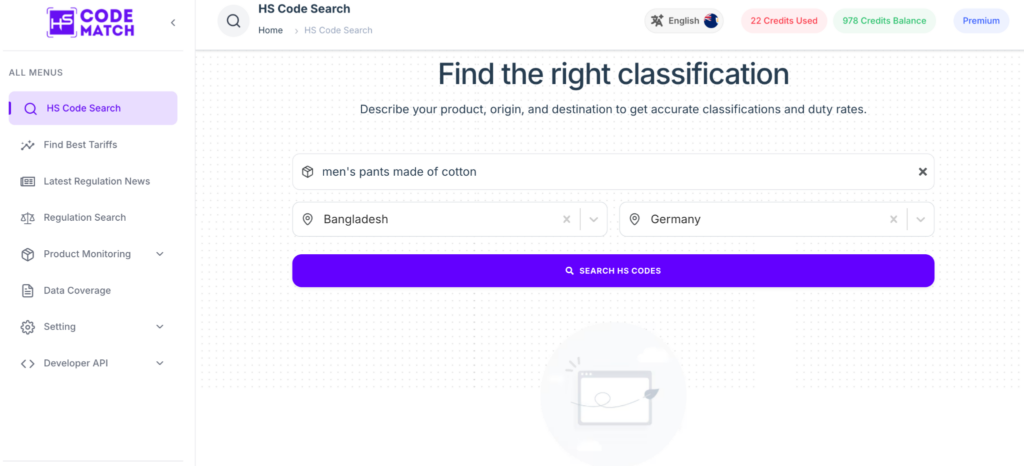
Step 1: Open the HSCodeMatch application
Open the HSCodeMatch application by accessing this link: app.hscodematch.com on your browser. Log in to your account and find the HS Code Search tool on the left sidebar of the HSCodeMatch app. Setting the product’s name as “men’s pants made of cotton”, the origin country as Bangladesh, and the destination country as Germany.
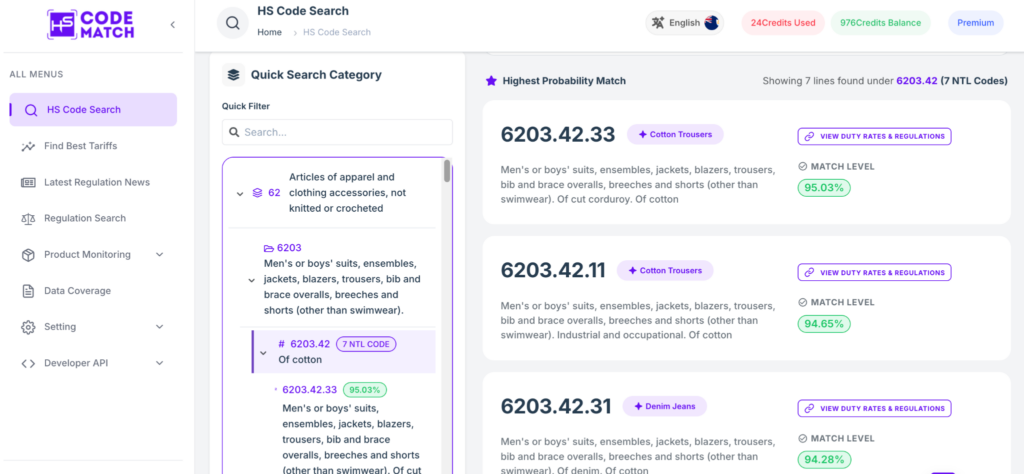
Step 2: Find the most accurate HS code on HSCodeMatch
With AI-powered, HSCodeMatch will automatically select the most relevant HS code sorted by the highest match level. For this example, we can choose the denim jeans under HS code 6203.42.31.00 in Germany.
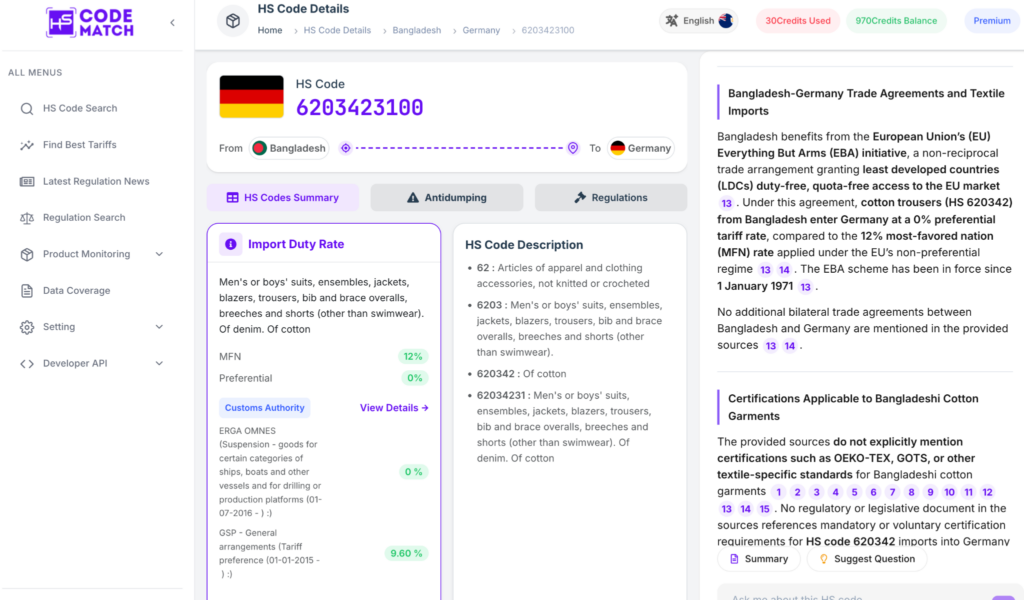
Step 3: Check the tariff rate and regulations on HS Code Details
Click the View Duty Rates and Regulations to open the HS Code Details page. In this page, you can get insight into duty rates, HS code descriptions, as well as the latest regulations related to the exportation of denim jeans in Germany.
Step 4: Ask the AI Assistant for help
If there is any confusion in finding the tariff, regulations, or procedures for export and import, you can directly ask the AI Assistant for help. On the right side of the page, you will find the AI Chatbot Assistant, equipped with the Summary and the Suggest Questions option.
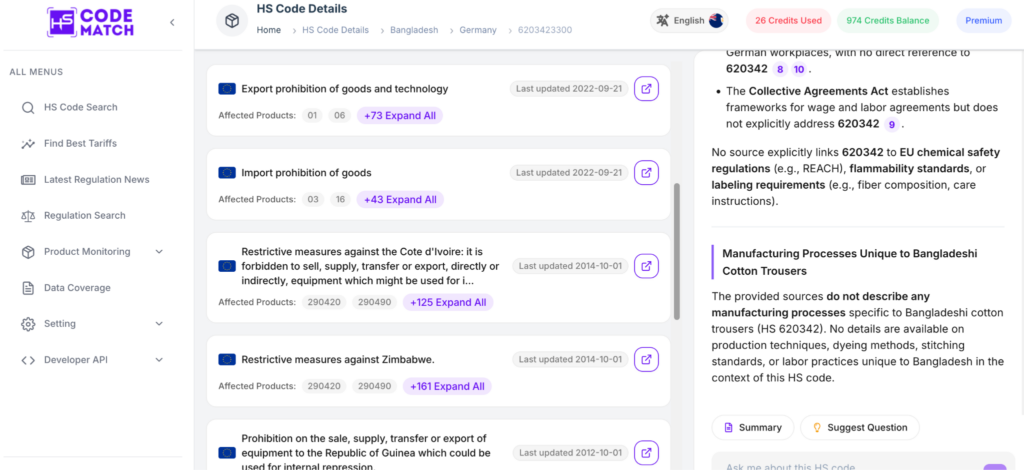
To assure you of the work of the AI Assistant on the HSCodeMatch app, we provide three examples of questions and answers from the AI Assistant. The following text is the questions and answers from the AI Assistant on HSCodeMatch regarding the exportation of men’s denim jeans from Bangladesh to Germany.
Are there any preferential tariffs for exporting men’s denim jeans from Bangladesh to Germany?
Yes, men’s denim jeans from Bangladesh to Germany, as a member of the EU, are under the preferential regime with 0% duty rates. This tariff reduction is under the EU non-reciprocal agreement for Least Developed Countries (LDCs). On the other hand, the standard tariff for exporting denim jeans to Germany is 12% under the Most Favoured Nation (MFN) regime.
| Tariff Type | Tariff Rate | Conditions |
| Preferential for LDCs | 0% | Non-reciprocal arrangement for countries included as LDCs |
| MFN (Most Favoured Nation) | 12% | Standard duty for all countries without an agreement with the EU |
Are there any additional documentation requirements for claiming the 0% preferential tariff from Bangladesh?
In order to qualify for an EU non-reciprocal arrangement for Least Developed Countries (LDCs), including Bangladesh, importers need to submit specific documents. The most important documents are proof of origin, which is known as the Form A certificate of origin, and must be issued by the Bangladesh authorities. The Form A document is a requirement to meet the EU’s Generalised Scheme of Preferences (GSP).
Other than proof of origin, there is no other certificate mandated by the EU countries for claiming 0% for denim jeans from Bangladesh. These are the standard import document requirements for shipping a pair of denim jeans to Germany.
| Document | Requirement |
| Form A certificate | A compulsory document as a proof of origin to be eligible for tariff reduction in the EU. |
| Commercial Invoice | The standard document for importing all kinds of products, including denim jeans. |
| Packing List | The standard document for importing all kinds of products, including denim jeans. |
| Bill of Lading or Airway Bill | The standard document for importing all kinds of products, including denim jeans. |
How do I obtain a Form A certificate of origin from Bangladesh to the EU?
In order to obtain a Form A certificate of origin, the exporters must apply through the Bangladeshi agencies authorized to issue this document. The exporters need to submit the required documents and ensure that the products comply with the trade agreement between the EU and Bangladesh.
In Bangladesh, the authorized bodies for issuing Form A certificates are the Office of the Chief Controller of Imports and Exports (CCI&E) and the Export Promotion Bureau (EPB). These two bodies are eligible to issue a Form A certificate. Other than that, you, the Dhaka Chamber of Commerce & Industry (DCCI), and the Metropolitan Chamber of Commerce & Industry (MMCI) can help you to assist the process of obtaining the certificates.
Under the GSP schemes of the EU, Japan, Canada, Norway, Switzerland, Russia, Belarus, Turkey, Australia, and New Zealand, all of them need a Form A document to be eligible for a preferential tariff. The following documents are needed by the exporters in Bangladesh to obtain the Form A certificate.
- A completed Form A application from the Bangladeshi authority.
- A commercial invoice provides detailed information about the products.
- Packing List, information about the packaging.
- Bill of Lading or Airway Bill for information on transportation service.
- Manufacturer’s declaration for the information of manufacturing companies.
- Proof of local value addition
- Export registration certificate
Conclusion
Finding the HS code for pants is quite complicated because it needs a detailed explanation about the materials. The classification of HS code for non-knitted pants falls under Chapter 62, along with the other non-knitted clothing products, but if it is knitted, it is classified under Chapter 61. It is under further classification of HS Heading 6203 for men and 6204 for women. The detailed categorization of HS code for trousers, including sweatpants, then differentiates by the material, including cotton, wool, synthetic fabrics, and others. They can be broken down into more detailed types of pants based on the national variation of the HS code in each country.
Frequently Asked Questions (FAQs) about HS Code for Trousers and Pants
1. What is the tariff rate for exporting men’s trousers or pants made from cotton from Bangladesh to Germany?
In order to export men’s pants from Bangladesh to Germany, the importers do need to pay the tariff or 0%. This is because Bangladesh is considered a Least Developed Country, which is eligible for tariff reduction under the EU non-reciprocal agreement.
2. What is the national variation of HS code for denim jeans made of cotton in Germany and the EU?
The national variation of HS code for denim jeans in Germany is following the 10 digit code from EU TARIC. The structure of HS code for denim jeans in Germany is 6203423100.
3. What is the national variation of the HS code for cut corduroy pants or trousers in Germany?
HS code or commodity code for cut corduroy pants in Germany is the following 10-digit EU TARIC code. The structure of the HS code for cut corduroy pants in Germany is 6203423300.
4. What are the main factors to define the HS or commodity code for pants or trousers?
The main factors to define the HS code for pants or trousers are the gender and materials. HS Heading of pants differs between men’s and women’s, and the further categorization of HS Subheading is distinguished by the materials of the pants.
5. What are the common materials for men’s and women’s pants or trousers?
The common materials for trousers or pants are listed in the HS Subheading, including cotton, synthetic fiber, wool or animal hair, linen, and others.
Find and Match the Right HS Code for Your Products.
Try Our App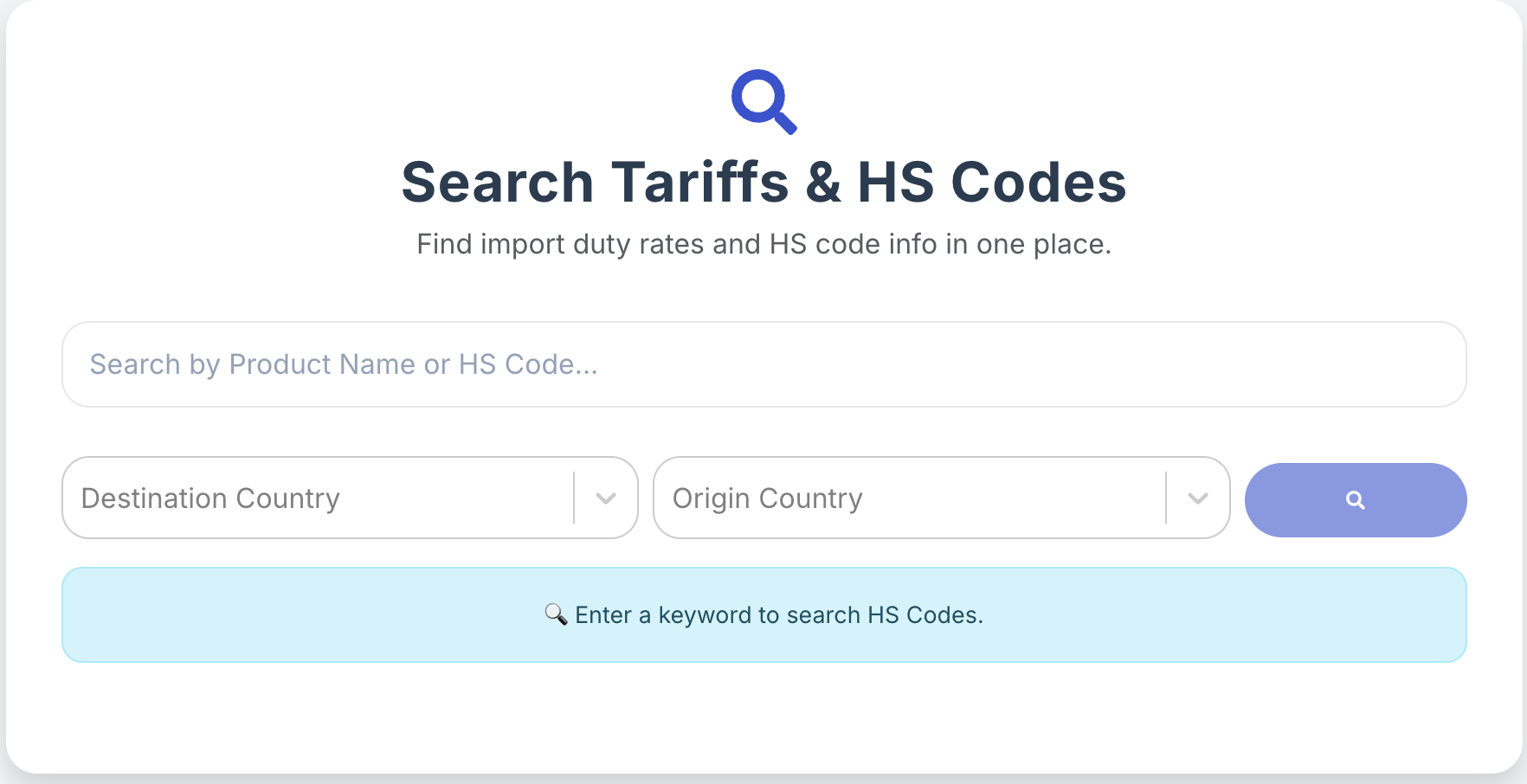

 Sep 10, 2026

