


 Apr 23,2026
  By Alice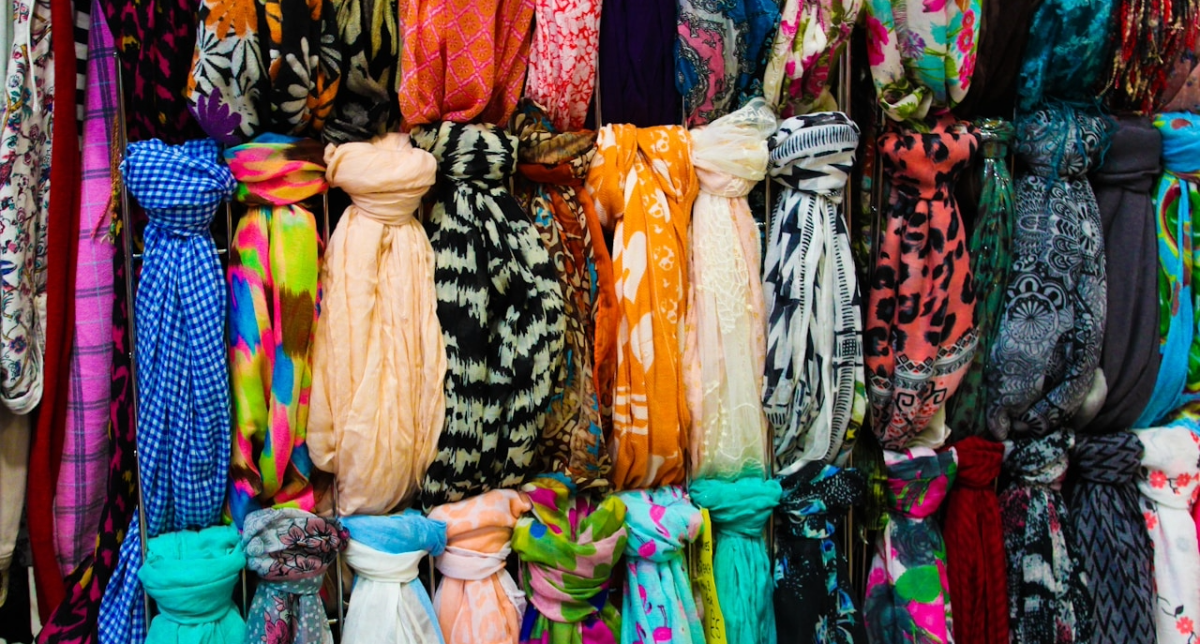
A scarf is not just a fashion statement. Along the way, it has become an essential element of clothing. It provides extra warmth and is even deemed a symbol of faith. Instead of merely accessories, scarves with their many types and models are transformed into a whole new commodity that is often traded separately from common main clothing elements such as shirts and trousers. Are you interested in trading scarves in the future? Let’s examine the potential and facts around scarves. Start with an HS code for a scarf.
What is the meaning of scarf exactly?
A scarf is generally a term to describe a long and broad fabric that is designed as an accessory or additional clothing. It is often worn in winter to provide extra warmth by putting it around your neck and tucking it inside the coat. However, as time goes by, the scarf’s function is not limited to essential warmth provision. It could be a fashion statement (finishing touch in your outfit, an accessory for your bag) or a symbol of faith and culture (such as veils for Catholic nuns, hijab among muslim women, keffiyeh in Arab countries,kabney in Bhutan, gele or headscarf commonly worn in African countries, etc.).
Types of Scarf
Not limited to one shape and style, there are, in fact, a handful of types of scarves. Here are the most popular scarves you can potentially find in the market.
| Types of scarves | Description |
| Twilly | Types of scarves that have similarities with a handkerchief, but are longer and bigger. It is often worn as an accessory for the neck to add color and an aesthetic look. |
| Snood | A snood is a circular scarf that was designed to give extra protection for the neck. It is commonly made with elastic material, as you need to pull it over your head to wear it. It is practical for sports and outdoor activities. |
| Pashmina | Pashmina is a broad rectangular scarf designed to cover the head and hair. It is a common clothing code in several countries and cultures. |
| Hijab or veil | Hijab and veil is a headscarf that specifically function as a religious clothing code. It has particular cuts that allow them to be worn instantly or customly styled. Unlike pashmina, which is loose, hijab and veil are generally fitted and have better hair coverage. |
| Gele or turban | A turban is a type of headwrap that covers hair in a fitted way. The difference between a turban and a hijab/veil is it does not provide coverage for the neck. |
| Shawl | A shawl is a long, narrow fabric that is specifically intended to be used around your neck. It is commonly known as winter clothes as it provides extra warmth. |
| Keffiyeh | A keffiyeh is a broad square fabric with a unique pattern, which is worn around the head and neck to provide extra protection from UV and dust. It is mostly found in countries with a desert climate (arid and hot). |
List of the HS codes for scarf
The classification above leans towards general fashion knowledge. In order to trade scarves as professionals, you need to understand the World Customs Organization classification system instead. Scarf is, fortunately, mentioned in the literal meaning in Chapter 62 of their document. If you look closely at the heading 62.14, they actually mentioned several types of scarves, such as “shawls, scarves, mufflers, mantillas, veils, and the like”. WCO then classifies them further based on the materials. Here are the HS codes for scarves you need to know.
| HS code | Materials |
| 6214.10 | Silk or silk waste |
| 6214.20 | Wool or fine animal hair |
| 6214.30 | Synthetic fibres |
| 6214.40 | Artificial fibres |
| 6214.90 | Other textile materials |
Another important note on the WCO classification system of the scarves is the size. Scarves, according to them, are square or approximately square fabrics with any side exceeding 60 cm. If your scarves have no side exceeding 60 cm, they are to be classified as handkerchiefs instead (HS code 62.13).
There is also a possibility that your scarves may fall under a different HS code. This case is common for crocheted or knitted scarves. If you are trading crocheted scarves, you need to use HS code 611710.
Biggest Actors in Scarf Trade
If you are planning to trade scarves, you may use this export and import data from UN Comtrade to see the big picture. The table below shows the biggest exporters of scarves and the like made of silk (HS code for scarves 621410).
| Countries | Trade Export Value (USD) |
| France | 322,737,226 |
| Italy | 164,257,414 |
| India | 48,889,287 |
| China | 47,974,178 |
| Tunisia | 28,356,00 |
Source: UN Comtrade 2024, accessed on 5 April 2026
Meanwhile, these are the biggest consumers or importers of the same commodity (HS code for scarf 621410). The two largest importers are France and the United States.
| Countries | Trade Import Value (USD) |
| France | 89,016,445 |
| United States of America | 80,643,858 |
| China | 75,491,111 |
| Japan | 54,045,422 |
| Hong Kong | 52,898,851 |
Source: UN Comtrade 2024, accessed on 5 April 2026
Those tables are merely small details in the scarf trade, which only focus on silk. In fact, scarves are versatile commodities that can be made from various materials, including lightweight and affordable ones such as wools, cottons, and even polyester.
How to Find HS Code for Scarf
Finding the HS code for a scarf indeed needs a meticulous process. No wonder all international actors need to double-check to guarantee the accuracy of the HS code for the scarf. Now, HSCodeMatch can help you to find the accurate HS code for a scarf instantly. The following step-by-step will guide you to find the right HS code using HSCodeMatch. For example, we can use the trade route of shawls between France and Japan.
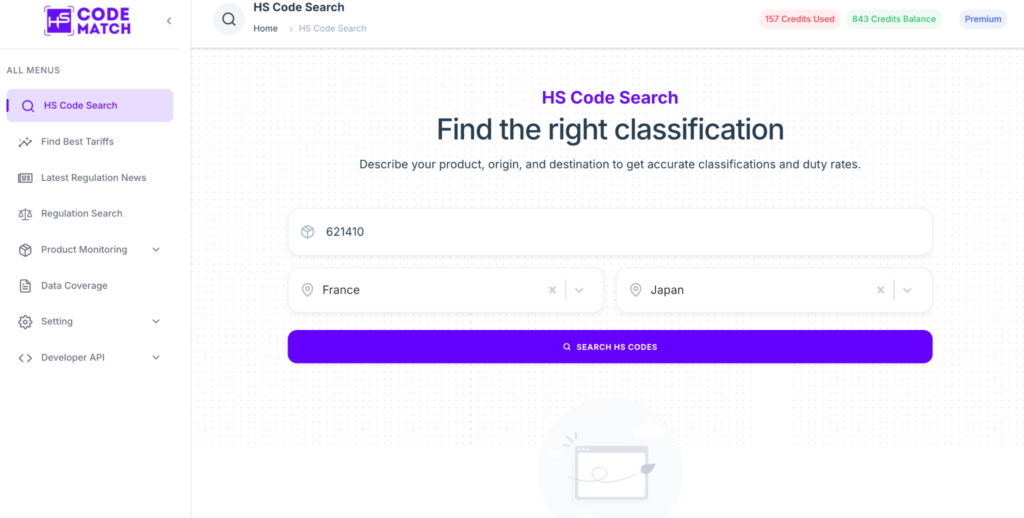
- Step 1: Proceed to the HSCodeMatch homepage by accessing the link hscodematch.com. Then, click Go to App on the right-hand side of the HSCodeMatch homepage. Choose the HS Code Search tool, and set the product name, “shawl” or HS code numbers, as well as the destination, “Japan”, and origin country, “France”.
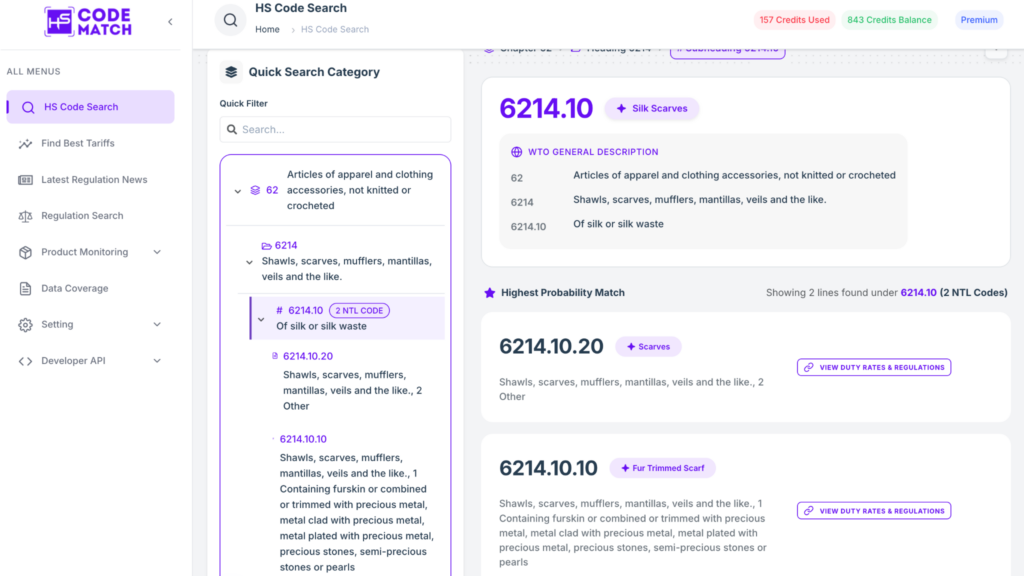
- Step 2: After submitting, the system will automatically show several HS codes for scarves. Then, choose the most relevant HS code with a higher probability or the number in the first row. Click ViewDetails for HS code number 611410200.
- Step 3: On the HS Code Details page, you can find the full description of HS code 621410200 for scarves in Japan. Also, there is an explanation about the import duty rate 8% under the non-preferential regime, or Most Favoured Nation (MFN), and 0% under the preferential tariff regime.
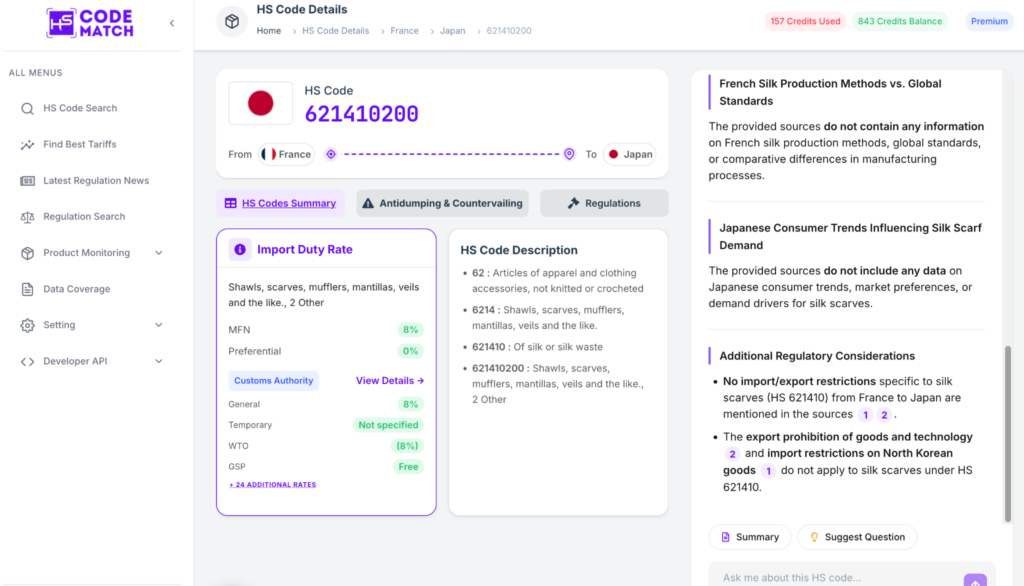
- Step 4: To get more information related to tariff rate and regulations, scroll to the lower part of the HS Code Details page. If you encounter any confusion in finding the specific information, you can directly ask the AI Assistant on the right side of the page.
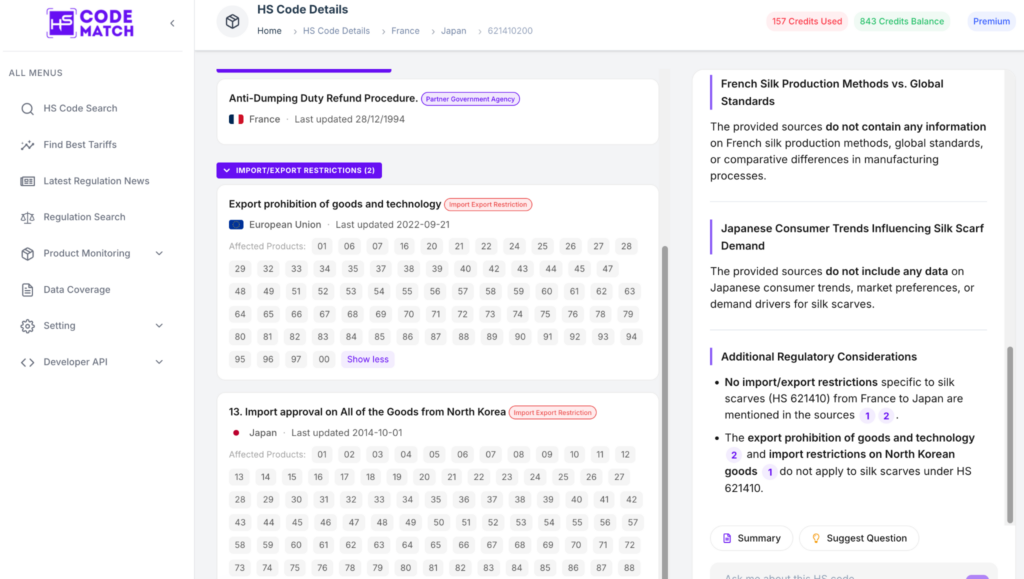
For the explanation of the AI Assistant on HSCodeMatch, we will provide three questions and answers regarding the exportation of scarves under the HS code from France to Japan.
What is the additional tariff rate for exporting scarves under HS code 621410200 from France to Japan?
There is no additional tariff rate for exporting scarves under HS code 621410200 from France to Japan. The tariff rate is 0% based on the EU-Japan Economic Partnership Agreement (EPA). However, if the scarf is not eligible for the agreement between the EU and Japan, the products will be subject to the MFN rate of 8%. But you do not need to worry that France is benefiting at a preferential rate for exporting these products to Japan. Here is the list of the tariff rates for exporting scarves from the EU to Japan.
| Tariff | Rate | Applicable Condition |
| Preferential tariff rate under the EU-Japan FTA | 0% | EU origin and must comply with the EU-Japan FTA |
| MFN (non-preferential) tariff | 8% | Standard MFN |
What are the rules of origin requirements for scarves under the EU-Japan FTA?
The rule of origin is a requirement to be eligible for scarves from France to obtain the EU-Japan FTA. The most important requirement for obtaining the rule of origin is wholly obtained or substantially transformed. If the textile products, including scarves, are not from the exporter country, then it must undergo tariff clarification change or meet some processing requirements. In addition, there is a value-added rule to know the degree of non-originating materials within the products. Here is the specific requirement for obtaining rules of origin under the EU-Japan FTA.
| Origin Requirement | Condition |
| Wholly Obtained | The products are entirely produced or assembled in the EU countries or Japan without materials from other countries. |
| Substantial Transformation | Non-originating products from the EU and Japan must transform tariff classification |
| Value-Added Rule | The rule for the maximum value of non-originating materials within the products |
| Products Specific Rule | Scarves are required to meet those conditions to be eligible to obtain the preferential tariff. |
What documentation is required to prove origin for scarves under the EU-Japan FTA?
The primary document as evidence of country of origin under the EU-Japan FTA is the EUR.1 movement certificate. It is also called the origin declaration on an invoice. Please note that shipping products under €6,000 or less needs to be issued by the exporters. On the other hand, if the shipping exceeds the threshold, then it requires exporter status approval or an EUR.1 certificate. There are alternatives to the proof or origins other than the EUR.1 certificate and origin declaration under the EU-Japan FTA, as follows:
- Importer’s knowledge: This document needs to be accompanied by the products if the products are less than €6,000. Importers might claim a preference based on the document’s knowledge or origin.
- Approved exporter system: Exporters with an approval status can publish the declaration without an EUR.1 certificate. This can be approved even for high-value products.
- Long-term supplier declarations: The suppliers can provide a declaration for multiple consignments for more than 2 years.
- Customs verification: This document is only required if there is a dispute regarding the origin of products. The local authorities in Japan probably require the importers to provide additional evidence, such as manufacturing records or invoices from suppliers.
Conclusion
A scarf is one of the most versatile commodities in the fashion industry. The most striking features of a scarf are its size and functions. They are much smaller than regular clothes, but significant in their functions. Whether providing extra protections for skins or becoming a symbol of particular faiths and cultures. HS code for a scarf generally falls under heading 6214. In order to get two more required digits, you only need to identify the key materials. However, if your scarf is crocheted, your HS code is 6117.10 instead.
Frequently Asked Questions (FAQ) about HS Code for Scarf
1. What is the national standard HS code for scarves in Japan?
The national standard HS code for exporting scarves in Japan is 621410200. This code applies based on the regulation in Japan as an extension of the universal HS code administered by the WCO.
2. What is the fastest way to find the HS code for a scarf?
The fastest way to get the right HS code for scarves is to classify them based on the main materials. WCO mentioned several specific materials, such as silk and wool, within their document, but also helps you identify products more easily by giving options of synthetic, artificial, and other materials they do not specifically mention, including cotton.
3. What is the difference between knitted and woven scarves?
Knitting means you make the fabric or scarf by interlocking yarns. Meanwhile, woven fabric or a scarf means you make them with a loom machine that weaves the threads together. In the trade sector, this difference is an important classifier for your textile products, including scarves.
4. How do you classify scarves that are made of mixed materials?
Generally, you classify them based on the dominant materials, but if the composition is 50:50, the product is classified under the heading that positions last in numerical order.
5. Does embellishment affect the HS code for a scarf? For instance, a crocheted scarf with beads.
There is nothing to be worried about if your scarf has an embellishment. The HS code for the scarf remains intact with the dominant material, which is fabric or thread.
Find and Match the Right HS Code for Your Products.
Try Our App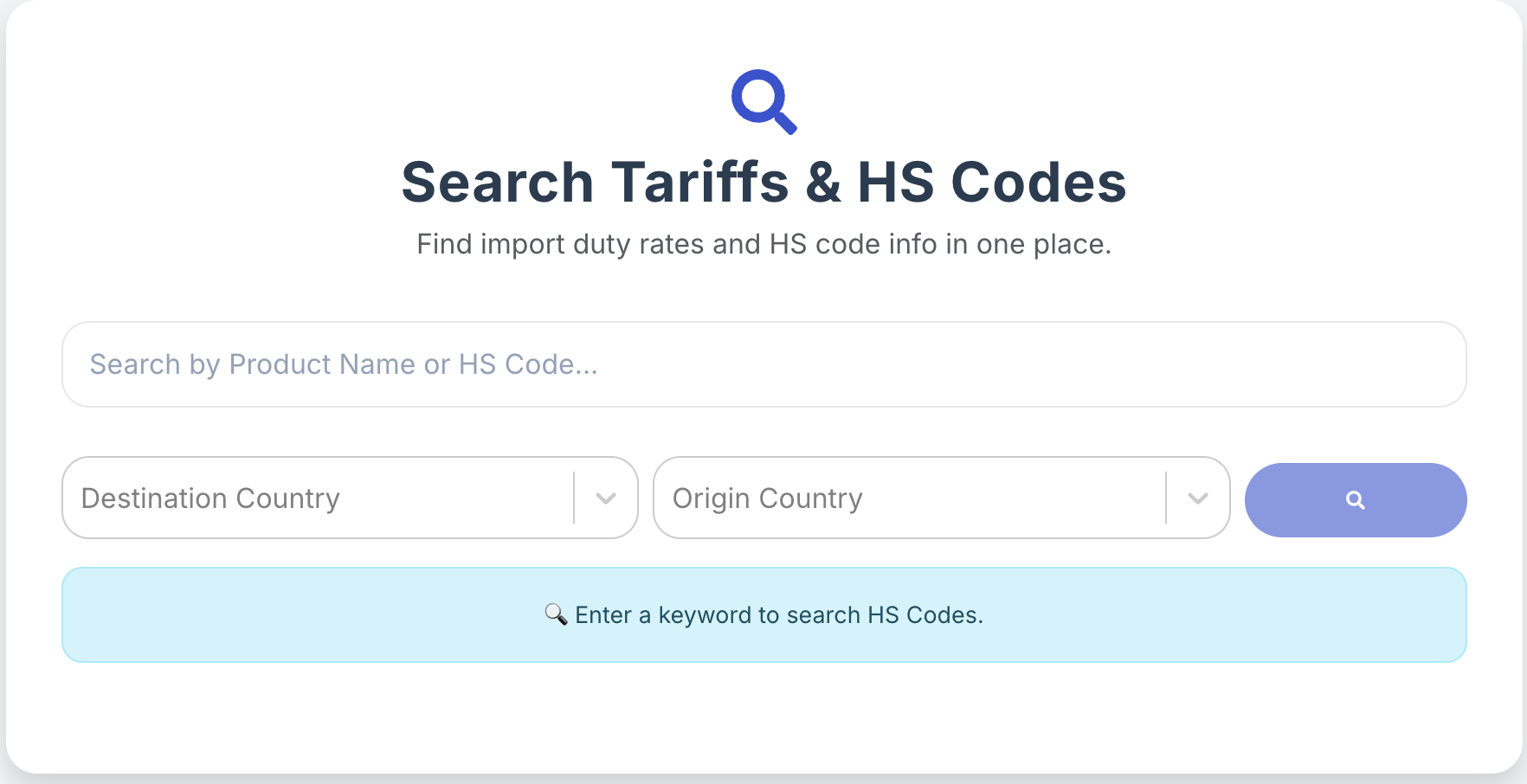

 Sep 10, 2026

