

 Sep 22,2026
  By Alice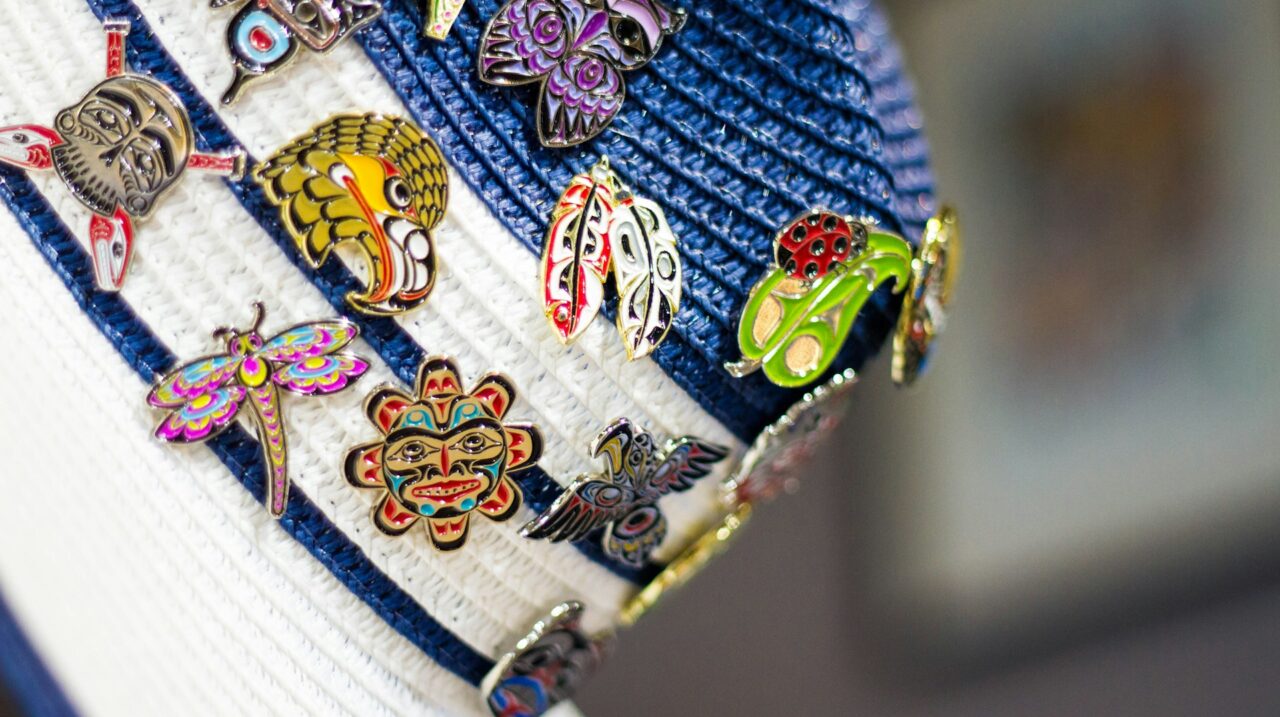
Hobby-related businesses are now one of the favorable sectors to get involved with. Encouraged by the economic recession, many young people resort to “doom spending” behavior, which leaves them with no restraint over their desire to spend money on stuff they do not really need, rather than saving for the future. Enamel pins are one of those little things that people might mindlessly spend their money on, and if you think you can be part of this business, scroll ahead to learn more. We will talk about the HS code for enamel pins and a global trade overview so far.
What is an Enamel Pin?
An enamel pin is basically a metal accessory that is filled with colored enamel to make it look more aesthetic and personalized. These days, you can basically make an enamel pin from any digital design with various sizes and shapes. Generally, enamel pins are about the size of coins, approximately 1–1.25 inches or 25–32 mm, but you can also order medium or large sizes (38–50mm).
Enamel pins are often sold as collectibles. Both big brands and independent illustrators see enamel pins as a strategic product, as they are wearable, ideal for campaigns or promotion, and most importantly affordable to mass-produce. Among Gen Z, enamel pins are often deemed identity signals and community belonging, rather than just aesthetic. Enamel pins can be divided into two categories based on quality.
| Type of enamel pins | Characters |
| Soft enamel | Budget-friendly as it requires fewer production steps. Made with no additional coating that gives you a tactile or textured feel. An optional epoxy coating is available with an additional fee. |
| Hard enamel | Offers better durability and smoother/even surface compared.It has a premium look, often deemed as jewelry-grade. |
Other than that, enamel pins are also categorized by their base materials. They are commonly made of iron or zinc alloy, but copper, stainless steel, and aluminum can also be part of the options. In order to create a unique look, additional finishing can also be applied, such as color dye, electrochemical anodizing, matte plating, antique plating, etc.
How to Classify Enamel Pins
As you learn the types, make sure you also learn how to classify enamel pins based on the Harmonized System of the World Customs Organization (WCO). This will be useful to scale up your business, whether you export the products or outsource the production process abroad. According to the characteristics of the enamel pin, you can classify it as imitation jewelry. This means you need to open Chapter 71 and go to heading 7117, then subheading 711719. This HS code mentions general imitation jewelry made with a metal base (plated or not plated with precious metal). There is no additional detail that needs your attention. However, you may need to check the list of HS codes below and decide the most accurate HS code based on your product’s function.
| HS code | Products |
| 711719 | Imitation jewelry with metal based other than cuff-links or studs |
| 831000 | Base metal sign-plates, name-plates, address plates and other similar plates with numbers, letters, or symbols |
| 961519 | Hairpins, curling pins, made of other materials that are not rubber or plastic |
Global Trade Overview of Enamel Pins
After learning the HS code for enamel pins, it is time to take a look at the global trade overview of this product. Using the HS code for enamel pins, 7117.19, you can get the list of top exporters and importers from any year. Let’s check the trade overview of enamel pins in 2025.
| Exporting Countries | Trade Value (millions USD) |
| China | 2,667.28 |
| France | 702.41 |
| Italy | 454.05 |
| Hong Kong | 420.2 |
| Germany | 404.24 |
Source: ITC Trade Map 2025, accessed 2nd September 2026
| Importing Countries | Trade Value (millions USD) |
| United States of America | 548.03 |
| France | 469.28 |
| Germany | 410.71 |
| Japan | 284.39 |
| China | 264.87 |
Source: ITC Trade Map 2025, accessed 2nd September 2026
As you can see above, China is marked as the largest exporter of imitation jewelry, including enamel pins. It is interesting to see France and Italy in that list, as this can indicate that the home base of luxury brands might also see imitation jewelry as a lucrative business. Germany might as well be on that list for their status as one of the world’s manufacturing giants.
There is not much surprise in importing countries. The USA is still dominating the market, but it is interesting to see Japan in the list. This might be related to their manga and anime culture, which builds a market for collectibles, including enamel pins.
How to find HS code for enamel pin
From the information above, we have found the largest exporters and importers of enamel pins. Now, it is time to learn how to find the HS code for enamel pins quickly. As we know, the classification of the HS code for enamel pins is critical and cannot be neglected. If you misclassify the HS code for enamel pins, it will impact your export and import process.
That is why we will give you a tutorial to classify the HS code for enamel pins without a complicated process by using the HSCodeMatch app. Let’s check the step-by-step process to classify an accurate HS code for enamel pins below.
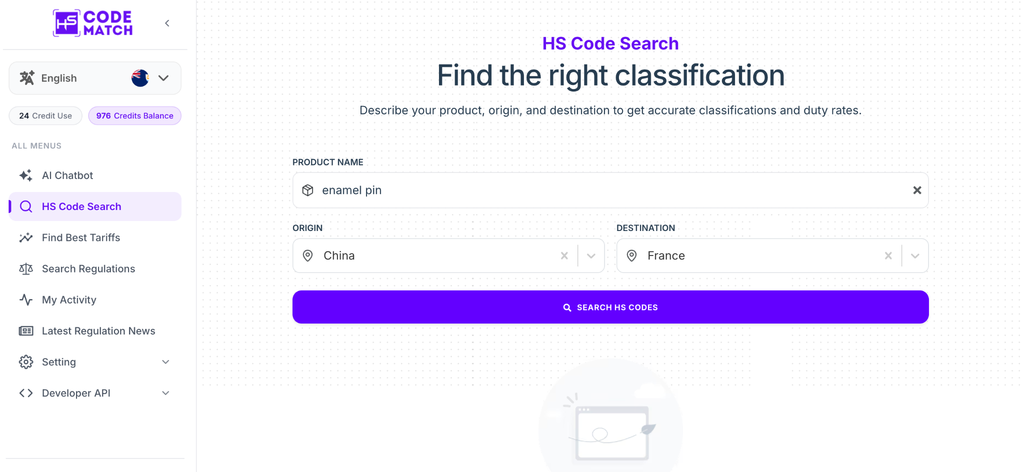
Step 1: Set the appropriate search criteria on HS Code Search
Open app.hscodematch.com to access the HSCodeMatch app and choose HS Code Search to find the HS code for an enamel pin. In this example, we can choose the trade lanes between China and France.
Step 2: Find the best-match HS code for an enamel pin
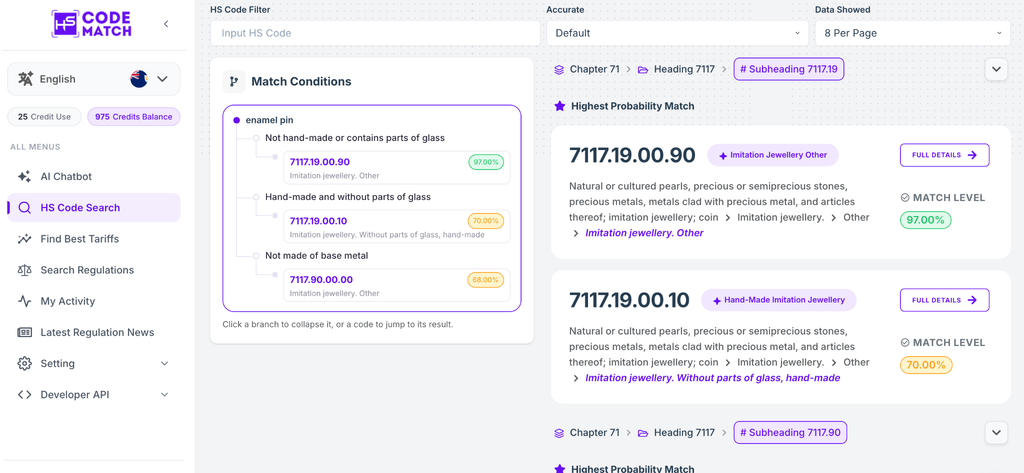
Once you submit the criteria, wait till it responds and click Full Details for the most relevant HS code. In these results, we can choose HS code 7117.19.00.90 in France.
Step 3: Check the tariffs and regulations
In HS Code Details, you are allowed to check and find out the applicable tariffs and regulations for exporting enamel pins from China to France.
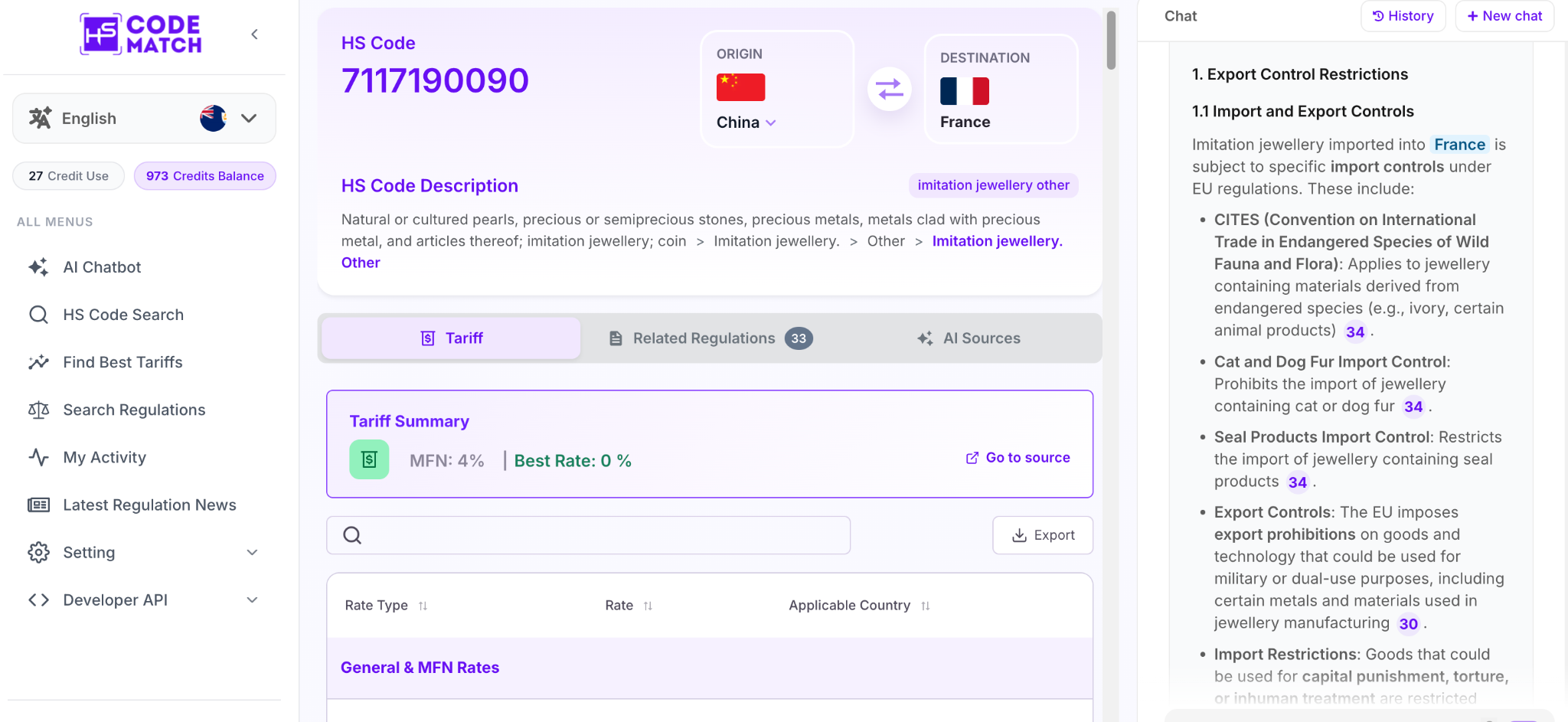
Step 4: Ask AI Chatbot Assistant to search tariffs and regulations
If you find any hindrance in searching tariffs and regulations, just ask the AI Chatbot Assistant. You are allowed to ask anything to our AI Chatbot Assistant regarding the exportation of enamel pins from China to France.
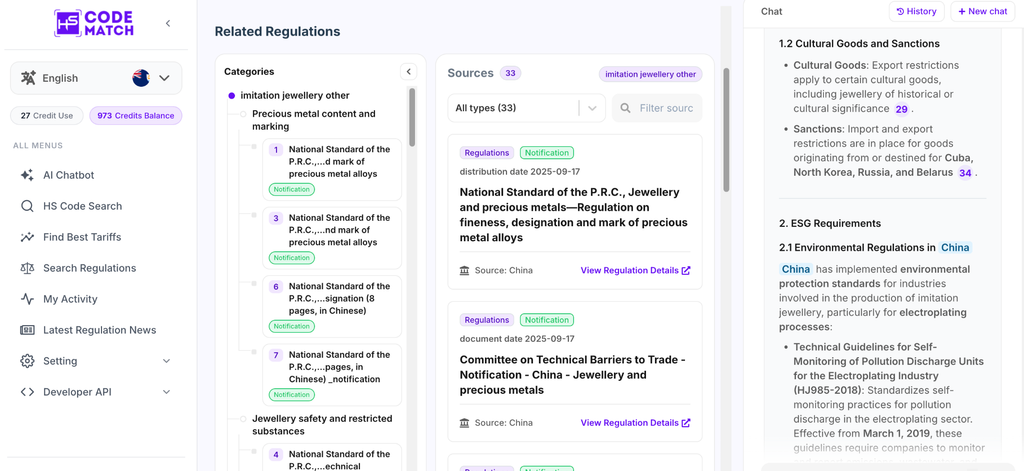
To show you how the AI Chatbot works, we will give you three examples of questions and answers on exporting enamel pins from China to France below.
What is the tariff rate for exporting enamel pins under HS code 7117190090 from China to France?
In order to export enamel pins under HS code 7117190090 from China to France is following MFN regime applies, which is a 4% duty rate. There are some applicable tariff rates for exporting enamel pins to France and the EU; you can see below:
| Type of Tariff | Duty Rate | Applicable Countries |
| Third Country Duty (MFN) | 4% | All countries, excluding Cuba, Russia, Belarus, and North Korea |
| Low Value Consignment Duty | 3.00 EUR | For shipments below 150 EUR (All countries, excluding Cuba, Russia, Belarus, and North Korea) |
| Preferential Duty (GSP-EBA) | 0% | Least developed countries |
| Preferential Duty (GSP+) | 0% | Countries under GSP+ incentive |
What is the labeling requirement for exporting enamel pins from China to France?
In order to export enamel pins or jewelry from China to France or the EU in general, there are labeling requirements you must follow. Check the following table to see the details of EU and France consumer protection regulations below.
| Requirement | Details |
| Material Composition | Primary materials must be labeled on the products. Must comply with textile fiber composition labeling if the products contain at least 80% textile fiber by weight. Precious metals must be labeled with the proportion of metal alloy. Enamel pins with plating materials must be disclosed |
| Language | All labeling information of the enamel pin must be in French |
| Price Display | Price of the products must be displayed accordingly |
| Gemstones and Pearls | Enamel pins with gemstones or pearls and the must be labeled with the description of those elements. |
| CE Marking | If the products fall under EU harmonized legislation, then they must be labeled with a CE marking to ensure compliance with EU standards |
What are the testing for exporting enamel pins under HS code 7117190090 from China to France?
To export enamel pins from China to France, you must submit the testing requirements following the standards in France and the EU. This is an overview of testing requirements in the EU.
| Testing | Applicable Standard | Requirements |
| Hazardous Substance Testing | REACH Regulation No. 1907/2006, EU Regulation on Cadmium in Jewelry | Testing for cadmium, lead, nickel, and other restricted substances |
| Electroplating Process Testing | China’s Technical Guidelines for Electroplating Industry | Test wastewater, waste gas, and solid waste for compliance with environmental standards |
| Safety Testing | General Product Safety Directive (2001/95/EC), EN 71-3 (Safety of Toys) | Test for small parts, sharp edges, and choking hazards |
| CE Marking Testing | REACH, RoHS, General Product Safety Directive | Test for compliance with EU harmonized legislation |
| Material Composition Testing | Regulation (EU) No 1007/2011 for Textile FIber Labeling | Test for textile fiber content (if applicable) |
Conclusion
Based on their function, enamel pins are commonly classified as imitation jewelry with a metal base. Therefore, the HS code for enamel pins is 711719, no matter what kind of metal you use as the base. However, if you make enamel pins for other purposes, for example, name plates or hairpins, you may classify them under other subheadings such as 831000 and 961519.
Frequently Asked Questions (FAQs): HS Code for enamel pin
1. Why are enamel pins classified as imitation jewelry?
This classification is determined by their main function. Unlike name plates or hairpins, enamel pins are mostly used as accessories or decoration. They are also wearable, and this makes them most similar to jewelry. However, they are not as valued as jewelry, as they are mostly made of an inexpensive metal base rather than precious metals or stones. Enamel pins are also mass-produced items rather than exclusive or luxurious ones.
2. Is there any exception that allows enamel pins to be classified as luxurious jewelry?
Yes, several luxury brands released enamel pins, and they are mostly produced as seasonal products, which adds exclusiveness to it. If those enamel pins are made of genuine precious metals, they may be classified as jewelry rather than imitation ones.
3. Is there any difference between HS code for soft and hard enamel pins?
No, there should be no difference. Both soft and hard enamel pins share the same HS code, as there is no further detailed category mentioned in the WCO document. Even the base materials do not affect the HS code for enamel pins, unless the base is made of certain genuine valuable metals.
4. What is the national HS code for enamel pins in France?
The national variation of the HS code for enamel pin pearls, precious, semiprecious stones, and other stones in France is 7117.19.00.90. This HS code is derived from the 6-digit universal HS code made by the WCO.
5. What is the tariff rate for exporting enamel pins from China to France?
Exporting enamel pins from China to France follows the Most Favored Nation (MFN) regime in France and the EU. The applicable tariff rate is 4% and there is no preferential tariff rate to reduce the duty rate for these products.
Find and Match the Right HS Code for Your Products.
Try Our App