


 Apr 14,2026
  By Alice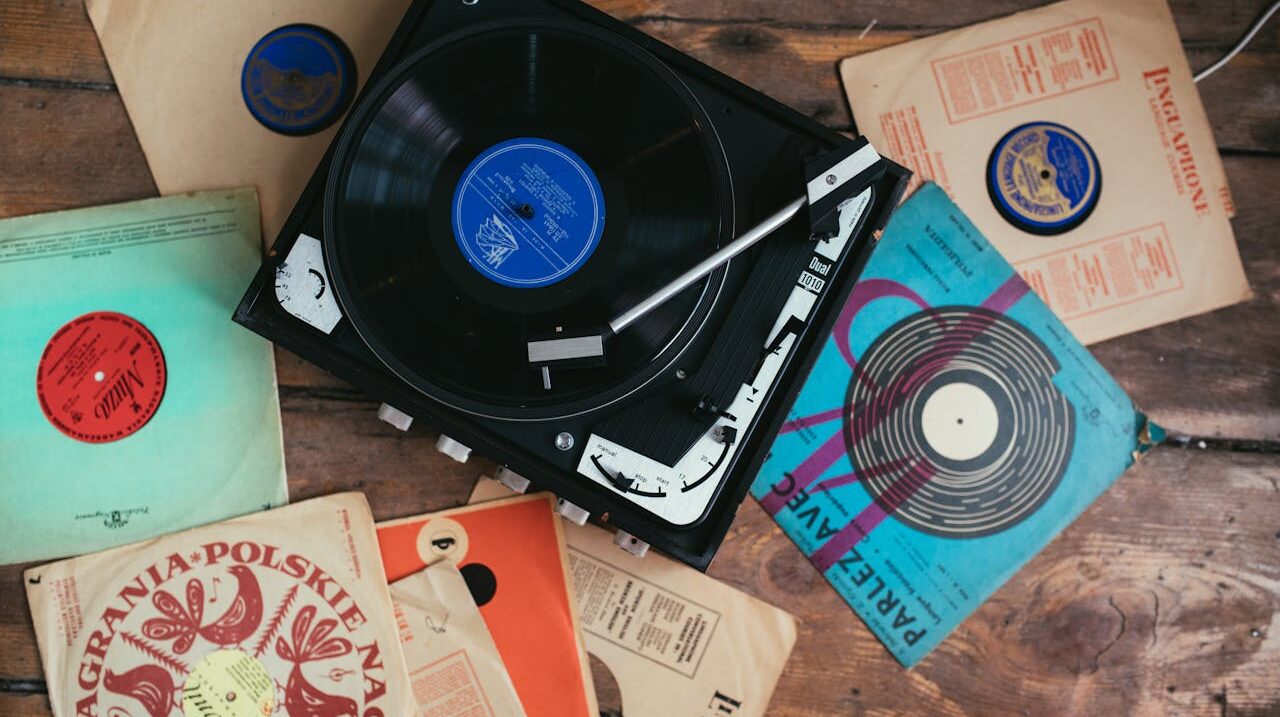
Vinyl records experienced surging sales these past few years. It might sound contradictory to the so-called digital era, where streaming services thrive and dominate music distribution. Observers pointed out the digital fatigue as the culprit, particularly since they introduced and imposed a subscription system. This profit-oriented system uproots consumers’ right to own things and creates long-term dependency. Owning physical media such as vinyl records or CDs, and DVDs now becomes an act of resistance. Looking at this pattern, do you think it is the best time to trade vinyl records? If you think so, let’s sail into the world of HS codes, surely the HS code for vinyl records.
What is the meaning of a vinyl record?
A vinyl record is also known as a phonograph record. It is a type of analog sound storage made from a polyvinyl chloride (PVC) sheet. It was first found in the 1920s, replacing older sound storage materials such as zinc and glass. Yet, it was not until the late 1940s that Columbia Records introduced the first vinyl record and started a new trend.
There are several recurrent types of vinyl records in the market. The first one to be developed is Long Play (LP). These vinyl records are 12 inches in diameter and can store up to 20 minutes of audio per side. You can also find other sizes of vinyl records, such as 7 inches (Single) and 10 inches (EP). As they are smaller in size, the amount of audio storage is also shorter. The 7-inch disc is usually made to store one song or single. Meanwhile, a 10-inch vinyl record is ideal for a mini album or Extended Play (EP) with 8 minutes duration per side.
In order to gain sales, marketers introduced several additional features on the vinyl record surfaces, such as pictures, colors, or even particular shapes. This type of vinyl is targeting collectors and superfans who crave special editions.
Cassettes, CDs, and streaming platforms kick in
After enjoying decades of domination, vinyl records had rivals in the 1960s. Record labels introduced cheaper and simpler alternatives for music fans. Cassettes were the first option for hearing music. It is smaller in size and more affordable. Unlike vinyl records that required specific devices such as a phonograph and a turntable, cassettes can be played in a more advanced electronic player, which often merged with conventional radio. It is called radio tape, and for decades, it became the norm in everyone’s households.
When CDs hit the market, record producers started to merge CD players with their radio tapes. This combination made cassettes and CDs the most common formats for listening to music. However, in the late 1990s, digital disruption began. Computers, software, and the internet were introduced to the public and experienced surging popularity. At that phase, we witnessed the birth of MP3. Instead of using devices, we can convert audio recordings into digital files and share them seamlessly via USB drives or online links. Instead of buying physical media, we were lulled by the convenience of digital music subscription platforms. When CDs were still thriving in the 2000s, people started to forget vinyl records. In the 2010s, all physical media had to compete with streaming platforms that offer cheap, even free (with ads) ways to listen to music legally.
Vinyl records revival in the 2020s
The anomaly began in the mid-2020s. People start to appreciate the joy of listening to music through physical media. One of the biggest reasons is the sound quality. CDs offer the best sound quality as they provide clear and crisp sound compared to streaming platforms and vinyl records. Yet, vinyl was claimed by its fans to have a richer sound effect that creates a “warmth” impression. This is similar to analog cameras in films, which allow audiences to see richer colors and textures (grain) compared to those made by modern digital cameras.
Digital fatigue also plays a part in the vinyl records revival. Digital fatigue is a state of exhaustion caused by overconsumption and overstimulation of digital media subscription platforms. Instead of liberating, we find ourselves getting more and more dependent on algorithms and subscriptions, which lead to unfulfilling feelings. Instead of feeling contempt for what we have, streaming services encourage us to explore unlimited options until we do not know what we need anymore and fall to the trap of algorithms.
As a rebellion, many people start to resort back to physical media, including vinyl records. This trend is mostly visible in developed countries in Europe as well as in the United States. This probably factored from the fact that they have a bigger income surplus compared to other regions. Therefore, collecting physical media such as vinyl records has become a new beloved entertainment.
Musicians and record labels know this for sure. Taylor Swift is one of the perfect examples. She takes advantage of her loyal fans’ enthusiasm by releasing 8 variants of vinyl records for her latest album, The Last of a Showgirl (2025). There is not much difference in audio content, but people can use it as a collectible. Swift provides a different set of cover albums and LP vinyl colors, along with unseen photos, posters, and handwritten poems. Swift surely is not the only musician who sees vinyl record sales as an income source.
In the past, album sales provided a big percentage of their net income, now they rely more on concert tickets. In the midst of those crises led by the streaming services’ low rate per play, musicians started to resort to physical media to at least get a proper income.
Thrifting vinyl records
Are you also interested in trading vinyl records? Other than hunting for newly produced vinyl records, many collectors do thrifting. This is because vinyl records are usually produced in limited amounts. Many musicians in the past stopped producing their old records and focus on remastering their work for digital platforms. For collectors and vinyl record fans, thrifting becomes the only access to their desired, relatively rare albums. This may lead to fierce bidding.
List of HS codes for vinyl records
To start trading vinyl records, it is important to note the HS code first. According to the World Customs Organization (WCO), any sound recorders and reproducers fall under Chapter 85. In particular, for discs, tapes, solid-state non-volatile storage devices (other than photographic and cinematographic goods) please check HS code 8523.
There, you can use the last code, which classifies other storage devices that are not magnetic, optical, or semiconductor. Thus, the vinyl record HS code is 852380. However, vinyl records are usually packed inside a paper jacket. This may lead you to also include HS code 481950, which classifies other packing containers, including record sleeves.
| Products | HS code |
| Vinyl plates or discs (any size) | 852380 |
| Record sleeves | 481950 |
| Raw materials of vinyl records (sheets of polymers of vinyl chloride or PVC) | 392049 |
The top 5 largest vinyl record exporters and importers
Not only the HS code, but we also need to know the trade route of vinyl records in the world. This is important to ensure your comprehension of vinyl records in international trade. The table below shows the biggest vinyl record exporting countries under HS code 852380 in 2024 from the UN Comtrade Database.
| Country | Total Export Value (USD) |
| Germany | 187,869,259 |
| United States | 173,092,705 |
| Netherlands | 164,567,072 |
| France | 138,810,632 |
| Czech Republic | 126,163,112 |
Source: UN Comtrade Database, retrieved March 18, 2026
As the data shown above, Germany is the largest exporter of vinyl records with an amount of more than 187 million USD in 2024. The second biggest exporter is the United States with a total value of more than 173 million USD. The remaining primary exporters of vinyl records are dominated by European countries, including the Netherlands, France, and the Czech Republic. All of the largest exporters are from the developed countries, which are known for their advanced technological infrastructure and industry.
| Country | Total Import Value (USD) |
| India | 382,501,923 |
| United States | 271,419,393 |
| United Kingdom | 154,637,053 |
| Germany | 118,596,593 |
| France | 109,724,289 |
Source: UN Comtrade Database, retrieved March 18, 2026
From the table, we can see that India is the primary importer of vinyl records with a total value of more than 382 million USD in 2024. It is followed by the United States in the second position with a total amount of imports of more than 271 million USD. The other biggest buyers of vinyl records in the world are the United Kingdom, Germany, and France.
How to Find HS Code for Vinyl Records
Finding the right HS code is essential for transferring goods across borders. An inaccurate HS code declaration prevents you from exporting products to another country, and penalties may apply in the destination country. To save time finding the correct HS code for vinyl products or other goods, HSCodeMatch appears to help. Here is the step-by-step instruction to find and match HS codes using HSCodeMatch.
- First step: Open the HSCodeMatch website by accessing hscodematch.com. Then, click the Go to App option on the right-hand side of the HSCodeMatch page. Then choose the HS Code Search tool and set the product’s name or HS code (if you already know it), as well as origin and destination countries. For this example, we can choose the trade lanes of vinyl records between Germany and India.

- Second step: The HSCodeMatch machine will show the most relevant HS code for vinyl records in the first row. Based on the example, we can choose the products under the HS code or the national code 85238010 for a gramophone record. Make sure you read all of the description to ensure that this is the right HS or national standard code.
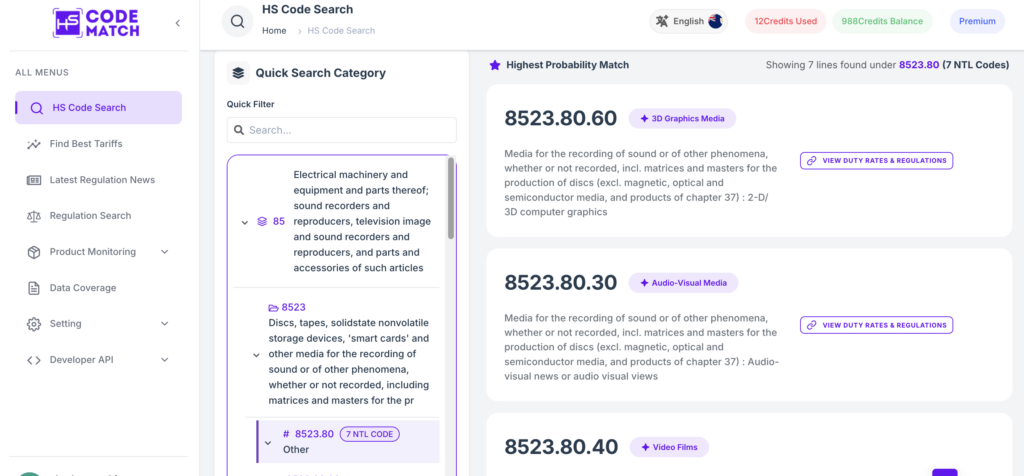
- Third step: Click the HS code number or the View Detail option to look at the full details of the HS code description and tariff rates for exporting vinyl records under HS code 85238010 from Germany to India. In the HS Code Details page, you will find the regulations from the Indian government.
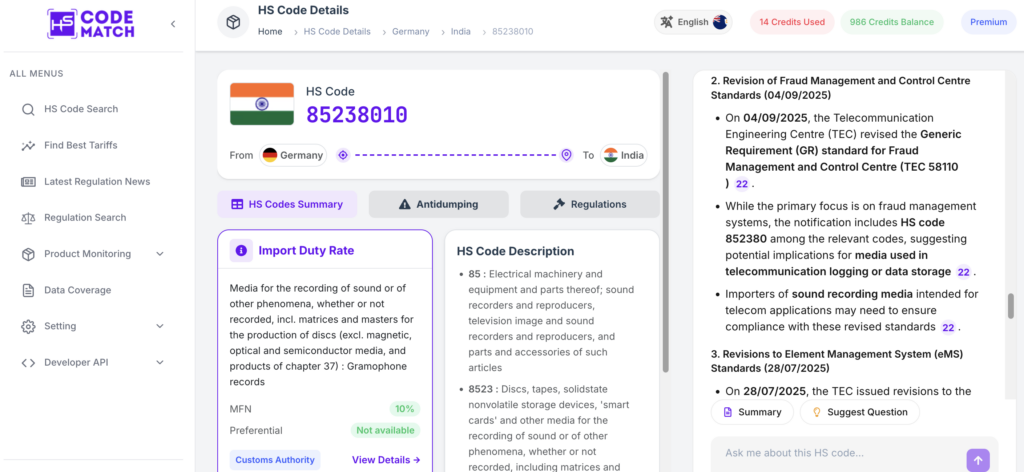
- Fourth step: When you scroll to the lower section of the page, you will find the full list of the latest import regulations in India. If you find any confusion, you are allowed to use the AI Assistant and ask anything related to the exportation of vinyl records from Germany to India.

To help you understand more about the AI Assistant, we provide several examples of questions and answers regarding exporting vinyl records from Germany to India.
What is the tariff rate to export a vinyl record under HS code 85238010 from Germany to India?
In order to export a vinyl record under HS code 85238010 from Germany to India, there is only one tariff rate of 10%. This tariff is based on a non-proliferation regime, also known as Most Favoured Nation (MFN). This rate is aligned with the Indian standard import duty, which mostly implements the MFN if there is no Free Trade Agreement (FTA). Unfortunately, there is no preferential tariff for these products to export to India.
| HS Code | Description | Tariff Rate based on MFN |
| 85238010 | Vinyl Records | 10% |
What documentation is required to export vinyl records from Germany to India?
There are several documents you need to attach before exporting a vinyl record from Germany to India, including a commercial invoice, packing list, bill of lading, certificate of origin, and export declaration, which must be filled out by the German customs authority. On the other hand, vinyl records are included as cultural goods based on the EU export law if they are more than 50 years old. Therefore, you need to obtain an export license from the cultural authority in Germany. Furthermore, you need to follow the labeling requirements specifically for musical media export in India, including the exporters/importers details. HS code, country of origin, and a declaration that this is a fragile product.
| Requirement | Details |
| Documentation | Commercial invoice, packing list, bill of lading/airway bill, certificate of origin, export declaration. |
| Cultural Goods | For the cultural products over 50 years of age or that have a historical value, they require export licenses in the EU. |
| HS/national code in India | 85238090 with the basic tariff rate 10% |
| Labeling requirements | Importer/exporter description, HS code, country of origin, and declaration of fragile products. |
What are the technical regulations for exporting vinyl records from Germany to India?
For exporting the vinyl record from Germany to India, there are two perspectives. From a German perspective, there is no export restriction to transfer these products to other countries, including India. However, if the products are considered as cultural products with historical value, they must obtain a cultural goods export license. From an Indian perspective, vinyl records are included as non-electronic media, which means they are not subject to a regulation called the Compulsory Registration Order (CRO) 2012. As a result, no need to undergo certification from the Bureau of Indian Standards (BIS). Still, the products must comply with the customs rules and labeling requirements under the Indian Customs Act 1962.
Conclusion
A vinyl record is a specific audio storage product that is not difficult to classify. WCO regulated it under Chapter 85. However, as vinyl records are usually shipped with the album jacket, you may also need to check Chapter 48, which regulates paper and paperboard in general. WCO states that the HS code for vinyl records is 852380, but do not forget to attach HS code 481950 for the record sleeves.
Frequently Asked Questions (FAQ) about HS Code for Vinyl Records
1. Are vinyl records still relevant in the digital era?
Yes, vinyl records are still in demand despite the invention of streaming services and simpler forms of physical media (cassettes and CDs). This is due to digital fatigue and the subscription system that leads to growing interest in tactile and screenless experiences. Vinyl records are also claimed to provide much richer sound compared to other formats of audio storage.
2. Do vinyl records have more than one HS code?
Yes, the HS code for vinyl records is 852380, as there is no further detailed specification on size. However, if you want to trade the raw materials of vinyl records, which are plates or sheets of PVC, you may use HS code 392049 instead.
3. What is the most common mistake when classifying vinyl records?
You need to make sure that the vinyl records you intend to export are not blank plates of PVC. It is because blank plates or sheets of PVC, which are the raw material for vinyl discs, are regulated under a different HS code, 392049. Note that the HS code for vinyl records 852380 is specifically made to classify those that store audio data.
4. Is there any specific HS code for used vinyl records?
No, there is no difference between new and used vinyl records based on the HS code from the WCO. There is no further detail classification for vinyl records in general, whether it is the size, colors, or shapes.
5. How to protect vinyl records from damage during shipping?
Vinyl records are fragile as they are thin-shaped and easily bend and break under certain forces. Due to this trait, it is recommended to shippers to add padding, especially when you ship them as a single package instead of bulk. As most record sleeves are made of paper, you can also add a plastic cover to prevent potential water damage during the shipping process
Find and Match the Right HS Code for Your Products.
Try Our App

 Sep 10, 2026

