
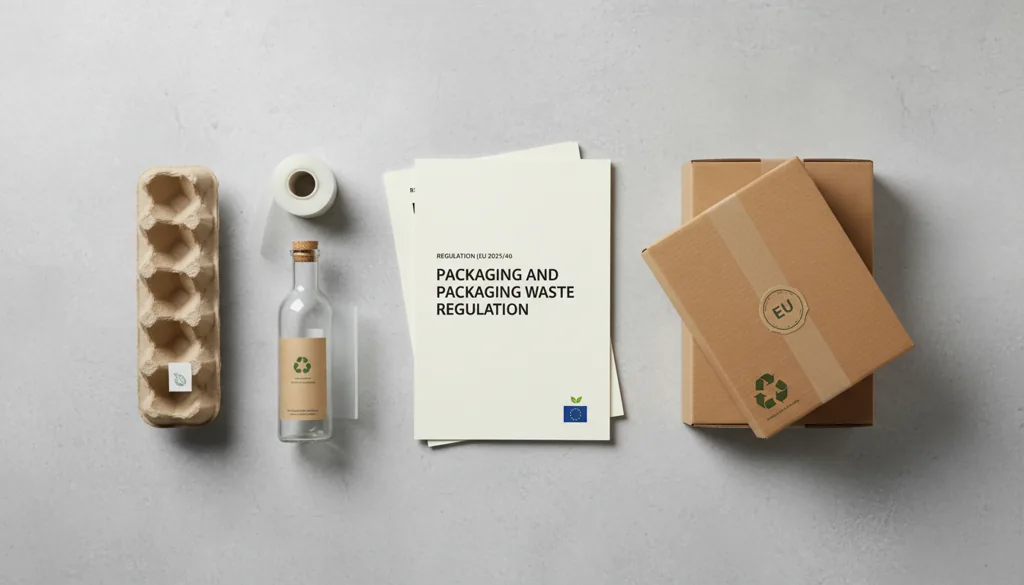
European Union’s new Packaging and Packaging Waste Regulation (Regulation (EU) 2025/40) introduces initial compliance obligations for businesses placing packaged goods on the EU market from August 12, 2026.
The European Union began applying its new Packaging and Packaging Waste Regulation, Regulation (EU) 2025/40, to all packaged goods sold in the bloc from Aug. 12, 20261.
The law entered into force on Feb. 11, 2025, but its first duties only started this August2. More rules will follow in stages until 20401.
In short, every box, wrapper, bottle and pallet wrap that enters the EU market now falls under one EU law. A shipment with packaging that breaks the rules can be refused at the border, and food packaging with too much of the "forever chemicals" called PFAS can no longer be sold.
What does the EU packaging law change from August 2026?
The regulation, known as the PPWR, replaces the 1994 Packaging Directive (Directive 94/62/EC)2. That directive was repealed on 12 August 2026, although some of its provisions still apply after that date2. A directive let each country write its own rules. A regulation applies directly in every EU country.
The European Commission, the EU’s executive body, says the law covers all packaging, whatever its material or origin2. It sets rules for how packaging is made, what it contains, and whether it can be reused or recycled. It also covers how packaging waste is collected and handled.
Packaging that meets the regulation can be sold freely across the EU3. EU countries cannot add national rules that conflict with it, unless the regulation allows this. For an exporter, this means one set of design rules for 27 markets, instead of many different ones.
Which food packaging must now be free of PFAS?
The main rule that started on Aug. 12 limits PFAS in packaging that touches food4. PFAS, short for per- and polyfluoroalkyl substances, are chemicals that stay in the environment and the human body for a very long time. Food packaging with PFAS above the legal limits can no longer be sold in the EU4.
The Commission’s news release of Aug. 11, 2026, lists the goods most affected4. Makers have used PFAS to keep water and grease out of these items:
- takeaway containers
- fast-food wrappers
- microwave popcorn bags
- bakery paper
- pizza boxes
Suppliers of these items now need proof that their products stay under the limits. The news release does not give the limit values themselves. In March 2026, the Commission published guidance with practical information on how the PFAS rules apply4.
Who must follow the PPWR rules for goods sold in the EU?
The rules apply to every business that sells packaging in the EU, the UK government’s export guide says1. That includes manufacturers, importers, distributors and retailers. Micro-enterprises, the smallest firms, follow lighter rules but must still meet the core duties.
The guide lists four kinds of packaging that are covered1. Primary packaging holds the product itself. Secondary packaging groups several items, and tertiary packaging is used for transport. Service packaging, such as a takeaway cup, is filled at the point of sale.
The UK guide warns exporters directly about border checks. Goods that do not meet the PPWR could be rejected at EU borders1. This covers any exporter outside the bloc that sends packaged goods into it.
What documents does a shipment need under the PPWR?
The UK guide lists the papers a seller needs for packaging sold from Aug. 12, 20261. The main ones are:
- a Declaration of Conformity for each packaging type, a signed statement that the packaging meets the law
- technical documentation that proves the packaging meets the rules now in force
- records of the packaging data that the PPWR and national schemes ask for
Papers for packaging sold in the EU
Sellers must also follow each country’s producer responsibility rules, known as EPR. Under these schemes, the business that sells the packaging pays towards collecting and recycling it. Exporters must register with the national authority in the EU country of sale1. They report the type, weight, recyclability and recycled content of their packaging, and pay the scheme’s fees.
Some sellers may need an authorised representative, a person or firm inside the EU who handles these duties locally1. In December 2025, the Commission proposed suspending this duty for producers that sell packaged goods directly to consumers in other EU countries2. The European Parliament and the Council of the EU are still examining that proposal.
When do the next PPWR rules on labels and recycling start?
Most of the law’s demands come later. From 2028, a common label for packaging will apply across the EU to help people sort waste4. The labels will show what the packaging is made of, where to throw it away and how to return it for reuse5.
PPWR rules arrive in stages
| From | What starts |
|---|---|
| Aug. 12, 2026 | PFAS limits for food packaging |
| 2028 | Common EU sorting label |
| 2030 | Empty-space limits, single-use plastic limits, reuse targets, recycled plastic content, recyclability grades |
| 2035 | Packaging must be recycled at scale |
| 2038 | Stricter recyclability duties |
From 2030, the EU will limit empty space inside packaging and restrict some single-use plastic packaging4. Reuse targets also start that year. The restrictions include single portions or sachets of sauces and condiments2.
Also from 2030, new plastic packaging must contain recycled plastic content, and all packaging must be recyclable4. A system of recyclability grades applies from 2030, with stricter duties from 20383. The rule that packaging must be recycled at scale starts in 20353.
Take-away businesses must let customers bring their own containers at no extra cost2. Companies must also offer reuse or refill options where possible, again with no extra charge5.
Why did the EU write a new packaging law?
The Commission says each person in the EU creates over 180kg of packaging waste a year, and the amount is rising5. Packaging makes up about half of all sea litter, and 40% of plastics used in the EU go into packaging. Without action, packaging waste was expected to grow 19% by 2030, and plastic packaging waste by up to 46%4.
Expected growth in waste by 2030 without action, %
Different national rules also created trade barriers inside the EU, according to the Commission’s packaging waste page2. The PPWR replaces those rules with one text for the whole market.
Jessika Roswall, the EU Commissioner for Environment, said the rules "come with adjustment costs" for business4. She said the Commission had worked with market operators to apply them "in a pragmatic and unbureaucratic way".
The Commission is now drafting the secondary laws, the detailed technical rules that the PPWR needs4. It published an updated list of frequently asked questions in August 20262. The next large step for packaged goods is the common EU label in 2028, which will change the printing on packs sold in the bloc.
Sources
- ↩ EU PPWR – Packaging and Packaging Waste Regulation https://www.business.gov.uk/campaign/europe/european-union-eu-regulations/eu-packaging-and-packaging-waste-regulation-eu-ppwr/
- ↩ Packaging waste – Environment – European Commission https://environment.ec.europa.eu/topics/waste-and-recycling/packaging-waste_en
- ↩ Packaging and packaging waste (from 2026) – EUR-Lex https://eur-lex.europa.eu/EN/legal-content/summary/packaging-and-packaging-waste-from-2026.html
- ↩ New EU rules on packaging enter into application – Environment https://environment.ec.europa.eu/news/new-eu-rules-packaging-enter-application-2026-08-11_en
- ↩ Packaging Waste Regulation – Environment – European Commission https://environment.ec.europa.eu/topics/waste-and-recycling/packaging-waste/packaging-packaging-waste-regulation_en