
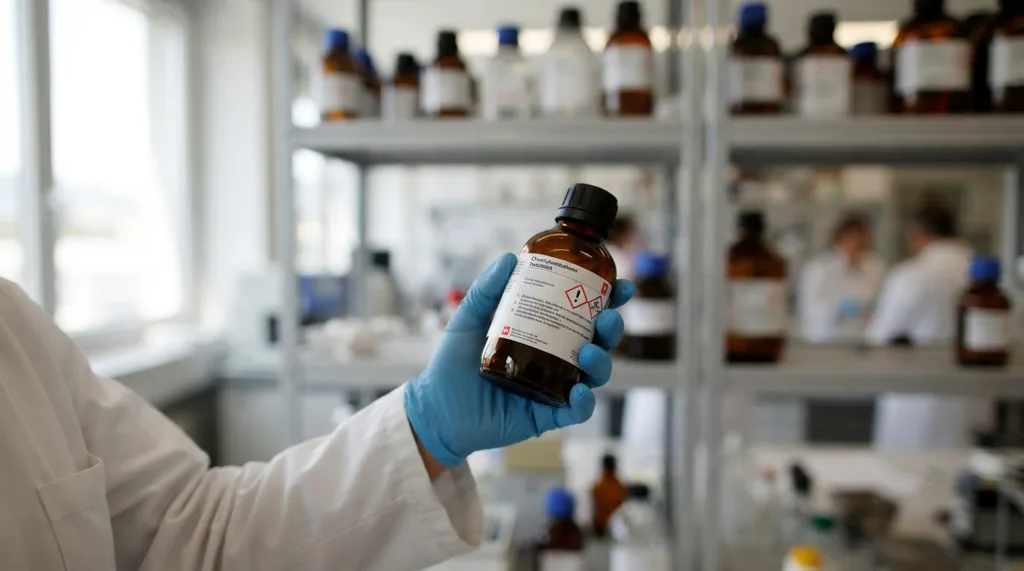
Switzerland is strengthening its chemical regulatory framework by amending the Chemicals Act to require chemical manufacturers to finance poison center operations while simultaneously enhancing protections against dangerous substances and preparations.
Switzerland’s health office will update hazard labels for chemicals sold in the country from 1 February 2027, following new European lists.
The Federal Office of Public Health (FOPH) has drafted an amendment to the Chemicals Ordinance, the main Swiss rulebook for dangerous substances and mixtures1. A second draft, from the Swiss government, would change the Chemicals Act itself so that makers of chemicals run and pay for the national poison information centre2.
In short, chemicals sold in Switzerland must follow newer European Union (EU) hazard labels from February 2027, with a transition period for some substances. Later, firms that notify chemicals for sale in Switzerland may also have to share the cost of the poison hotline.
What changes in the Swiss chemical labelling rules?
The ordinance draft changes two annexes of the Chemicals Ordinance (ChemO)1. Annex 2 lists the technical rules that chemicals must meet. Annex 3 is the list of substances of very high concern, often called the "candidate list"1.
The FOPH issued the draft together with the Federal Office for the Environment and the State Secretariat for Economic Affairs1. According to the draft, the change enters into force on 1 February 20271.
Switzerland follows the EU rules on classification and labelling of chemicals, known as the CLP Regulation. Classification means deciding which hazards a substance has, such as causing cancer. Labelling means the warning symbols and sentences printed on the pack. The EU updates its lists of hazards through "adaptations to technical progress" (ATPs), and Switzerland copies them into Annex 21.
Which EU hazard updates does Switzerland adopt?
The draft makes three changes to the table of EU updates that apply in Switzerland:
- The 24th ATP is added. This is a new EU Commission delegated regulation from 2026 on harmonised classification and labelling of certain substances1.
- The 14th ATP entry is rewritten. It refers to Commission Delegated Regulation (EU) 2020/217 of 4 October 20191.
- The 21st ATP entry is rewritten. It refers to Commission Delegated Regulation (EU) 2024/197 of 19 October 2023, now including a correction dated 22 September 20251.
EU hazard updates in the Swiss draft
| Update | What the draft does |
|---|---|
| 24th ATP | Added as a new entry; EU 2026 regulation |
| 14th ATP | Entry rewritten; Regulation (EU) 2020/217 |
| 21st ATP | Entry rewritten; Regulation (EU) 2024/197 with 22 September 2025 correction |
| Start date | 1 February 2027 |
The 24th ATP is the main new step. Its number and date in the EU Official Journal are still blank in the Swiss draft1. This shows that the Swiss text is waiting for the final EU publication.
Once the update applies, a substance on the 24th ATP list must carry the hazard class and label set by the EU. Mixtures that contain such a substance must also follow the new labels1.
What happens to titanium dioxide in Switzerland?
The rewritten 14th ATP entry keeps some parts of the EU regulation out of Swiss law. Annexes I and II of Regulation (EU) 2020/217 are excluded1. So is the entry for titanium dioxide (TiO2), index number 022-006-00-2, with its note W and note 1021.
Titanium dioxide is a white pigment. In the EU it was classified as a possible cause of cancer when breathed in as a powder. The Swiss draft refers to an EU notice on that classification, published on 10 December 20251.
In practice, Switzerland does not apply this part of the 14th ATP to titanium dioxide. Swiss labels for this pigment therefore do not have to follow that EU entry, under the draft text1.
Which test methods must laboratories use?
Annex 2 also says how the properties of chemicals must be tested. The draft updates the references to two sets of test methods1.
Tests must follow the methods in Regulation (EC) No 440/2008, the EU rulebook of test methods under its REACH chemicals law1. The Swiss reference now points to that regulation as last amended by Regulation (EU) 2025/2573 of 19 December 20251.
Tests may also follow the testing guidelines of the Organisation for Economic Co-operation and Development (OECD). The draft fixes the version of 2 July 2026 as the one that counts1. The OECD guidelines are free to read online, the draft notes1.
For a foreign maker, this means test reports based on older versions may need checking. A report must match the method versions that the ordinance names.
How does the 2028 transition period work?
The draft adds a new transition rule for the 24th ATP1. Some substances on the new list may already be on Swiss shelves with old labels.
Substances listed in the 24th ATP, and mixtures that contain them, may still be supplied until a date in 2028, even if their classification and labelling do not yet meet the new rules1. The exact day and month are still blank in the draft1.
After that date, old stock with old labels can no longer be passed on to buyers. Importers and Swiss sellers will need new labels and new safety information before then.
What is on the new candidate list?
Annex 3 is the Swiss list of substances of very high concern. It is also known as the candidate list1.
The draft says the list applies in its version of 1 February 20271. That version contains 253 substances and groups of substances1. The list itself is not printed in the official law collection. It is published by reference only, and readers find it through a link1.
Why does Switzerland want chemical makers to fund the poison centre?
The second draft deals with the national poison information centre, Tox Info Suisse3. It advises about 40,000 callers a year from across Switzerland when poisoning is suspected3. Chemicals and medicines are among the most common causes of these calls3.
Poison centre funding dates
The Federal Council, the Swiss government, says the centre’s funding is not well regulated3. Private backers have largely withdrawn in recent years3. The federal government and the cantons raised their payments, but they could not cover yearly running costs of about 4.35 million Swiss francs3.
In September 2025 the Federal Council asked for a voluntary deal with industry3. Talks between the Federal Department of Home Affairs and the chemical and drug industries did not produce one3. The industry was not ready to give lasting, substantial support on a voluntary basis, the government said3.
On 21 October 2026 the Federal Council opened a public consultation on a law change3. The consultation runs until 8 February 20273.
Who must run the poison centre under the Chemicals Act draft?
The draft amendment to the Chemicals Act says three groups must jointly run a poison information centre2:
- Makers of substances and mixtures that must be notified or reported to the authorities2.
- Holders of a sales licence for biocides, which kill pests or germs, and for plant-protection products2.
- Holders of a sales licence for medicines under the Therapeutic Products Act2.
Average yearly cost per firm, Swiss francs
The government says these firms make the products behind more than 70% of poisoning cases3. It expects about 5,500 chemical firms and about 300 medicine firms to be affected3.
The cost would be about 240 francs a year on average for a chemical maker3. For a medicine licence holder it would be close to 5,300 francs a year3. The federal government and the cantons would still support the centre3.
What must the poison centre do?
The centre must give advice on treating and preventing poisoning by the products of these firms2. It must also advise on other poisonings, for example from food, cosmetics, mushrooms and plants2.
Advice must be available all year, 24 hours a day, including Sundays and public holidays2. It must be given in French, German, Italian and English2. It is free, except for health professionals asking in their work2.
The centre must publish a yearly report by 30 June, with its accounts and poisoning statistics2. The federal government and the cantons would share equally the cost of advice on poisonings not caused by the firms’ products2.
The centre may see the full recipes of products in the Swiss product register when it handles a poisoning case2. It may also ask makers and licence holders for more information, free of charge2. It must delete trade secrets after one year at the latest2.
What happens if firms do not set up the centre?
If firms fail to run a centre, the Federal Department of Home Affairs will appoint one2. The firms must then pay its costs, which the federal government bills each year2.
The draft sets out how these bills are worked out2:
- Chemical, biocide and plant-protection firms pay a fixed basic amount plus an amount based on the number of products they sell2.
- Medicine licence holders pay an amount based on their sales of medicines2.
Firms can take the centre back only if they prove funding for at least two years and a working organisation2. A maker that hides information from the authorities or gives false information faces up to three years in prison or a fine2. A breach of the duty to inform the authorities can bring a fine of up to 20,000 francs2.
When would the poison centre rules start?
The Chemicals Act draft has no start date yet. The Federal Council will set it, and the law is open to an optional referendum, a public vote that citizens can demand2.
Tox Info Suisse would keep its current tasks until 31 December of the year the change enters into force2. By 30 June of that year, the firms must tell the FOPH whether they can run the centre from the next 1 January2. If they cannot, the FOPH will appoint a centre at their cost2.
Key points on Swiss chemical labelling and the poison centre
The table sums up the two Swiss drafts.
| Question | Answer |
|---|---|
| Who drafted the labelling change? | Federal Office of Public Health (FOPH) |
| Which law changes for labels? | Chemicals Ordinance, Annexes 2 and 3 |
| Main labelling change | Adds the EU’s 24th ATP hazard list |
| Start date for labels | 1 February 2027 |
| Transition for old labels | Supply allowed until a date in 2028 |
| Titanium dioxide | EU entry not applied in Switzerland |
| Candidate list size | 253 substances and groups |
| OECD test guideline version | 2 July 2026 |
| Poison centre funders | Chemical makers and medicine licence holders |
| Average yearly cost | About 240 francs per chemical maker |
| Consultation deadline | 8 February 2027 |
The next fixed date is 8 February 2027, when the poison centre consultation closes. A week earlier, on 1 February 2027, chemicals sold in Switzerland must follow the updated hazard lists, unless the 2028 transition covers them1.
Sources
- ↩ Dokumentvorlage AS für Word 2016 https://members.wto.org/crnattachments/2026/TBT/CHE/26_05691_00_f.pdf
- ↩ Dokumentvorlage AS für Word 2021 https://members.wto.org/crnattachments/2026/TBT/CHE/26_05692_00_f.pdf
- ↩ Auskunftstelle für Vergiftungen: Bund will Finanzierung gesetzlich langfristig absichern https://www.admin.ch/de/newnsb/U9NjD-IKAqb3