
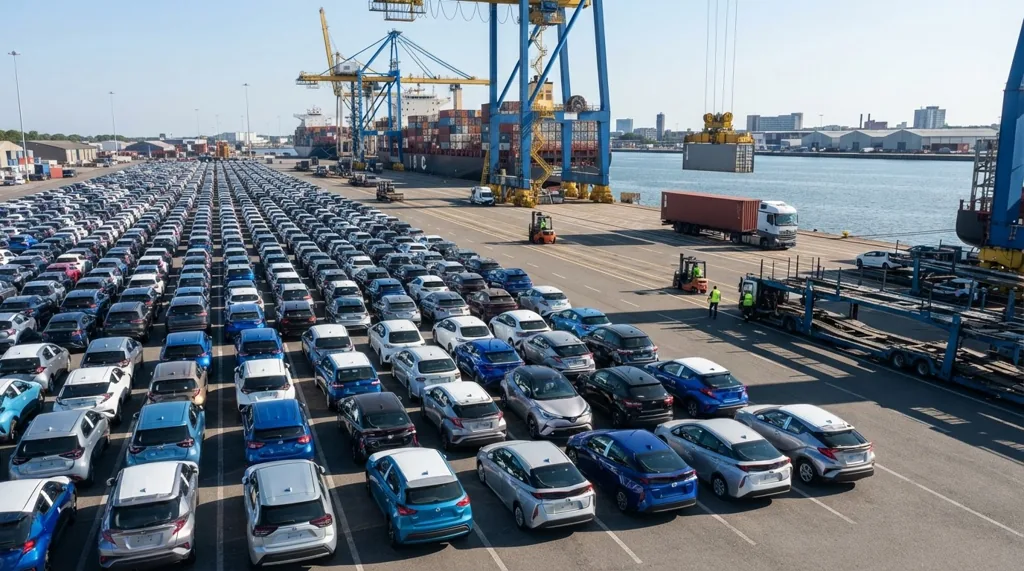
European Union limits hybrid car imports with a fixed quota for each main supplying country from Dec. 1, 2026, for up to 200 days.
The European Commission will limit imports of new hybrid passenger cars from Dec. 1, 2026, with a fixed quota for each main supplying country.
The Commission set the limits in Commission Implementing Regulation (EU) 2026/2614 of Nov. 23, 2026. It was published in the Official Journal of the European Union on Nov. 24, 20261. The regulation takes effect on Dec. 1, 20261.
In short, each main exporting country may send only a set number of hybrid cars into the EU while the measure lasts. Once a country’s quota is used up, more cars from that country cannot enter. The Commission says imports outside the quotas "are not allowed"2.
This is the next step in a case the site reported on Nov. 5, 2026. At that time the Commission had only opened an investigation and set no limit. What is new is that limits now apply at the border.
What changes for hybrid car shipments from Dec. 1?
The measure is a safeguard, a temporary limit on imports from all countries that protects home producers from a sudden rise in imports. It takes the form of a quantitative restriction, a cap on the number of cars, not an extra duty2. The Commission sets "a maximum quantity of hybrid vehicles that may be imported into the EU" for as long as the measure runs2.
The quota is a hard limit. A shipment that arrives after its country’s quota is full cannot be released for sale in the EU2. This is different from a tariff-rate quota, where goods above the limit can still enter after paying a higher duty.
The usual EU import duty on these cars stays in place. The EU’s import tariff on all the hybrid car codes is 10% of the car’s value3. The quota is added on top of that duty.
How are the hybrid quotas shared out?
The Commission divides the quotas into two kinds2:
- Country-specific quotas go to each country that supplied more than 2% of EU hybrid imports in 2025.
- A residual quota is shared by all other countries of origin.
How the hybrid car quotas work
| Rule | What it says |
|---|---|
| Type of limit | Fixed number of cars per country |
| Who gets own quota | Countries with over 2% of 2025 EU imports |
| Quota size | 2025 imports plus a little over 15% |
| Other countries | One shared residual quota |
| Cars above quota | Not allowed in |
Each country-specific quota equals that country’s 2025 imports into the EU, plus a little over 15%2. A country that shipped more in 2025 therefore gets a larger quota. Smaller suppliers compete for the single residual quota.
The measure covers imports from every origin, not only from China2. The Commission says it also carries out an understanding reached with China on Oct. 9, 20262. That understanding, made at the second EU-China Trade and Investment Consultations, aimed to slow China’s hybrid exports to the EU2.
Which countries ship the most hybrids to the EU?
China is now the largest source of hybrid cars entering the EU3. Imports from China rose from 46,001 cars in 2023 to 302,403 in 20253. In the 12 months from July 2025 to June 2026, they reached 486,582 cars3.
EU hybrid car imports in 2025, by origin
The regulation’s figures for 2025 show the main suppliers3:
- China: 302,403 cars
- Japan: 269,459 cars
- Türkiye: 199,182 cars
- United Kingdom: 166,200 cars
- South Korea: 107,104 cars
- Mexico: 54,802 cars
- Morocco: 37,771 cars
- Serbia: 30,515 cars
- United States: 29,142 cars
- South Africa: 28,757 cars
Total imports in 2025 were 1,225,813 cars3. On these figures, a 2% share equals about 24,500 cars. The press release does not list the countries that received their own quota, or the number of cars in each.
Growth differed widely by supplier. Imports from China rose by almost 1,000% in the latest 12 months compared with 20233. Morocco and Serbia also grew fast, from almost nothing3. Imports from the United Kingdom and the United States fell over the same years3.
Which hybrid cars are covered?
The quotas cover new hybrid cars designed to carry nine people or fewer, including the driver3. These cars have both a piston engine and one or more electric motors that drive the car3. The number of driven wheels does not matter3.
Two types are covered3:
- Full hybrids (HEVs), which make their own electricity from braking and from the engine. This group includes mild hybrids (MHEVs), which use a small battery to help the engine save fuel.
- Plug-in hybrids (PHEVs), whose battery is charged from the power grid.
The goods fall under parts of four codes in the EU’s tariff list, known as CN codes: 8703 40 10, 8703 50 00, 8703 60 10 and 8703 70 003. The detailed EU codes, known as TARIC codes, are 8703 40 10 10, 8703 40 10 90, 8703 50 00 10, 8703 60 10 10, 8703 60 10 90 and 8703 70 00 103.
Which vehicles and countries are left out?
Some vehicles are outside the measure3:
- cars whose electric power runs only other functions, not the driving of the car
- L-category vehicles, a separate EU class of light vehicles set by Regulation (EU) No 168/2013
- motorcycles
Fully electric cars are not covered either, because the product needs both an engine and an electric motor3.
Imports from some countries are also excluded3. Cars made in Norway, Iceland and Liechtenstein are exempt because their markets are closely linked to the EU’s3. Kenya is exempt under its trade agreement with the EU3. Ukraine is exempt because the EU has suspended its basic safeguard rules for Ukrainian goods3. Together, these countries supplied less than 0.01% of EU hybrid imports3.
Why did the Commission limit hybrid imports?
The Commission points to a fast and growing rise in imports. Hybrid imports grew from 957,965 cars in 2023 to 1,225,813 in 20253. In the 12 months to June 2026 they reached 1,423,691 cars, up 49% on 20233.
The rise sped up in 2026. In the first seven months of 2026, imports were 39.5% higher than a year earlier3. Monthly imports grew by an average of 9.33% in 2026, against 4.64% in 20253.
The Commission names several causes. Car factories worldwide, above all in China, have added capacity quickly with state support3. Other large markets have closed their doors to these cars3. The United States charges 100% extra duty on plug-in hybrids made in China, and Türkiye adds 40% on Chinese passenger cars3. Canada limits Chinese electric cars, including some hybrids, to 49,000 a year3.
The Commission also links the rise to its 2024 duties on Chinese battery electric cars. Those countervailing duties, extra taxes against state subsidies, range from 17% for BYD to 35.3% for SAIC3. After they began, Chinese electric car imports stopped rising and hybrid imports surged3. Many factories can switch between engine types easily, the regulation says3.
How are EU carmakers affected?
The Commission found that EU hybrid makers face a threat of serious harm2. It says the threat is "imminent", meaning close at hand2. EU makers are losing market share even as the EU market grows2.
The regulation’s figures show the pattern. Hybrid registrations in the EU rose from 3,530,443 cars in 2023 to 5,113,654 in the latest 12 months3. Yet EU makers’ share of that market fell from 74% in 2025 to 72% in the latest period3. Factories ran at only about 62% of their capacity on average over four years3.
Prices are also an issue. The regulation says imports entered the EU at prices "significantly below" those of EU makers3. The Commission acted early because harm could be "difficult to remedy" if it waited3.
Who must act at the border?
Importers and car dealers in the EU face the most direct change. A hybrid car can enter only while its country’s quota still has room. Late shipments risk being stopped once a quota is full.
Carmakers abroad now face a fixed number of cars for their country. Makers in the same country share one quota. Makers in smaller supplier countries share the residual quota with every other small origin.
EU carmakers gain protection from further growth in imports. Buyers in the EU may find fewer imported hybrid models on sale if quotas fill.
When do the hybrid quotas end?
The provisional measure applies from Dec. 1, 20261. It can last for a maximum of 200 days2. The investigation that began on Oct. 30, 2026 continues during this time3.
Key dates in the hybrid car case
The Commission is still collecting questionnaire replies from EU makers, importers and dealers3. Parties can also send written views and ask for hearings3. The Commission says it will study this new information before any final decision3.
Final measures may follow within nine months of the Oct. 30, 2026 start of the case2. This deadline can be extended by up to two months2.
Key points on the EU hybrid car quotas
The table sums up the main facts of the regulation.
| Question | Answer |
|---|---|
| What changed? | Import quotas on hybrid cars |
| Who acted? | European Commission |
| Legal act | Implementing Regulation (EU) 2026/2614 |
| Published | Nov. 24, 2026 |
| Start date | Dec. 1, 2026 |
| How long? | Up to 200 days |
| Goods covered | New full, mild and plug-in hybrid cars, up to nine seats |
| Customs codes | Parts of 8703 40 10, 8703 50 00, 8703 60 10, 8703 70 00 |
| Quota size | 2025 imports plus a little over 15% |
| Who gets a quota? | Countries with over 2% of 2025 imports |
| Other countries | One shared residual quota |
| Imports above quota | Not allowed |
From Dec. 1, 2026, hybrid cars enter the EU only within their country’s quota, for up to 200 days. Final measures may follow within nine months of Oct. 30, 20262.
Sources
- ↩ Implementing regulation – EU – 2026/2614 – EN – EUR-Lex https://eur-lex.europa.eu/eli/reg_impl/2026/2614/oj/eng
- ↩ Commission imposes provisional import quotas on hybrid passenger vehicles https://ec.europa.eu/commission/presscorner/detail/de/ip_26_2564
- ↩ L_202602614EN.000101.fmx.xml https://eur-lex.europa.eu/legal-content/EN/TXT/HTML/?uri=OJ:L_202602614