
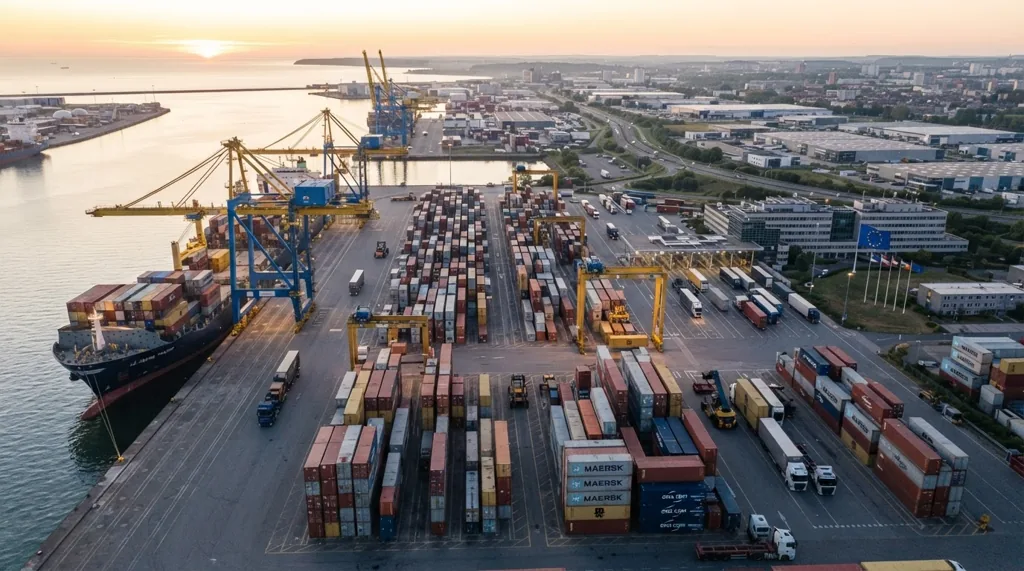
European Union requires online sellers outside the EU to report sales through a new Customs Data Hub from 1 July 2028.
The European Union has replaced its customs code, and online sellers shipping goods to EU consumers must use a new EU Customs Data Hub from 1 July 2028.
The new law is Regulation (EU) 2026/2108 of the European Parliament and of the Council, adopted on 16 September 20261. It sets up a new Union Customs Code (UCC) and a new European Union Customs Authority. It also repeals the old code, Regulation (EU) No 952/20131.
In short, online platforms and sellers outside the EU, not shoppers, become responsible for parcels sent to EU buyers. From 1 July 2028 they must report those imports through one EU-wide digital system2.
What does Regulation 2026/2108 change?
The regulation was published in the Official Journal of the European Union on 19 September 20261. The European Commission said the reform entered into force and would be applied gradually from 21 September 20262. The Commission calls it the most complete reform of the EU Customs Union since it was founded in 19682.
The Commission describes three main parts of the reform. These are smarter risk checks and customs controls, new rules for e-commerce, and a closer partnership with business2. The law also creates a central EU Customs Data Hub, which the regulation describes as a set of connected electronic services for collecting and sharing customs information1.
A new EU agency, the European Union Customs Authority (EUCA), will run the data hub2. EUCA will be based in Lille, France2. The Commission expects it to have around 285 staff2.
Why did the EU rewrite its customs code?
The regulation lists weaknesses found in the old code1. Customs could not handle the growing number of goods bought online from outside the EU. National IT systems could not keep up with new technology. Customs offices in different member states also applied the rules in different ways1.
The Commission gives figures for online parcels. In 2025, 5.9 billion low-value e-commerce items were imported into the EU, four times the number in 20222. The Commission says more than 90% of these items came from China2. It also says many such products fail EU safety and quality rules2.
Importers today deal with 27 national customs administrations and more than 111 separate IT systems2. These systems are costly to run and are not always connected2. There is no central EU customs database, the Commission says2.
Customs work has also grown beyond collecting duties. The regulation notes that customs must now check many rules on safety, health, the environment, human rights and intellectual property1. It refers to new tools such as the digital product passport, an electronic record of product information1.
What is the EU Customs Data Hub?
The data hub is a single online platform for all customs operations in the EU2. Traders will send customs and product information through this one system2. Businesses will submit data only once instead of using several national systems2.
The hub will collect import and export data from businesses. It will give customs a full view of supply chains and of goods moving in and out of the EU2. Customs offices in all member states will see the same real-time data2.
The hub will gradually replace member states’ own customs IT systems2. The Parliament said it will replace at least 111 software systems now used by customs3. The Commission estimates savings for member states of over €2 billion a year2.
Who becomes the importer for online sales?
The regulation creates a new role, the "importer for distance sales"1. A distance sale is an online sale where goods are sent from outside the EU straight to a buyer in the EU. In some of these sales, a business, not the consumer, will count as the importer1.
The Commission says this role falls on non-EU online platforms and sellers2. They will be responsible for customs paperwork and for paying duties on goods they sell into the EU2. They must also make sure the goods meet EU product rules, for example by naming a responsible business in the EU2.
The Parliament described the same change. Sellers and platforms that make direct sales from outside the EU will be treated as importers3. They must give customs all the data needed, pay or guarantee charges, and make sure goods follow EU law3.
These companies must be based in the EU or use an EU-based representative3. That representative must hold either authorised economic operator (AEO) status, an existing customs approval for reliable traders, or the new trusted trader status3. The Parliament said this rule should stop the use of shell companies3.
How will online sales be reported to customs?
The Commission explains the new process. Platforms and sellers will tell customs about each sale to an EU consumer through the data hub immediately after the sale2. This lets customs act before the goods reach the border2.
How an online sale reaches customs
In practice, a parcel would move through these steps:
- A consumer in the EU buys goods from a platform or seller outside the EU.
- The platform or seller sends the sale data to the EU Customs Data Hub straight away.
- EUCA and national customs run a risk check on the data.
- Customs can check the goods before loading, at entry, during transport in the EU, or at the final address.
- The platform or seller pays the duties and fees and answers for the goods meeting EU rules.
The Commission says customs may also give "do-not-transport" instructions2. Those orders aim to stop goods that break the rules from entering the EU at all2.
What are the key dates for the data hub?
The data hub opens in stages. The Commission gives this timetable2:
- 2027: EUCA is set up with the member states, and some of its work starts.
- 1 July 2028: use of the data hub becomes mandatory for e-commerce imports and exports.
- 2031: other businesses can start using the hub on a voluntary basis.
- 1 March 2034: use of the hub becomes mandatory for all traders.
When the EU Customs Data Hub applies
| Date | Who it covers | What happens |
|---|---|---|
| 2027 | EU Customs Authority | Set up with member states, some work starts |
| 1 July 2028 | E-commerce imports and exports | Use of the hub becomes mandatory |
| 2031 | Other businesses | Voluntary use of the hub |
| 1 March 2034 | All traders | Use of the hub becomes mandatory |
The Parliament gave the same voluntary date of 2031 and mandatory date of 2034 for all traders3. In 2034 the hub will become the single mandatory entry point for EU customs, the Commission says2.
For sellers to EU consumers, the key date is therefore 1 July 2028. Other importers and exporters have until 1 March 2034 before they must switch2.
How do the €3 duty and handling fee fit in?
The reform ends the old rule that freed parcels worth up to €150 from customs duty2. That exemption ended on 30 June 20262. From 1 July 2026 the EU applies a temporary €3 customs duty per item on these low-value parcels2.
The Commission says this temporary duty will apply until 1 July 20282. Once the data hub is fully running, normal customs duties will apply2. This means the start of the hub for e-commerce also ends the flat €3 duty.
A separate charge, the Union handling fee, covers the cost of customs work on small parcels. From 1 November 2026 the EU applies a €2 Union handling fee2. The Parliament said the fee is paid by the same business that pays other customs charges on the parcel, so the cost is not shifted to consumers3. The Commission will set the fee level and review it every two years3.
Sellers that keep stock in EU warehouses may pay a lower handling fee on deliveries inside the EU3. Their goods must arrive in collective packaging and in large enough amounts to make checks easier3.
What penalties do platforms face?
The Commission says breaking the rules can bring fines, the loss of some customs benefits, and even limits on access2. The Parliament gave more detail on fines.
Fines for repeated breaches, % of imports in previous 12 months
Companies that repeatedly ignore EU rules could pay at least 1% and up to 6% of the value of goods they imported into the EU in the previous 12 months3. Customs may also suspend or withdraw their trusted trader status and mark them as high-risk operators3.
What changes for other importers and exporters?
The regulation adds new duties for importers and exporters generally. They will be responsible to customs for making sure goods meet the rules, including product rules beyond customs duties1.
The law also creates a "Trust and Check" trader, a business that shows customs full details of its supply chain1. These traders can clear all their imports in the member state where they are based, wherever the goods enter the EU2. Under some conditions, they may release goods themselves without waiting for customs2. They will also face fewer checks and can pay duties at set intervals rather than on each import2.
Holders of customs decisions must check their own compliance on a continuing basis1. Customs must closely watch holders set up in the EU for less than three years1. The regulation also sets a 30-day limit for applicants to send missing information on a request for a customs decision1.
The Commission estimates businesses will save €2.7 billion a year in costs from the simpler procedures2. It also says importers will not have to give more detail to customs than today2.
Key points on the EU Customs Data Hub for e-commerce
The table sums up the main facts of the reform.
| Question | Answer |
|---|---|
| What changed? | New Union Customs Code replaces the 2013 code |
| Legal act | Regulation (EU) 2026/2108 |
| Who issued it? | European Parliament and Council |
| Adopted | 16 September 2026 |
| Published | 19 September 2026 |
| Who runs the hub? | EU Customs Authority in Lille |
| Who is the importer for online sales? | Non-EU platforms and sellers |
| Hub mandatory for e-commerce | 1 July 2028 |
| Hub voluntary for others | 2031 |
| Hub mandatory for all traders | 1 March 2034 |
| Fines for repeat breaches | 1% to 6% of yearly imports |
| Handling fee | €2 Union handling fee from 1 November 2026 |
The next date for online sellers is 1 July 2028. From then, each sale to an EU consumer must be reported through the data hub, and the temporary €3 duty gives way to normal customs duties2.
Sources
- ↩ Regulation – EU – 2026/2108 – EN – EUR-Lex https://eur-lex.europa.eu/legal-content/EN/TXT/?qid=1792393676383&uri=CELEX%3A32026R2108
- ↩ EU Customs Reform – Taxation and Customs Union – European Commission https://taxation-customs.ec.europa.eu/customs/eu-customs-reform_en
- ↩ Deal reached on Union Customs Code reform | News | European Parliament https://www.europarl.europa.eu/news/en/press-room/20260323IPR38815/deal-reached-on-union-customs-code-reform