
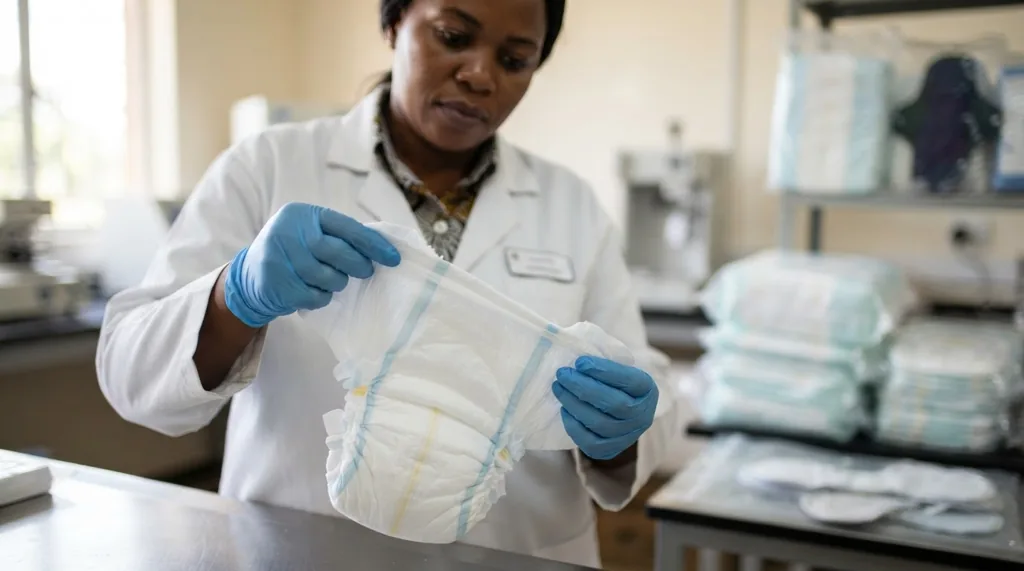
Zambia has enacted comprehensive specification standards for disposable diapers, sanitary pads, and related absorbent hygiene products to protect consumer health and ensure product quality across multiple product categories.
Zambia has proposed compulsory quality, testing and labelling rules for baby diapers, adult diapers and sanitary pads, with no start date set yet.
The plans are set out in four draft texts that Zambia has shared through the World Trade Organization (WTO). Two are new Zambian Compulsory Standards for sanitary pads. The other two are African standards for infant and adult diapers, written by the African Organisation for Standardisation (ARSO)1.
In short, every pack of diapers or pads sold in Zambia would have to pass set laboratory tests and carry a full label. Shipments that fail on absorbency, germs or labelling could not be sold.
What has Zambia proposed for diapers and pads?
The four drafts cover four product groups. Each one is a separate technical text with its own tests and label rules:
- Disposable sanitary pads, under Zambian Compulsory Standard ZS 1214, Part 21.
- Reusable sanitary pads, under Zambian Compulsory Standard ZS 1213, Part 12.
- Disposable diapers for infants, under African Standard ARS 1566:20173.
- Disposable adult diapers, under African Standard ARS 1572:20194.
The two pad standards sit in a schedule attached to a draft regulation. Each is headed "Schedule (Regulation 2)", which means the standard is the legal annex of the rule itself1. A compulsory standard is a product rule that every seller must meet, not a voluntary guide.
The two diaper texts are African standards, agreed by member countries of ARSO. ARSO is an intergovernmental body set up in 1977 to bring African product standards into line and help trade inside Africa3. Zambia filed both diaper texts with the WTO alongside its two pad standards.
Why does Zambia want hygiene product rules?
The Zambia Bureau of Standards (ZABS), the national standards body, wrote the disposable pad standard. Its draft links the rule to schooling for girls5. Parliament approved a motion asking the government to provide sanitation and sanitary pads to girls in public schools5.
The bureau says that supplying enough pads "requires considerations for product safety and quality assurance"5. A technical committee on sanitary products, known as TC 3/13, prepared the text. Its members include the Zambia Medicines Regulatory Authority, the Zambia Compulsory Standards Agency, UNICEF Zambia and several local makers5.
The draft also used a South African standard as a model. That is SANS 1043:2010, on the manufacture of sanitary towels5.
The adult diaper standard gives its own reason. It says older or ill users who stay in bed face a high risk of skin breakdown and bedsores, so a product that protects the skin matters4. The infant diaper standard says a diaper must keep the baby’s skin dry and stop leaks onto clothes and bedding3.
What must infant diapers pass?
The infant diaper standard covers disposable diapers for children aged 0 to 24 months3. Each diaper must have a waterproof outer layer, a soft non-woven inner lining and an absorbent pad. The legs must be elastic and fit for purpose3.
Maximum soak-in time for infant diapers, seconds
The main test is speed. A laboratory pours salt water onto the diaper twice and times how long it takes to soak in. After the second pour, the maximum time is 30 seconds for small, 40 for medium, 50 for large and 70 for extra-large diapers3.
Other limits apply to all sizes:
- Rewet of 10 grams at most: this measures how much liquid comes back up to the skin under pressure.
- Tab strength of at least 40 newtons: the fastening tabs must not tear off easily.
- Re-fastening at 90% of original strength: tabs that can be opened and closed must still hold.
- pH between 6 and 8: the diaper must be neither acid nor alkaline on the skin.
These figures come from the standard’s performance table3. The laboratory tests at least six diapers from each sample3.
The standard also lists 14 defects. The pad must be centred and free from hard spots or glue. No filler may be reachable from the outside, and the edges must be sealed3.
What must adult diapers pass?
The adult diaper standard sorts products by how much urine a user loses. It names four levels: light, moderate, heavy and overnight4. Overnight products cover losses over 472 millilitres, more than 90% of a full bladder4.
The standard sets the materials too. The super-absorbent gel, called super absorbent polymer (SAP), must be made from acrylic polymers. It must contain no phthalates, chemicals used to soften plastics4. The soft fabric must be polypropylene made without organic solvents or chlorine. The glue must be resin-based and free of phthalates4.
Each size has a set capacity. The maximum absorptive capacity is 780 millilitres for small, 928 for medium, 980 for large and 1,200 for extra-large4. All sizes must soak up liquid within 10 seconds, and the pH must stay between 6 and 84.
There is also a germ limit. The total bacterial count must not exceed 1,000 per diaper4.
What tests apply to disposable sanitary pads?
The disposable pad standard covers single-use pads, also called sanitary towels or sanitary napkins. It does not cover reusable pads or maternity pads1.
The absorbent filler must be white or light in colour, with no dye that runs in water1. The bottom layer must be waterproof and clearly marked, so the user knows which side faces down1. Pads must have no bad smell, dry or wet, and must not rub or cause discomfort1.
The standard’s performance table sets these limits1:
- Absorbency rate of 10 seconds at most for the filler to soak up water.
- No leakage when 30 millilitres of test fluid is dripped on and pressed with a 1-kilogram weight.
- Moisture in the filler of 8% at most.
- pH between 5.5 and 8.5.
- No fluorescence, which shows the filler has no optical brighteners.
- Minimum size of 60 by 190 millimetres, not counting wings.
The rules on germs depend on the claim on the pack. A pad sold as sterile must pass a sterility test1. A non-sterile pad must have no more than 1,000 bacteria per gram. It must also be free of three named bacteria, including Staphylococcus aureus1.
A pad sold as flushable must break up in water and pass a flushing test1. The standard also asks makers to use plastics that break down naturally "whenever possible"1.
What do reusable pads need, from fabric to factory?
The reusable pad standard defines a reusable pad as one that can be washed and reused at least 30 times2. It covers pads used during periods, after childbirth and for other health needs2.
Disposable and reusable pads compared
| Question | Disposable pads (ZS 1214) | Reusable pads (ZS 1213) |
|---|---|---|
| Soak-in time | 10 seconds at most | 10 seconds for top fabric |
| pH range | 5.5 to 8.5 | 6.5 to 7.5 |
| Germ limit | 1,000 bacteria per gram | 1,000 per pad |
| Label language | English | English, others in addition |
Each pad must absorb a set amount of fluid without leaking. A light pad must take 4 millilitres, a regular pad 8 and a heavy pad 162. The top fabric must soak up liquid within 10 seconds2.
The colour must not run. Colour fastness, a score for how well dye stays in the fabric, must reach at least 4 for washing, rubbing and sweat2. The pH must be between 6.5 and 7.52. Fasteners must not be made of iron or steel that could rust and hurt the skin2.
The total bacteria count must not exceed 1,000 per reusable pad2. Drying times are set as well. Pads must dry within 6 hours outdoors on a cloudy day, or 12 hours indoors2.
This standard goes further than the others. It sets rules for the factory and its workers2. Workers must pass a medical check before hiring and then at least every 12 months. Food, tobacco and spitting are banned in work areas2. Water used in production must meet Zambia’s drinking water standard, ZS 1902.
What must the labels on diaper and pad packs show?
All four standards set label rules, but the lists differ. The pad labels must be in English1. For reusable pads, any other language must be in addition to English2.
A disposable pad pack must show 14 items, including1:
- the maker’s name and trade mark, and contact details
- the number of pads and their size
- the batch number and the country or region of manufacture
- the date of manufacture and the expiry date
- storage and disposal instructions
The pad standard adds one warning. Health claims may not appear unless a health authority has checked them1.
A reusable pad pack must show the flow level (light, normal or heavy) and the fabric used. It must also carry washing and care instructions, with a warning to wash the pad before first use2. Instructions for use and care must go in every packet2.
An adult diaper pack must show the product type and its incontinence level. It must also show the country of origin, the batch number and the date of manufacture and expiry4. An infant diaper pack needs the maker’s name or trade mark, the size and a batch or date code3.
How will shipments be sampled and tested?
Both pad standards define a lot. It is all packs of the same size and type from one batch in a shipment1. Samples are tested from each lot1.
The number of containers checked rises with the size of the lot. A lot of up to 250 containers means 6 containers are picked. A lot of 5,001 containers or more means 30 are picked1. In every case, up to 10% of the pieces checked may fail without the lot failing1.
The reusable pad standard uses the same sampling table2. The adult diaper standard instead refers to the international sampling rule ISO 2859-14.
For importers, this means each batch in a shipment counts on its own. A shipment that mixes several batches would be sampled batch by batch. Bulk cartons of pads may only hold packs from the same batch and size1.
What happens next for the Zambian drafts?
The disposable pad text is still a draft. The ZABS version calls itself a "Draft Zambian Standard" and leaves its publication date blank5. None of the four WTO texts gives a date for adoption or for the rules to take effect.
Once the rules apply, makers abroad will need test results that meet each limit. Importers will also need packs labelled in English to the full list.
Key points on Zambia’s diaper and pad standards
The table sums up the four drafts.
| Question | Answer |
|---|---|
| What is changing? | Compulsory quality rules for hygiene products |
| Who wrote the pad rules? | Zambia Bureau of Standards |
| Which goods? | Infant diapers, adult diapers, disposable and reusable pads |
| Which standards? | ZS 1214, ZS 1213, ARS 1566, ARS 1572 |
| Disposable pad pH range | 5.5 to 8.5 |
| Infant diaper soak time | 30 to 70 seconds, by size |
| Pad germ limit | 1,000 bacteria per gram |
| Reusable pad life | At least 30 washes |
| Label language | English for pads |
| Sampling | 6 to 30 containers per lot |
| Start date | Not yet set |
The texts are drafts, and no start date has been set yet. When they apply, only diapers and pads that pass these tests and carry the full label could be sold in Zambia.
Sources
- ↩ 26_05661_00_e.pdf https://members.wto.org/crnattachments/2026/TBT/ZMB/26_05661_00_e.pdf
- ↩ 26_05662_00_e.pdf https://members.wto.org/crnattachments/2026/TBT/ZMB/26_05662_00_e.pdf
- ↩ H — ZMB / 26 05648 00 e https://members.wto.org/crnattachments/2026/TBT/ZMB/26_05648_00_e.pdf
- ↩ H — ZMB / 26 05647 00 e https://members.wto.org/crnattachments/2026/TBT/ZMB/26_05647_00_e.pdf
- ↩ DZS 1214 2026 Disposable Sanitary Pads – Specification.pdf https://www.zabs.org.zm/documents/draft-standards/DZS%201214%202026%20Disposable%20Sanitary%20%20Pads%20-%20Specification.pdf