
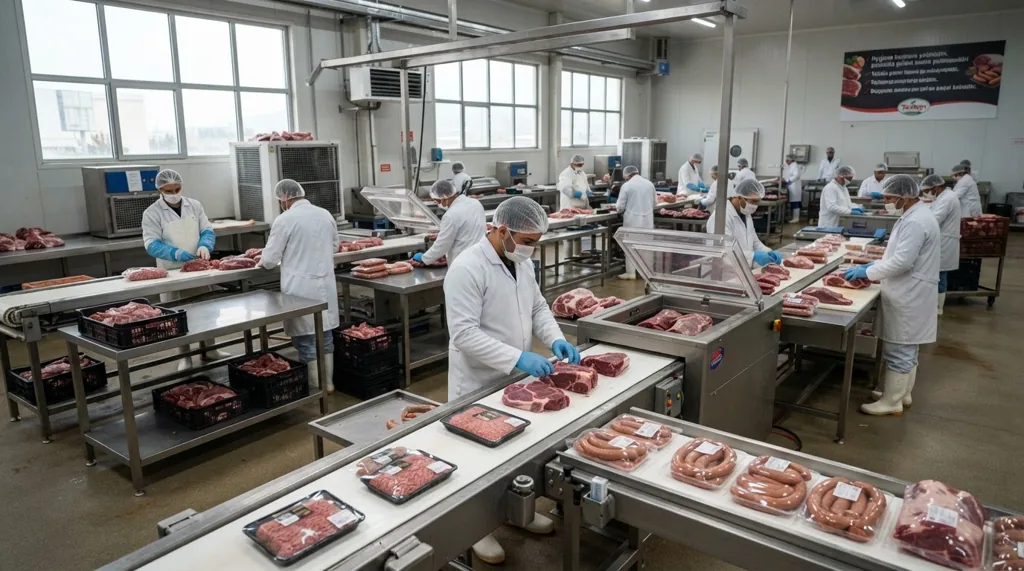
Turkey has issued updated regulatory guidelines for meat, meat preparations, and meat products to enhance safety, labeling, and quality control in the domestic food sector.
Türkiye’s Ministry of Agriculture and Forestry published a new food standard for raw meat, minced meat, döner, sausages and other meat products in the Official Gazette on Sept. 16, 20261.
The rule is the Turkish Food Codex Communiqué on Meat, Prepared Meat Mixtures and Meat Products, numbered 2026/152. It sets what these foods may contain and how they must be made, packed and sold1.
In short, meat products sold in Türkiye now face new limits on fat, protein, calcium and fillers. Chicken and turkey döner, burgers and meatballs must be leaner than under the earlier rule, and some sausage and ham limits have moved.
What did the Turkish ministry publish?
The communiqué appeared in Official Gazette issue No. 33372 of Sept. 16, 20261. The ministry’s legal services department announced the same day that communiqué No. 2026/15 had been published2.
A communiqué in Türkiye is a detailed rule issued by a ministry under a wider regulation. This one rests on the Turkish Food Codex Regulation, published in the Official Gazette of Feb. 19, 2020, issue 310441. The Food Codex is the country’s set of binding food standards.
The stated aim is to set how these products are produced, packed and placed on the market according to good technical practice1. In practice, it fixes what a buyer gets: how much meat protein a product holds, and how much fat, salt and filler.
Which meat goods does communiqué 2026/15 cover?
The communiqué covers raw meat, minced meat, minced poultry, prepared meat mixtures, mechanically separated poultry meat and meat products1. Prepared meat mixtures are raw meat with salt, spices or other food added, but still raw in character, such as uncooked meatballs.
The text defines many traditional products by name1. They include:
- sucuk, a dry fermented sausage, and heat-treated sucuk;
- pastırma, cured and dried beef coated with a spice paste;
- kavurma, meat cooked in its own fat;
- döner, from red meat or poultry;
- köfte (meatballs), burgers, ham, dried ham, pâté and canned meat;
- emulsified products, such as frankfurter-type sausages, and breaded meat.
Some goods are outside the rule1. These are meat extracts, rendered animal fat, tallow, gelatine, collagen, salted or dried blood and blood plasma, bone broth and bone-marrow fat.
The rule also reaches further than packaged products. Raw meat, mince and meat products used in dishes such as mantı, lahmacun, pide, kebab and pizza must meet it too1.
How much fat may poultry döner and burgers contain?
The biggest change is for poultry. Prepared poultry mixtures, such as chicken meatballs and chicken burgers, may contain at most 15% fat by weight1. They also need at least 10% meat protein, at most 10% collagen in the meat protein, and at most 2% salt1.
Fat limits, old rule and new
| Product | Communiqué 2018/52 | Communiqué 2026/15 |
|---|---|---|
| Poultry burgers and meatballs | 20% | 15% |
| Poultry döner | 20% | 15% |
| Red-meat köfte and burgers | 25% | 25% |
Under the earlier communiqué, No. 2018/52, published on Jan. 29, 2019, the fat limit for these mixtures was 20%3. The same cut applies to poultry döner. Its fat limit falls from 20% under the earlier rule3 to 15% under the new one1.
Red-meat products keep their fat limit. Prepared red-meat mixtures made from mince, such as köfte and burgers, may contain at most 25% fat and 2% salt1. That matches the earlier rule3. The new text adds a floor of at least 10% total meat protein for these mixtures1.
What are the new döner rules?
Red-meat döner comes in three named forms1:
- leaf döner, made only from thin slices of raw red meat;
- mince döner, with at most 90% mince and at least 10% sliced meat;
- leaf-mince döner, with at least 60% sliced meat and at most 40% mince.
Minimum meat protein in döner, % by weight
The new text renames the third type. The earlier rule called it "mixed döner"3. Poultry döner has two forms: leaf poultry döner and leaf-mince poultry döner, with at least 60% sliced poultry1.
Raw red-meat döner must contain at least 12% meat protein by weight, and raw poultry döner at least 14%1. After cooking, döner must reach at least 16% meat protein and poultry döner at least 18%1. Döner may not contain nuts or cheese, and leaf döner may not contain dietary fibre1.
Raw döner keeps a shelf life of 12 hours at the point of sale, counted from when cooking starts1. That limit was also in the earlier rule3.
Which fillers and additives are banned?
Fillers are cheap ingredients that add bulk, such as starch or soya. The communiqué bars starch, soya and soya products in köfte, burgers and mergez sausage1. It also bars added protein, protein hydrolysate and protein powder, except milk and egg proteins1. Starch and plant protein from spices, bread or breadcrumbs may not exceed 5% in total1.
For döner the limits are tighter. Starch and plant protein from spices may not exceed 1% by weight1. Milk, yogurt and egg proteins are again allowed where the recipe needs them1.
Raw meat and mince sold as such may not contain any added ingredient, including food additives1. The only exceptions are those allowed by the hygiene regulation for animal foods and the Food Additives Regulation1. Products that have no product description in the communiqué may not contain added protein or protein sources, except ingredients such as spices, milk, yogurt or eggs that the product’s nature needs1.
What other production rules apply?
The communiqué limits how meat from different animals may be mixed1. Beef, buffalo and camel meat may be mixed with sheep and goat meat. Poultry meats may be mixed with each other. Other mixes are barred, although red meat or fat may go into poultry products where the method needs it1.
What the meat standard forbids
Other key rules are1:
- Mechanically separated red meat may not be used in any product under the rule.
- Mechanically separated poultry meat may be used only in poultry emulsified products, with calcium at most 750 mg/kg.
- Offal may not go into sucuk, pastırma, kavurma, ham, köfte, burgers, döner, breaded products, mergez or emulsified products, with two named exceptions.
- Raw meat and offal must be kept and shipped so they do not touch.
The new text also sets calcium limits for poultry products made without mechanically separated meat1. Calcium is a sign of bone in the meat. The limits are 150 mg/kg in poultry mince, 250 mg/kg in prepared poultry mixtures, 400 mg/kg in heat-treated poultry sucuk and 350 mg/kg in other poultry products1.
Head meat used in emulsified products must meet Türkiye’s regulation on protection against transmissible spongiform encephalopathies, a group of brain diseases in cattle and sheep1.
How do sucuk, ham and sausage limits change?
Several limits for cured products have moved. For sucuk, minimum meat protein is now 15% by weight, and its moisture-to-protein and fat-to-protein ratios must stay below 2.61. The earlier rule set 16% protein and ratios below 2.53. The pH of sucuk may not exceed 5.41.
Heat-treated sucuk now needs at least 13% meat protein, with a moisture-to-protein ratio below 3.71. The earlier figures were 14% and 3.63. Emulsified products now need at least 9% meat protein1. The earlier rule asked for 10%3.
Ham keeps its limits of at least 13% meat protein, at most 8% fat and at most 3% salt1. The new text adds a cap of 5% on non-meat protein and starch together in ham1. Pastırma keeps its limits: moisture at most 50%, salt at most 10% of dry matter and spice coating at most 10%1.
What changes for importers and shops?
The communiqué governs products placed on the Turkish market1. Imported meat products sold in Türkiye therefore have to meet the same recipe limits as local ones. A foreign maker of chicken burgers or döner cones with 20% fat would need to change the recipe to sell under the new 15% cap.
The rule also sets duties for retail shops1. Shops may make only uncooked köfte and local specialities each day from red meat. Mince and other prepared mixtures may be made only at the customer’s request. Raw poultry must be sold pre-packed, and the shop may not open the pack before sale, except to cut it on the customer’s request1.
Poultry mince and mixtures made from it may be sold only frozen1. Meats from different animals must be produced and sold apart from each other and from other foods1.
Products registered as geographical indications, such as a protected regional sausage, may follow their registered specifications1. They must still meet the general food codex rules.
Key points on Türkiye’s meat products standard
The table sums up the main facts of communiqué 2026/15.
| Question | Answer |
|---|---|
| What changed? | New standard for meat and meat products |
| Who issued it? | Ministry of Agriculture and Forestry |
| Legal name | Communiqué No. 2026/15 |
| When published? | Sept. 16, 2026, Gazette No. 33372 |
| Goods covered | Raw meat, mince, döner, sucuk, ham, burgers |
| Goods excluded | Gelatine, collagen, tallow, bone broth |
| Poultry döner fat limit | 15%, down from 20% |
| Red-meat köfte fat limit | 25%, unchanged |
| Sucuk meat protein | At least 15% |
| Banned input | Mechanically separated red meat |
| Raw döner shelf life | 12 hours at the point of sale |
| Who must act | Makers, importers and shops selling meat |
Meat products sold in Türkiye must now follow the limits of communiqué 2026/15, published on Sept. 16, 2026. For poultry döner, chicken burgers and chicken meatballs, the practical effect is a leaner recipe, with fat capped at 15%1.
Sources
- ↩ 16 Eylül 2026 ÇARŞAMBA https://www.resmigazete.gov.tr/eskiler/2026/09/20260916-6.htm
- ↩ Türk Gıda Kodeksi Et, Hazırlanmış Et Karışımları ve Et Ürünleri Tebliği (No: 2026/15) yayımlanmıştır. https://www.tarimorman.gov.tr/HHGM/Haber/268/Turk-Gida-Kodeksi-Et-Hazirlanmis-Et-Karisimlari-Ve-Et-Urunleri-Tebligi-_no-2026_15_-Yayimlanmistir
- ↩ Content from www.resmigazete.gov.tr https://www.resmigazete.gov.tr/eskiler/2019/01/20190129-4.htm