
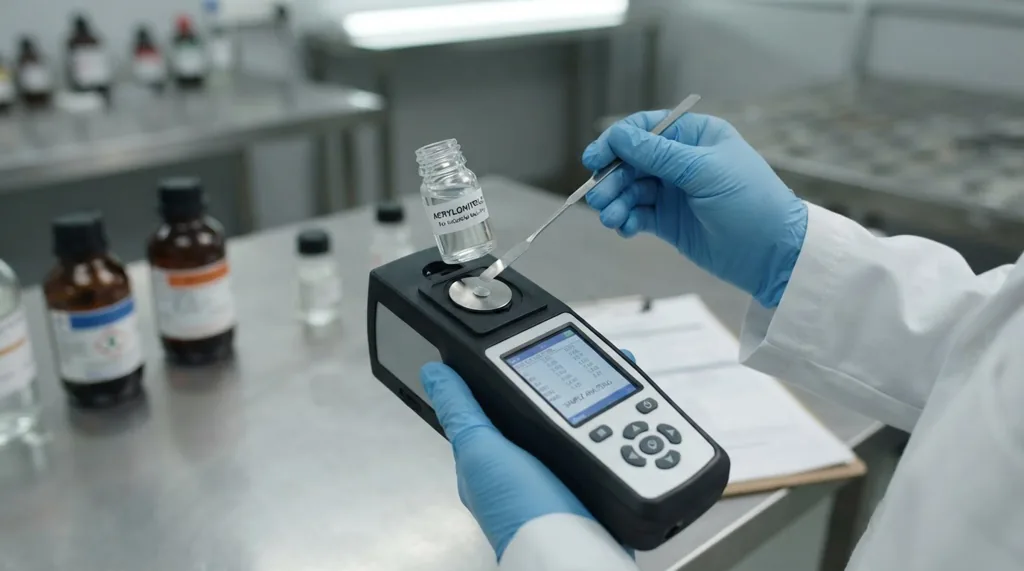
India has told customs officers, in an instruction dated Oct. 1, 2026, that listed insecticide chemicals imported for non-insecticidal use, including acrylonitrile, need an import permit under rules in force since July 8, 2026.
India’s customs board told its officers on Oct. 1, 2026, that every shipment of a listed insecticide chemical brought in for factory or other non-insecticidal use, including acrylonitrile, must have an import permit under rules in force since July 8, 20261.
The order is Instruction No. 18/2026-Customs from the Central Board of Indirect Taxes and Customs (CBIC), the agency that runs India’s customs offices1. It goes to all customs commissioners and directors general across the country.
In short, some chemicals are listed as insecticides under Indian law but also have industrial uses in factories. A company that imports one of them for such a use now needs a permit from India’s pesticide registration body, and customs officers have been told to check for it.
What does the CBIC instruction say?
The instruction passes on a message that CBIC received on Sept. 21, 2026, from the Directorate of Plant Protection, Quarantine and Storage (DPPQ&S)1. DPPQ&S is the plant-health office of India’s agriculture ministry. Its message concerned a gazette notice of July 8, 2026, that amended the Insecticides Rules, 19711.
The instruction makes four points:
- The permit is now law. The Registration Committee found that the gazette notice "has force of law" and binds every applicant1.
- It covers every listed substance. It applies to anyone importing a substance in the Schedule to the Insecticides Act, 1968, for non-insecticidal purposes1.
- One form for all. All permit applications must now be made in the form set by the rules1.
- Acrylonitrile is included. The instruction names this chemical directly1.
CBIC told its field offices to bring the rules to the notice of all officers "for information and compliance"1. It asked them to report any difficulties back to the board.
Why does acrylonitrile get its own mention?
Acrylonitrile had a special legal history. The Registration Committee is the body under the Insecticides Act that grants registrations and import permits. In July 2026 it read a letter from Supreme Petrochem Ltd dated July 24, 20261.
The letter pointed to an order of the Gujarat High Court dated Nov. 19, 20251. According to the committee’s minutes, that order had set aside the permit requirement for acrylonitrile imported for non-insecticidal use.
The committee answered that the situation had changed. The permit requirement is now written into the Insecticides Rules themselves by the July 8 gazette notice1. For that reason it is a statutory requirement, meaning one set by law, and it applies to all substances "including acrylonitrile"1. The committee told its staff to inform Supreme Petrochem of this decision.
What did the July 2026 gazette notice change?
The legal basis is the Insecticides Third (Amendment) Rules, 2026, published as G.S.R. 597(E) by the Ministry of Agriculture and Farmers Welfare1. The rules state that they came into force on the day they were published in the official gazette, July 8, 20261.
From draft rule to customs order
The government made the rules under section 36 of the Insecticides Act, 19681. A draft was first published on Nov. 18, 2025, as G.S.R. 855(E), and copies were made public on Nov. 19, 20251. The public had 30 days to send objections and suggestions, and the government says it considered those it received.
The rules add a new clause (c) to rule 4 of the 1971 rules1. They also add a new chapter titled "Manner of import of an insecticide for non-insecticidal purpose" with a new rule 8A, and a new application form, Form IA1.
How does a company get the import permit?
Rule 8A sets out the steps1. In order:
- The importer sends an application in Form IA to the Registration Committee.
- The importer pays an application fee of 5,000 rupees with the form.
- The committee may hold an enquiry to check the information given.
- The committee decides on a complete application, preferably within 45 days. This period may be extended by not more than 15 days.
Time to decide a complete application, days
The notes to Form IA give a shorter target. They say an application should be decided "preferably in 30 days", or 4 to 6 weeks as set by the committee, after a complete form is received on the online portal1. An incomplete application can be rejected without notice.
Earlier, a separate step applied for some chemicals. The Department of Chemicals and Petrochemicals says industry had to get its import request recommended by that department before applying to the Registration Committee2. Its checklist asked for a factory licence, an affidavit, three years of production and use figures, a pollution board clearance and a justification for the imports2.
How long is an import permit valid?
A permit granted under rule 8A is valid for one year1. The rules make one exception.
Two kinds of import permit
| Question | Standard permit | Pesticide maker’s permit |
|---|---|---|
| Who holds it | Any non-insecticidal importer | Holder of a pesticide registration |
| Use of the chemical | Non-insecticidal use | Raw material for that pesticide |
| Valid for | One year | Three years |
| Application | Form IA, 5,000 rupees | Form IA, 5,000 rupees |
If the importer holds a certificate of registration for a pesticide, and the imported chemical will be used as raw material for that pesticide, the permit is valid for three years1. This longer term helps pesticide makers who import dual-use chemicals as inputs.
What must the Form IA application show?
Form IA asks for detailed facts about the importer’s factory and its use of the chemical1. The main items are:
- Name and address of the applicant, and the place where the chemical will be stored or used.
- The chemical and its minimum purity, plus the full address of the foreign supplier.
- The product made with it, the plant’s licensed and installed capacity, and what the chemical does in the process.
- The yearly quantity, in metric tonnes, to be imported.
- A factory or industrial licence and a current clearance from the Pollution Control Board.
- Three years of import and use figures, with the matching output of the final product.
- A sworn statement justifying the quantity asked for.
Papers attached to Form IA
The form also asks whether the chemical is for use in India, for export, or both1. For use in India, a local industrial health and safety office must certify that the chemical will be stored apart from other materials to avoid poisoning. For export, the importer must name the foreign buyer of the finished product and attach an advance licence where one applies.
What limits and exemptions apply?
The form sets a check on quantity. If the amount asked for differs by more than 30% from average use over the last three years, the applicant needs a detailed justification from the relevant ministry, department or state industry department1.
The applicant must also promise that the imported chemical is not for sale but only for its own stated use1. If any information proves wrong, the permit can be cancelled without notice, and the losses fall on the applicant.
One small exemption is written into the form. No permit is needed for unit packs of 5 grams or less of certified reference material or reference standards of insecticides or pesticides1. Every other shipment of a listed substance for non-insecticidal use needs a permit.
Who is affected by the new permit rule?
The rule reaches any company that imports a listed insecticide substance for a use other than killing pests. The Department of Chemicals and Petrochemicals notes that some chemicals in the Act’s schedule also have industrial uses2.
For these companies, a shipment now needs the Registration Committee’s permit before customs will clear it. CBIC’s instruction tells customs officers to apply the rule, so a cargo without a permit can be held at the port.
Importers of acrylonitrile face the biggest change. Some had relied on the Gujarat High Court order of November 2025 to import without a permit1. The committee’s view is that this route has closed since the rules came into force.
Customs brokers who file entries for these chemicals will also need the permit details. Foreign suppliers are affected too, since Form IA asks for their full address1.
What happens to applications already filed?
The Registration Committee, at its 474th meeting on July 30, 2026, replaced all its earlier decisions on import permits1. It said it would follow the July 8 notification from then on.
Applications already pending with the committee’s office will be dealt with under the revised guidelines1. The committee told its office to issue a public notice with the guidelines and forms. It also asked for the decision to be sent to the Directorate General of Foreign Trade (DGFT), the commerce ministry body that sets India’s import and export policy1.
The DPPQ&S letter to CBIC says the public notice has been put on the directorate’s website1. The same letter was addressed to DGFT for "necessary action"1.
Key points on India’s insecticide import permit
The table sums up the new rule for non-insecticidal imports.
| Question | Answer |
|---|---|
| What changed? | Import permit needed for non-insecticidal use |
| Who told customs? | CBIC, Instruction No. 18/2026-Customs |
| Date of instruction | Oct. 1, 2026 |
| Legal basis | Insecticides Third (Amendment) Rules, 2026 |
| Rules in force since | July 8, 2026 |
| Which goods? | Substances in the Insecticides Act schedule |
| Named chemical | Acrylonitrile |
| Who grants permits? | The Registration Committee |
| Application form and fee | Form IA, 5,000 rupees |
| Decision time | Preferably 45 days, plus up to 15 |
| Permit validity | One year; three years for pesticide makers |
| Exemption | Reference packs of 5 grams or less |
With CBIC’s instruction now in the hands of customs officers, shipments of acrylonitrile and other listed chemicals for industrial use need a Registration Committee permit to clear Indian ports1. Each permit lasts one year, or three years for registered pesticide makers, so importers will return to the committee on that cycle.
Sources
- ↩ gst_1790859338InstructionNo18-2026-Customscompressed.pdf https://gstclub.in/storage/documents/gst_1790859338InstructionNo18-2026-Customscompressed.pdf
- ↩ CIB&RC | Department of Chemicals and Petrochemicals https://chemicals.gov.in/cibrc