
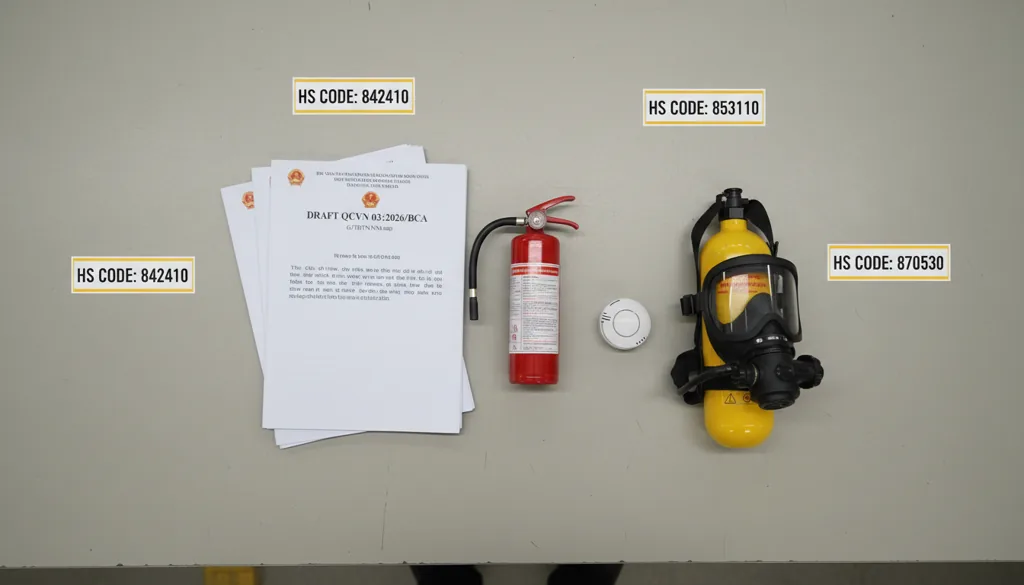
Viet Nam has drafted new national technical regulations to standardize safety, performance, and quality requirements for fire protection and rescue equipment.
Viet Nam’s Ministry of Public Security has put a revised draft circular before its minister for signature that would bring in a new national technical regulation for fire protection and rescue equipment, QCVN 03:2026/BCA, for goods made, assembled or imported in Viet Nam from a start date in 20271.
The new rule would replace QCVN 03:2023/BCA, the regulation in force since 2023, and the circular that issued it, Circular No. 56/2023/TT-BCA of Oct. 30, 20231. The draft was written by the ministry’s Fire Prevention, Firefighting and Rescue Police Department, which also notified it to the World Trade Organization (WTO) in April2.
In short, Viet Nam is updating the safety tests that fire extinguishers, fire alarms, sprinkler heads and similar goods must pass. It is also dropping the old rule that each product needed a permit before sale, and replacing it with testing, an online product declaration and checks after the goods are on the market.
What is Viet Nam changing for fire equipment?
The draft regulation sets technical requirements, test methods and the number of samples to test for fire protection and rescue equipment2. It also sets rules on testing and approval, sampling, labelling and tracing the goods back to their maker2.
Under the draft circular, equipment made, assembled or imported from the start date must meet QCVN 03:2026/BCA1. The maker or importer must also complete testing and approval, declare that the product meets the regulation, file product information, label the goods and keep records to trace them1. The level of these duties depends on how risky the product is1.
The regulation has four main parts and annexes: general rules, technical requirements for each product, management rules, and implementation3. The management part covers testing and approval, the information declaration, labelling and checks after sale3.
Why is the Ministry of Public Security rewriting QCVN 03?
The department gives two main reasons in its submission to the minister. First, Viet Nam’s laws on fire safety, product quality and technical standards have changed a great deal since 20233. Second, new kinds of fire and rescue equipment are now made, imported and used in Viet Nam, but the current regulation does not cover them3.
Many of the standards the 2023 regulation refers to, including ISO, EN and NFPA standards, have also been revised or replaced3. The department says the rewrite will bring Vietnamese rules closer to international standards and cut the cost of following the rules for businesses3.
The ministry’s explanatory report stresses safety. Fire and rescue equipment only proves its worth in an emergency, and a small quality fault can mean a fire is not brought under control4. The report also points to fast urban growth, more industrial zones, warehouses and high-rise buildings, and more extreme weather4.
The WTO notification gives the purpose as protection of human health or safety and quality requirements2.
How did the fire equipment rules get here?
Viet Nam’s rules for these goods have changed twice in a short time. The National Assembly passed Law No. 55/2024/QH15 on fire prevention, firefighting and rescue on Nov. 29, 2024, and it took effect on July 1, 20254. Under that law, fire and rescue equipment made in Viet Nam must meet the declared standards and technical regulations before it is sold4.
From permit to declaration
The government then issued Decree No. 105/2025/ND-CP on May 15, 20254. Its Article 23 set up a circulation permit, a licence each listed product needed before going on the market4. That permit replaced the earlier system, in which every shipment had to be inspected before sale4.
Now the permit itself is going. On June 27, 2026, the Government Office told the ministry, in Official Letter No. 6135/VPCP-CDS, to amend Decree 105 quickly and abolish the permit procedure4. The ministry has drafted that amending decree, which would replace the permit with an information declaration and quality checks during production, import and sale4.
How will fire equipment reach the market without a permit?
The draft moves from checks before sale to checks after sale. In the department’s words, management shifts from inspection and circulation permits to testing and approval, information declaration and post-market checks3.
Getting fire equipment on sale, old rule and new
| Question | Decree 105 (2025) | QCVN 03:2026/BCA draft |
|---|---|---|
| Before sale | Circulation permit | Testing and approval, declaration |
| Main checks | Before sale | After sale |
In practice, the new process for a product would run like this:
- The product is tested against QCVN 03:2026/BCA, or against an international, regional or foreign standard where the regulation allows it3.
- A testing and approval body assesses it, using the method set for home-made or imported goods3.
- The maker or importer declares that the product meets the regulation and files the product information1.
- The goods are labelled and can be traced, and the authorities check quality after sale1.
The ministry is building a database for fire prevention, firefighting, rescue and fire alarm messages3. It says it only needs to add an electronic declaration function to it, at no large cost3.
The draft also sets rules on accepting results from testing and approval bodies in Viet Nam and abroad3. The explanatory report says that accepting foreign results and moving to checks after sale fits international practice and Viet Nam’s commitments under the WTO, EVFTA and CPTPP4.
How many fire and rescue products does the draft cover?
The draft shrank between its first and second versions. The first version set requirements for 85 types of equipment with 865 technical criteria3. The second version covers 57 types of equipment with 481 technical criteria3.
Equipment types covered, by draft
The draft also has one shared group of requirements for parts that use radio links3. It refers to 49 standards, of which 41 are Vietnamese national standards (TCVN) and 8 are ISO standards3. It draws on 42 more as reference, including 16 ASTM standards3.
Of the 57 types, 32 were already in the 2023 regulation and have been reviewed and updated3. Among their criteria, 123 stay the same or change only in wording, 159 are amended, and 42 are new3.
Nine types of equipment in the 2023 regulation are dropped3. These carry 106 of the 2023 regulation’s 439 technical criteria, about 24.1%3. The department says it dropped them to match the ministry’s new list of medium-risk and high-risk goods3. The draft also reviews 38 technical terms and updates the HS codes, the customs codes for each product, to match Viet Nam’s import and export goods list3.
Which new fire products join the list?
The draft adds 25 new types of equipment, 43.9% of the 57, with 150 new technical criteria3. The new products are:
- foam-shell powder extinguishers and mini fire extinguishers;
- low-expansion foam for fighting fires in liquids that mix with water;
- 10 fire-fighting gases, including FK-5-1-12, HFC-227ea, IG-541 and carbon dioxide (CO2), and the cylinders that hold them;
- video fire detectors;
- containers of solid material that makes fire-fighting aerosol;
- powder spray heads; and
- water-mist spray heads for low, medium and high pressure3.
Makers of these goods have not needed to meet QCVN 03 before. From the start date, a shipment of one of these products would need test results against the new rule. The department says local testing bodies will need more equipment to test the 25 new types3.
Which fire products count as high risk?
The new regulation follows Viet Nam’s amended product quality law, Law No. 78/2025/QH15, in force since Jan. 1, 20264. That law sorts goods into low, medium and high risk instead of treating some goods as "possibly unsafe"4.
The ministry set its own list in Circular No. 125/2026/TT-BCA of June 30, 20264. In it, high-risk goods are those that directly affect fire-fighting and human safety, such as fire extinguishers, fire-fighting agents and gas cylinders4. These goods face stricter testing and approval, testing, state quality checks and tracing4.
Medium-risk goods include fire alarm control panels, fire detectors, sprinkler heads, emergency lights, exit signs, fire pumps, fire hydrants, alarm valves, deluge valves and fire hoses4. For these, the rules match the risk of each product, to balance control with easier production, import and trade4.
Do imported fire extinguishers and alarms have to comply?
The draft circular names importers directly. It applies to organisations and people who make, assemble, import, trade or use fire and rescue equipment3. Equipment imported from the start date must meet the new regulation1.
The WTO notification of April 23, 2026, said something different. It stated that imported fire protection and rescue equipment was not subject to mandatory application under section 1.1.2 of the draft2. The revised draft circular does not repeat that line, and its scope and transition rules cover imported goods1.
For each group, the draft would mean these changes:
- Importers must have goods tested and approved, declare them and file product information, instead of seeking a circulation permit1.
- Makers abroad can have test results from foreign bodies considered, under the draft’s rules on accepting foreign results3.
- Testing bodies already appointed for this equipment can keep working under the new circular until their appointment expires1.
- Traders and users of the equipment are also covered by the regulation3.
When could the fire equipment rules start?
No start date is fixed yet. The draft circular leaves the day and month blank and says it takes effect in 20271. The department asks the minister to let it take effect at the same time as the amended Decree 105, which abolishes the permit, so that no gap opens in quality control3.
Viet Nam’s standards law says a technical regulation takes effect at least six months after it is issued, unless safety makes it urgent3. The department says the plan has a transition of at least 6 months3. The drafting work runs from July 2025 to the end of December 20264.
The April WTO notice had proposed adoption on June 15, 2026, and entry into force on July 1, 20262. Comments were due by May 23, 20262. Those dates have passed without the rule being issued.
What happens to tests already done?
The draft circular sets four transition rules1:
- Applications for testing and approval received before a date in 2026 that is still blank, and not yet decided, continue under QCVN 03:2023/BCA1.
- Testing bodies appointed for the old group of fire equipment keep working until their appointment expires1.
- Test results issued before the start date can still be used if the sample is the same model, the product has not changed, and the test is no weaker than QCVN 03:2026/BCA1.
- The testing and approval body must check and confirm that old results may be used1.
This means a maker with recent test reports may not need to test again, if the product and the test are the same. The testing body takes responsibility for that decision1.
Key points on QCVN 03:2026/BCA
The table sums up the draft regulation.
| Question | Answer |
|---|---|
| What is it? | National technical regulation for fire and rescue equipment |
| Who issues it? | Viet Nam’s Ministry of Public Security |
| What does it replace? | QCVN 03:2023/BCA and Circular 56/2023/TT-BCA |
| How many product types? | 57, down from 85 in draft one |
| How many new types? | 25, including mini extinguishers and video detectors |
| How many technical criteria? | 481 |
| What goes away? | The circulation permit before sale |
| What replaces it? | Testing, online declaration, checks after sale |
| High-risk goods | Extinguishers, fire-fighting agents, gas cylinders |
| Are imports covered? | Yes, under the revised draft circular |
| Start date | A date in 2027, not yet set |
| Transition | At least 6 months |
The next step is the minister’s signature on the circular. It will take effect with the amended Decree 105, on a date in 2027 that the draft does not yet give1.
Sources
- ↩ library-20260921182835-d8c5396a-7cc1-4cd2-ab06-e425ecbb38ec-6-du-thao-thong-tu-ban-hanh-qcvn03-2026-bca-ver2-5.pdf https://bocongan.gov.vn/media/bca-media/library-20260921182835-d8c5396a-7cc1-4cd2-ab06-e425ecbb38ec-6-du-thao-thong-tu-ban-hanh-qcvn03-2026-bca-ver2-5.pdf
- ↩ Draft QCVN 03:2026/BCA – National technical regulation on Fire protection and Rescue equipment; (130 page(s), in Vietnamese) https://docs.wto.org/dol2fe/Pages/SS/directdoc.aspx?filename=Q:/G/TBTN26/VNM400.pdf&Open=True
- ↩ Microsoft Word – 5. Tờ trình ký Thông tư https://bocongan.gov.vn/media/bca-media/library-20260921182836-03d4cb59-3e1b-4782-b015-9e0207503731-5-to-trinh-ky-thong-tu.pdf
- ↩ library-20260921182836-a2adea2a-843c-455d-a0e5-1841abf13a82-2-0-thuyet-minh-qcvn-03-2026-bca-ver2-5-17-8-26.pdf https://bocongan.gov.vn/media/bca-media/library-20260921182836-a2adea2a-843c-455d-a0e5-1841abf13a82-2-0-thuyet-minh-qcvn-03-2026-bca-ver2-5-17-8-26.pdf