
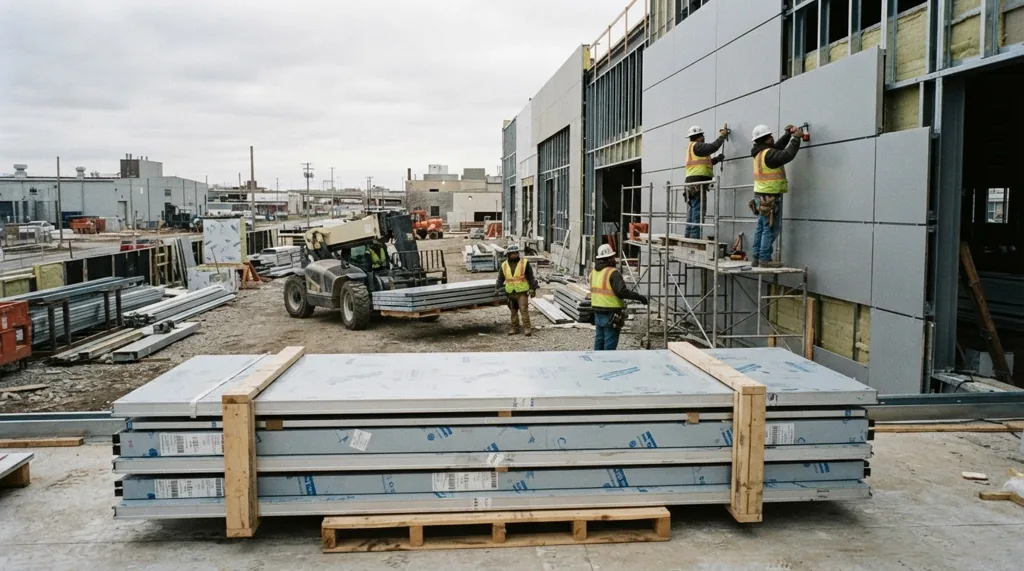
United States of America: Commerce opened an inquiry on Oct. 2, 2026, into whether Alumetal’s aluminum composite panels from China evade duties on Chinese common alloy aluminum sheet.
The U.S. Department of Commerce on Oct. 2, 2026, opened an inquiry into whether aluminum composite panels made in China by Shanghai Alumetal Decorative Material Co. are evading the U.S. anti-dumping and countervailing duties on Chinese common alloy aluminum sheet1.
The panels are thin building boards: a plastic core pressed between two very thin aluminum sheets. Commerce suspects they may be aluminum sheet changed only slightly, so that they slip past duties that have applied to Chinese sheet since 20191.
In short, Commerce is checking whether one Chinese maker’s panels are really taxed aluminum sheet in a new form. While it checks, U.S. customs will hold the final duty bill open on these shipments and can ask importers for a cash deposit at the sheet duty rates.
What did Commerce start on Oct. 2?
Commerce started a circumvention inquiry, an investigation into whether goods have been changed or rerouted to avoid an existing duty1. The notice was published in the Federal Register on Oct. 2, 2026, and applies from that date1. It was signed on Sept. 24, 2026, by an acting deputy assistant secretary in Commerce’s International Trade Administration1.
Commerce opened the case on its own, without a request from a U.S. producer. The Federal Register notice calls this "self-initiating"1. It said the information it already holds supports opening an inquiry1.
The inquiry covers one company’s goods. These are aluminum composite panels, or ACPs, produced in China by Shanghai Alumetal Decorative Material Co., which the notice calls Alumetal, and exported to the United States1.
Which aluminum panels does the inquiry cover?
The notice describes the panels in exact terms. To fall inside the inquiry, a panel must have all of these features1:
- a plastic core of low-density polyethylene (LDPE), the soft plastic used in many films and bags;
- two aluminum sheets pressed onto the core and permanently bonded to it;
- each sheet 0.2 mm thick or less;
- a total panel thickness of 6.3 mm or less, but more than 0.2 mm;
- aluminum made from 1100 alloy, a nearly pure grade of aluminum.
The panel must also be produced by Alumetal in China and exported to the United States1. Panels from other Chinese makers are not named in this inquiry. Panels with a different core, alloy or thickness are also outside its description.
The thickness range matters. The duty orders cover flat aluminum products between 0.2 mm and 6.3 mm thick1. The panels’ total thickness falls in that same band.
What are the duty orders on aluminum sheet?
The inquiry tests these panels against two older orders. Commerce published a countervailing duty order, an extra import tax that cancels out government subsidies paid to foreign makers, on Feb. 6, 20192. It published an anti-dumping duty order, an extra import tax on goods sold abroad below their normal price, on Feb. 8, 20193.
Both orders followed findings by the U.S. International Trade Commission (ITC), the agency that decides whether imports harm U.S. industry. On Jan. 30, 2019, the ITC found that Chinese common alloy sheet was materially injuring a U.S. industry3. It reached that finding for both the dumped imports and the subsidized imports2.
The orders cover flat-rolled aluminum 6.3 mm thick or less but over 0.2 mm, in coils or cut to length, of any width1. The sheet is made from 1XXX-, 3XXX- or 5XXX-series alloys, as named by the Aluminum Association, an industry body1. Clad sheet with a 3XXX-series core and outer layers on one or both sides is also covered1.
The orders also reach Chinese sheet that is processed further in another country. Painting, varnishing, cutting, punching, slitting, annealing or tempering abroad does not remove sheet from the orders1.
Which aluminum products stay outside the orders?
One product is excluded by name: aluminum can stock, the sheet used to make drink cans, can lids and the tabs that open them1. Can stock is 0.200 mm to 0.292 mm thick, has one of four hardness grades (H-19, H-41, H-48 or H-391), and carries a lubricant on its surface1. It falls under U.S. tariff codes 7606.12.3045 and 7606.12.30551.
Covered sheet normally enters under eight U.S. tariff codes: 7606.11.3060, 7606.11.6000, 7606.12.3090, 7606.12.6000, 7606.91.3090, 7606.91.6080, 7606.92.3090 and 7606.92.60801. It may also enter under seven others, including 7606.11.3030 and 7607.11.90901.
The codes are only a guide. The written product description decides what the orders cover, not the tariff code1. The law also allows changed goods to be covered "whether or not included in the same tariff classification"1. So a panel entered under a different code can still be pulled into the orders.
How high are the duties on Chinese sheet?
The 2019 orders set the deposit rates that applied at the start. Under the anti-dumping order, most named Chinese exporters had a rate of 49.85%3. The rate for all other Chinese exporters, called the China-wide entity, was 59.72%3.
Subsidy duty rates in the 2019 order, %
The countervailing order set separate subsidy rates. Two Chalco companies had 116.49%, Henan Mingtai and Zhengzhou Mingtai had 46.48%, and Yong Jie New Material had 55.02%2. All other companies had 50.75%2.
Both duties can apply to the same shipment. These are the rates in the 2019 orders. Later reviews of individual companies can change them, so the rates in force today may differ.
Alumetal is not named in the 2019 tables of company rates3, 2. The notice does not say which rate its panels would face.
Why did Commerce act against Alumetal?
The inquiry grew out of an earlier case. On April 14, 2025, Commerce opened a scope inquiry, a check on whether a product already falls inside an existing order1. That case looked at ACPs made by Alumetal and imported by Aluminum Line Products Company, or ALPCO1.
Commerce said it studied the evidence in that scope case and decided a circumvention inquiry is warranted1. The new inquiry asks whether the panels evade the orders if they are found not to be covered by the orders’ product description1. It works as a second test of the same goods.
The legal test is about minor changes. U.S. trade law lets duty orders cover goods "altered in form or appearance in minor respects"1. Commerce can weigh five points1:
- the physical features of the goods;
- what final buyers expect from them;
- how the goods are used;
- how they are marketed and sold;
- what the change costs compared with the value of the imported goods.
Commerce’s full reasons are in an initiation memorandum published with the notice1. The notice itself does not give figures on trade volumes or prices.
What changes at the border for these panels?
Commerce will tell U.S. Customs and Border Protection (CBP) about the inquiry1. CBP will keep suspension of liquidation in place for panels already under it1. This means customs does not close the final duty bill on a shipment until Commerce decides.
CBP will also apply the cash deposit rate that would apply if the panels were inside the orders1. A cash deposit is money the importer pays at entry as security against the duties that may be owed later.
If Commerce later finds the panels are evading the orders, the rules widen. CBP would then suspend and take deposits on entries not yet suspended, made on or after Oct. 2, 20261. Commerce may also reach back to unsettled entries made before that date1. It cannot reach entries made before Nov. 4, 2021, when these rules took effect1.
Who is affected by the Alumetal inquiry?
The importer pays U.S. duties, so U.S. buyers of Alumetal’s panels carry the cost. They may face cash deposits at entry and an open final bill. The earlier scope case named ALPCO as an importer of these panels1.
Alumetal itself, as the Chinese maker and exporter, faces the risk that its panels are treated as Chinese common alloy sheet. Other Chinese panel makers are not named, so their shipments are not part of this case.
Commerce runs one inquiry for both orders. Under its rules, the case runs on the anti-dumping record only1. When it ends, Commerce will copy its final finding onto the countervailing duty record1. So one decision will settle both duties.
How a past case on alloy 4017 ended
Commerce has done this before with Chinese aluminum sheet. In 2023 it ran a circumvention inquiry on sheet made from aluminum alloy 40174. That alloy is not in the 1XXX, 3XXX or 5XXX series named in the orders.
Two circumvention cases on Chinese aluminum
| Question | Alloy 4017 sheet | Alumetal panels |
|---|---|---|
| Goods | Sheet made from alloy 4017 | Panels with plastic core |
| Who is covered | Whole country | One maker, Alumetal |
| Status | Final finding July 27, 2023 | Opened Oct. 2, 2026 |
Commerce found on July 27, 2023, that 4017 sheet was changed in only minor ways and belonged inside the orders4. It applied the finding to the whole country, not one company4. CBP was told to take deposits at the order rates on 4017 sheet entered on or after Aug. 26, 20224.
When will Commerce decide on the panels?
The orders themselves remain in force. In 2024 Commerce and the ITC found that ending them would likely lead to more dumping, subsidies and harm to U.S. industry5. Commerce kept both orders, effective Aug. 28, 20245.
Key dates for the aluminum sheet orders
For the panel inquiry, Commerce intends to issue its final determination within 300 days of the Oct. 2, 2026 notice, unless it drops the case1. That points to a decision by late July 2027. Commerce may issue a preliminary finding before that1.
Key points on the Alumetal aluminum panel inquiry
The table sums up the inquiry.
| Question | Answer |
|---|---|
| What changed? | Commerce opened a circumvention inquiry |
| Who issued it? | U.S. Department of Commerce |
| When was it published? | Oct. 2, 2026 |
| Which goods? | Aluminum composite panels with plastic core |
| Which maker? | Shanghai Alumetal Decorative Material Co. |
| Panel thickness | Over 0.2 mm, up to 6.3 mm |
| Which orders? | Anti-dumping and countervailing orders from 2019 |
| 2019 China-wide anti-dumping rate | 59.72% |
| 2019 all-others subsidy rate | 50.75% |
| What happens at the border? | Liquidation stays suspended; cash deposits apply |
| Final decision due | Within 300 days |
Until Commerce decides, Alumetal panels entering the United States face deposits as if they were Chinese aluminum sheet. A final finding is due within 300 days of Oct. 2, 2026.
Sources
- ↩ Federal Register :: Common Alloy Aluminum Sheet From the People’s Republic of China: Initiation of Circumvention Inquiry of the Antidumping Duty and Countervailing Duty Orders https://www.federalregister.gov/documents/2026/10/02/2026-20256/common-alloy-aluminum-sheet-from-the-peoples-republic-of-china-initiation-of-circumvention-inquiry
- ↩ Federal Register :: Common Alloy Aluminum Sheet From the People’s Republic of China: Countervailing Duty Order https://www.federalregister.gov/documents/2019/02/06/2019-01273/common-alloy-aluminum-sheet-from-the-peoples-republic-of-china-countervailing-duty-order
- ↩ Federal Register :: Common Alloy Aluminum Sheet From the People’s Republic of China: Antidumping Duty Order https://www.federalregister.gov/documents/2019/02/08/2019-01836/common-alloy-aluminum-sheet-from-the-peoples-republic-of-china-antidumping-duty-order
- ↩ Federal Register :: Common Alloy Aluminum Sheet From the People’s Republic of China: Affirmative Final Determination of Circumvention of the Antidumping and Countervailing Duty Orders; 4017 Aluminum Sheet https://www.federalregister.gov/documents/2023/07/27/2023-15947/common-alloy-aluminum-sheet-from-the-peoples-republic-of-china-affirmative-final-determination-of
- ↩ Federal Register :: Common Alloy Aluminum Sheet From the People’s Republic of China: Continuation of Antidumping and Countervailing Duty Orders https://www.federalregister.gov/documents/2024/09/06/2024-19942/common-alloy-aluminum-sheet-from-the-peoples-republic-of-china-continuation-of-antidumping-and