
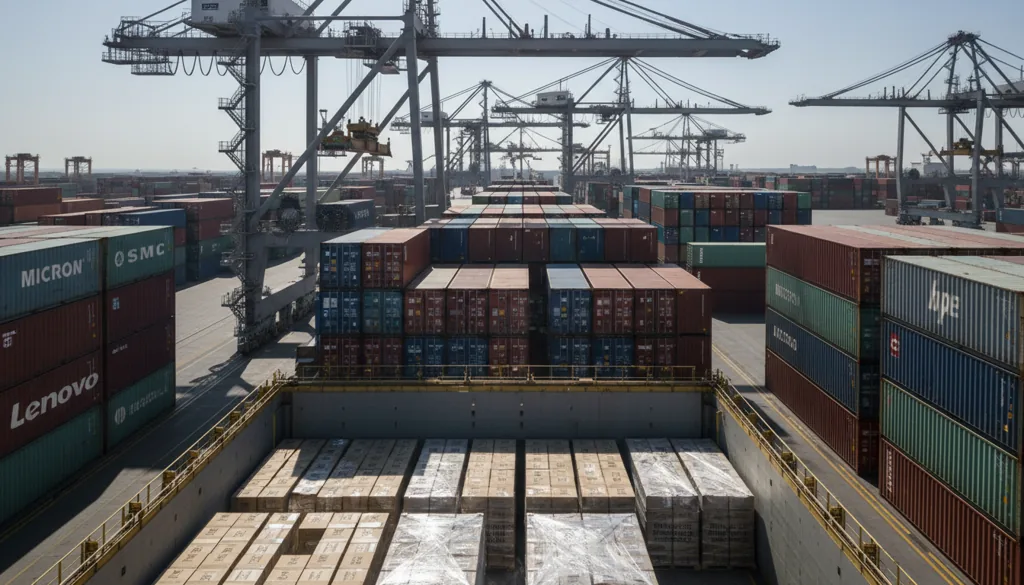
United States International Trade Commission initiated a Section 337 investigation into certain dynamic random access memory devices, products containing the same, and components thereof following a complaint filed on August 11, 2026.
The U.S. International Trade Commission voted on Sept. 22, 2026, to open a patent investigation into imported DDR5 memory modules and the servers, computers and storage systems that contain them, a case that could end in a ban on those imports1.
The case, Investigation No. 337-TA-1523, follows a complaint filed on Aug. 11, 2026, by Netlist, Inc. of Irvine, California2. The Commission published its notice of institution in the Federal Register on Sept. 25, 20261.
In short, a California company says that some imported server memory copies its patented designs. If the Commission agrees, U.S. customs could stop shipments of these memory modules, and of servers built with them, from the named companies at the border.
What is the Netlist complaint about?
Netlist filed its complaint under section 337 of the Tariff Act of 1930, a U.S. law against unfair practices in import trade1. A supplement to the complaint followed on Aug. 25, 20262. The complaint says the goods break U.S. patent law when they are imported, sold for import, or sold in the United States after import1.
Under section 337, infringing a U.S. patent in import trade is an unlawful practice in itself3. Infringing means making, using or selling something that a patent protects without the owner’s permission. In patent cases, the complaining company does not need to show that the imports injured it3.
Netlist also says that an industry in the United States exists, or is being set up, for the patented products1. This is a legal condition of every section 337 patent case. Netlist asks the Commission to issue a limited exclusion order and cease and desist orders1.
Which memory products does the DRAM case cover?
The investigation covers "certain DRAM devices (specifically, DDR5 generation DIMM), and products containing the same (such as servers, computing systems, and storage systems), and components thereof"1. In plain words, these are DDR5 memory modules, the plug-in memory cards used in computers and servers. DRAM stands for dynamic random access memory, the working memory of a computer.
Patent claims in the case, by Netlist patent
The case also reaches the larger machines that hold these modules. The notice names servers, computing systems and storage systems as examples1. Parts of these products are included as well. The Commission’s rules say this plain description in the notice defines the scope of the investigation4.
Netlist relies on four U.S. patents1. The notice lists the patent claims, which are the numbered statements of what each patent protects:
- U.S. Patent No. 10,025,731: claims 1-13 and 16-18, or 16 claims1.
- U.S. Patent No. 10,217,523: claims 1-15, 17 and 18, or 17 claims1.
- U.S. Patent No. 12,373,366: claims 1-14 and 16-28, or 27 claims1.
- U.S. Patent No. 12,675,407: claims 1-20, or 20 claims1.
That makes 80 patent claims in the case. The Commission will decide whether the imports infringe one or more of them1.
Which companies does the Netlist case name?
The Commission named six companies as respondents, the companies accused of breaking section 3372. They are:
- Micron Technology, Inc., of Boise, Idaho.
- Micron Semiconductor Products, Inc., of Boise, Idaho.
- Hewlett Packard Enterprise Co., of Spring, Texas.
- Lenovo Group Ltd., of Hong Kong.
- Lenovo (United States) Inc., of Morrisville, North Carolina.
- Super Micro Computer, Inc., of San Jose, California.
Netlist is the complainant, the company that brought the case1. The Office of Unfair Import Investigations, a unit of the Commission, is also a party1. Its lawyer acts as an independent party who represents the public interest3.
Buyers of servers and storage systems from these brands may be affected. A limited exclusion order covers products of named companies5. Here that could include servers that contain the accused memory.
What could happen to DDR5 shipments at the border?
The Commission has not yet decided anything on the merits of the case2. Opening the investigation does not stop any goods today. Shipments of DDR5 memory and servers continue to enter the United States while the case runs.
The orders the Commission can issue
| Question | Exclusion order | Cease and desist order |
|---|---|---|
| What it does | Stops the products at the border | Tells companies to stop certain actions |
| Asked for by Netlist | Yes, a limited one | Yes |
| When it becomes final | 60 days after issuance | 60 days after issuance |
If the Commission finds a violation, it can use two tools3:
- An exclusion order, which tells customs to stop the products at the border. U.S. Customs and Border Protection, the border agency, enforces these orders3.
- A cease and desist order, which tells the companies to stop certain actions3.
Netlist asks for a limited exclusion order, not a general one1. The Commission’s rules allow a general exclusion order, which blocks the goods from every source, only in two cases5. One is to stop companies from getting around a limited order. The other is a pattern of violations where the source of infringing goods is hard to identify5.
If it issues an order, the Commission also sets a bond, an amount of money the respondent must post5. The rules say the bond must be large enough to protect the complainant from any injury5.
Why will the judge study the US industry and public interest?
The Commission ordered the judge in this case to take evidence on the public interest1. This means the effect that a ban would have on public health and welfare, competition in the U.S. economy, U.S. production of similar goods, and U.S. consumers5. The judge must give the Commission findings and a recommendation on these points1.
Under the rules, a judge does not normally take evidence on the public interest unless the Commission orders it5. Here the Commission did so in the notice. Before acting, the Commission can also ask the Department of Justice, the Federal Trade Commission, customs and other agencies for advice5.
The Commission also asked for a full record on the U.S. industry1. The judge may look at how far Netlist’s claims rely on spending by other companies. The judge may also look at how much of the spending linked to the U.S. products takes place outside the United States1.
How does the section 337 case move forward?
The Commission’s news release and its rules set out the path of the case2. The main steps are:
- The Chief Administrative Law Judge names the judge who will run the case1.
- Within 45 days after institution, the Commission sets a target date for finishing the investigation2.
- The judge holds a formal hearing, where the parties present evidence2.
- The judge issues an initial determination on whether section 337 was broken2.
- The Commission may review that decision and adopt, change or reverse it3.
- The Commission makes a final determination and decides on any orders2.
If the Commission does not review the judge’s decision, that decision becomes the Commission’s final decision3. Appeals of Commission orders go to the U.S. Court of Appeals for the Federal Circuit3.
The judge usually issues a protective order soon after the case starts3. It controls how the companies’ confidential business data is handled.
What must the six DRAM respondents file?
The six named companies must answer the complaint and the notice. The Commission will consider their answers if they arrive within 20 days after service, the date the Commission sends them the complaint and notice1. The Commission will extend this deadline only for good cause1.
Each answer must be made under oath and respond to every claim in the complaint6. Each answer must include, where available, data on the quantity and value of imports of the accused goods6. Respondents that are importers must also give the Harmonized Tariff Schedule numbers for their imports6. These are the customs codes used to classify goods at the U.S. border.
Respondents that do not make the accused goods themselves must name and give the address of their suppliers6. If possible, each respondent must also send a sample of the accused product with its answer6.
A company that does not answer in time risks losing the case. The Commission may then accept Netlist’s claims as true and issue an exclusion order, a cease and desist order, or both1.
When could a DDR5 import ban take effect?
No ban date is set yet. The investigation itself began with the Commission’s order of Sept. 22, 2026, and the notice was issued on Sept. 23, 20261. The Commission will set its target date for the end of the case within 45 days of institution2.
The DDR5 case so far
The Commission says it will make a final decision "at the earliest practicable time"2. Any order it then issues takes effect when issued. It becomes final 60 days after issuance, unless the U.S. Trade Representative disapproves it for policy reasons during that period2. The President gave the Trade Representative this power to veto exclusion orders in 20053.
For importers and buyers of DDR5 servers, nothing changes at the border until the Commission issues an order. After that, the 60-day review period follows.
Key points on the DDR5 memory investigation
The table sums up the main facts of the case.
| Question | Answer |
|---|---|
| What happened? | Patent investigation opened on imports |
| Who acted? | U.S. International Trade Commission |
| Case number | Investigation No. 337-TA-1523 |
| Which goods? | DDR5 memory modules, servers, computing and storage systems |
| Who complained? | Netlist, Inc. of Irvine, California |
| How many companies named? | Six, from Micron, Hewlett Packard Enterprise, Lenovo, Super Micro |
| What is asked for? | Limited exclusion order and cease and desist orders |
| Patents in the case | Four U.S. patents, 80 claims |
| Investigation opened | Sept. 22, 2026 |
| Federal Register notice | Sept. 25, 2026 |
| Answer deadline | 20 days after service |
| Next date | Target date set within 45 days |
The next step is the Commission’s target date for finishing the case, due within 45 days of institution. Until the Commission issues an order, DDR5 memory modules and the servers that contain them can still enter the United States.
Sources
- ↩ Certain Dynamic Random Access Memory (DRAM) Devices, Products Containing the Same, and Components Thereof (III); Notice of Institution of Investigation https://www.federalregister.gov/documents/2026/09/25/2026-19697/certain-dynamic-random-access-memory-dram-devices-products-containing-the-same-and-components
- ↩ USITC Institutes Section 337 Investigation of Certain Dynamic Random Access Memory (DRAM) Devices, Products Containing the Same, and Components Thereof (III) https://www.usitc.gov/press_room/news_release/2026/er0923_69264.htm
- ↩ 337 Investigations Frequently Asked Questions https://www.usitc.gov/intellectual_property/documents/337_faqs.pdf
- ↩ eCFR :: 19 CFR 210.10 — Institution of investigation. https://www.ecfr.gov/current/title-19/chapter-II/subchapter-C/part-210/subpart-B/section-210.10
- ↩ eCFR :: 19 CFR 210.50 — Commission action, the public interest, and bonding by respondents. https://www.ecfr.gov/current/title-19/chapter-II/subchapter-C/part-210/subpart-G/section-210.50
- ↩ eCFR :: 19 CFR 210.13 — The response. https://www.ecfr.gov/current/title-19/chapter-II/subchapter-C/part-210/subpart-C/section-210.13