
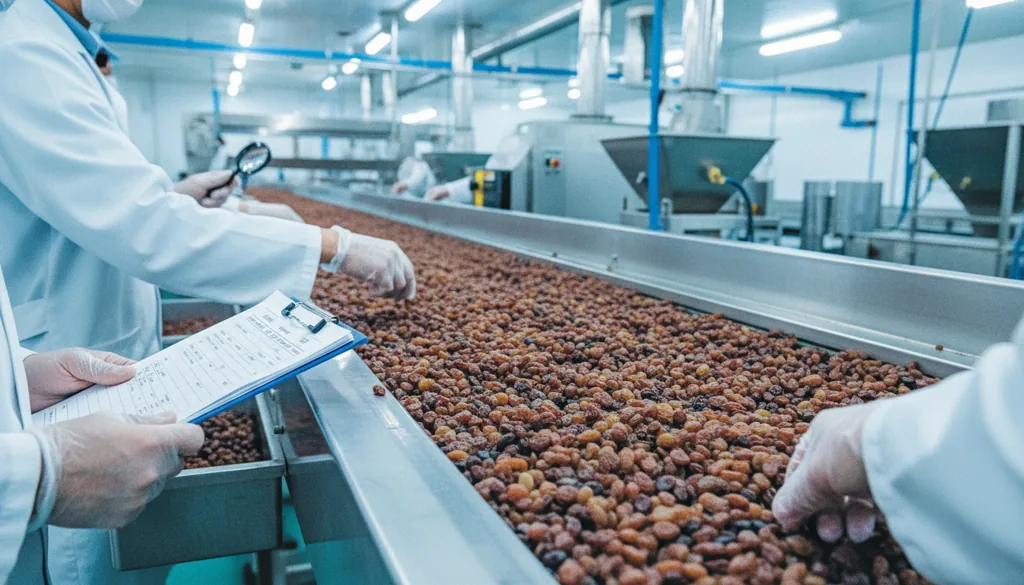
Colombia has established mandatory fitosanitary requirements for the importation of dried grapes from Argentina for human and industrial consumption, ensuring compliance with health and agricultural safety standards.
Colombia’s farm health agency, the Instituto Colombiano Agropecuario (ICA), has set the plant-health rules that seedless raisins from Argentina must meet to enter Colombia, under a resolution signed on Sept. 21, 2026 that takes effect when it is published in Colombia’s official gazette, the Diario Oficial1.
The measure is ICA Resolution No. 00018421 of Sept. 21, 20261. It covers seedless raisins (Vitis vinifera L.) grown in and shipped from Argentina, whether they are eaten as they are or used by industry1.
In short, Colombia now has a clear, written list of conditions for Argentine raisins. Each shipment needs a plant-health certificate from Argentina, must travel in new and labelled packaging, and will be inspected when it arrives in Colombia1.
What does ICA require for Argentine raisins?
Article 3 of the resolution sets out three conditions for every import1. They apply to the whole product range the resolution names: seedless raisins for human consumption, for industrial use, or for both1.
Three conditions for every raisin shipment
The three conditions are:
- A plant-health certificate issued in the country of origin. This is the official paper, called a phytosanitary certificate, that shows the goods were checked for pests before leaving.
- New packaging, properly labelled with the name of the product and the name of the exporter.
- A plant-health inspection at the point of entry, carried out in Colombia when the goods arrive.
Each condition must be met for the raisins to be imported1. The resolution does not list any pests by name, any treatment such as fumigation, or any laboratory test1.
Why did Colombia set rules for raisins?
ICA’s legal task is to protect the health of Colombia’s farm animals and crops1. The resolution says ICA must prevent the entry and spread of pests and diseases that could harm the country’s plants and animals1.
To do that, ICA studies the risk of each product before it sets import conditions1. The resolution says ICA carries out risk studies and other technical work to fix "the adequate level of protection" and to define the conditions for farm imports1. Requests for such risk studies follow an earlier rule, ICA Resolution 8389 of 20231.
The decision itself came from ICA’s Imports Committee, an advisory and decision-making group set up under ICA Resolution 13633 of 20231. That committee met on April 8, 2026 and agreed the conditions for Argentine raisins1. The resolution says it was then necessary to put the approved conditions into law1.
How does the plant-health certificate work?
The certificate comes from the national plant protection organisation of the exporting country1. In the resolution’s words, that body has a duty to issue the certificate so that plant products entering another country have been inspected or tested under official procedures1.
The certificate shows that the goods are considered free of the specified quarantine pests, which are pests that a country wants to keep out because they are not yet present or are under official control1. The resolution calls the certificate an internationally agreed document1. It says the certificate is used to show that shipments meet the destination country’s import conditions, and that this makes international trade easier1.
For Argentine raisins, the certificate is therefore the first paper a Colombian importer will need. It is issued in Argentina, before the goods are loaded.
What happens when the raisins reach Colombia?
The third condition is a plant-health inspection at the point of entry1. ICA staff carry out this check.
Under Article 4, ICA officials who inspect, watch over and control these imports act as health police inspectors1. They have the support and protection of Colombia’s civil and military authorities when they do this work, under Article 65 of Law 101 of 19931.
Every official control produces a written record, in digital or paper form1. The people taking part must sign it, and a copy stays at the place of the check1. For an importer, this means each inspection leaves a signed record of what ICA found.
Who must follow the new rules?
Article 2 says the rules apply to every person or company that imports seedless raisins of Argentine origin into Colombia1. This covers both individuals and businesses1.
Who has to act
The changes fall on several groups:
- Colombian importers must make sure each shipment arrives with the certificate and in the right packaging.
- Argentine exporters must ask their national plant protection body for a certificate and pack the raisins in new, labelled boxes or bags.
- Customs brokers and freight agents in Colombia must plan for the entry inspection by ICA.
- Food makers that use raisins as an ingredient are covered too, since the rules include raisins for industrial use.
The resolution applies only to raisins that both come from Argentina and are shipped from Argentina1. Raisins grown elsewhere, or shipped to Colombia through a third country, are not covered by this text1.
What if a shipment breaks the rules?
Article 5 sets the penalties. Breaking any part of the resolution is punished under Articles 156 and 157 of Law 1955 of 20191. The resolution says this is without prejudice to any civil or criminal action that may also follow1.
In practice, a shipment without a certificate, in used packaging, or without the product and exporter names on the label does not meet the conditions. ICA’s inspectors at the border are the ones who check this.
How was the measure drafted and notified?
ICA first published the text as a draft, which Colombia sent to the World Trade Organization (WTO)2. The draft has the same title and the same three conditions as the final resolution2. Its date and signature were left blank, to be filled in when it was signed2.
The draft said ICA would hold a national public consultation through SUCOP, the single public consultation system of Colombia’s National Planning Department2. The final resolution confirms that this consultation took place1.
Both texts explain why the WTO was told. Colombian law says that when a draft rule affects international trade, it must be notified through Colombia’s contact points at the WTO, the Andean Community (CAN) and the G3, so that others can comment1. The WTO agreement on food safety and plant-health measures also asks members to notify and publish such measures1.
ICA also filled in a competition questionnaire under Decree 2897 of 20101. It found that the rule does not affect free competition in the market, so it was not sent to Colombia’s competition authority, the Superintendency of Industry and Commerce1.
What changed between the draft and the final text?
The core of the rule did not change. The three conditions in Article 3 are worded the same way in the draft and in the signed resolution2. The rules on official control in Article 4 and on penalties in Article 5 are also the same2.
Draft and final resolution
| Question | Draft sent to WTO | Final resolution |
|---|---|---|
| Number and date | Left blank | 00018421, Sept. 21, 2026 |
| Import conditions | Three conditions | Same three conditions |
| Public consultation | Will take place | Took place |
The main changes are in the formal parts. The final text carries the number 00018421 and the date Sept. 21, 20261. It is signed by Linda Luz Barbosa Díaz, acting head of ICA’s sanitary and plant-health regulation office1. The draft spoke of a public consultation that "will" take place; the final text says it took place1.
When do the rules take effect?
Under Article 6, the resolution applies from its publication in the Diario Oficial1. The resolution was signed in Bogotá on Sept. 21, 20261. The text does not give a transition period for shipments already on their way.
The power to issue the rule comes from Decree 3761 of 2009, Decree 1071 of 2015 and ICA Resolution 13314 of 20231. That last resolution gave ICA’s sanitary and plant-health regulation office the task of issuing import conditions for animals, plants and their products1.
Key points on Colombia’s raisin import rules
The table sums up the main facts of ICA Resolution 00018421.
| Question | Answer |
|---|---|
| What changed? | Plant-health import rules set |
| Who issued it? | ICA, Colombia’s farm health agency |
| Which instrument? | Resolution No. 00018421 |
| Date signed | Sept. 21, 2026 |
| Which goods? | Seedless raisins (Vitis vinifera L.) |
| From where? | Grown in and shipped from Argentina |
| Which uses? | Human consumption and industrial use |
| Papers needed | Plant-health certificate from Argentina |
| Packaging | New, labelled with product and exporter |
| Border check | Plant-health inspection at entry |
| Penalties | Law 1955 of 2019, Articles 156 and 157 |
| Start date | On publication in the Diario Oficial |
From the day the resolution appears in the Diario Oficial, every shipment of Argentine seedless raisins will need a certificate from Argentina, new labelled packaging and an ICA inspection at the Colombian border1.
Sources
- ↩ 26_04983_00_s.pdf https://members.wto.org/crnattachments/2026/SPS/COL/26_04983_00_s.pdf
- ↩ 26_03728_00_s.pdf https://members.wto.org/crnattachments/2026/SPS/COL/26_03728_00_s.pdf