
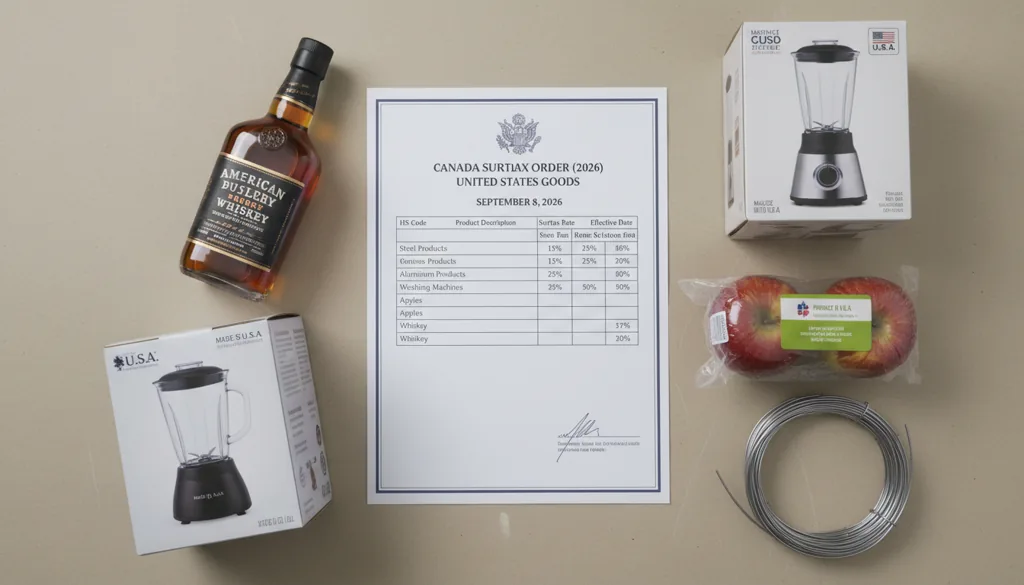
Canada introduced the United States Surtax Order (2026), applying surtax rates of 15%, 25%, or 50% on U.S.-origin goods effective September 8, 2026.
Canada’s government put an extra import tax of 15%, 25% or 50% on a list of U.S.-made goods, from cheese and furniture to milk powder and tools, starting Sept. 8, 2026.
The new tax is set out in the United States Surtax Order (2026), registered as SOR/2026-186 on Sept. 4, 20261. A surtax is an extra tax that customs collects on top of normal import duty.
In short, many U.S. goods now cost more to bring into Canada. The Canadian importer pays the surtax at the border, and the rate depends on the product.
Why did Canada tax U.S. goods from Sept. 8?
On Aug. 22, 2026, the United States put tariffs of 50% on a range of goods from Canada1. It used Section 338 of its Tariff Act of 1930 and said Canada treated U.S. cars, alcohol and dairy unfairly1. Canada rejects that claim and says its trade practices are fair.
How the two sides got here
On Aug. 25, 2026, Finance Minister François-Philippe Champagne said Canada would match the U.S. tariffs "dollar for dollar, rate for rate"2. The Canadian tax focuses on sectors such as steel, dairy, appliances, farm equipment, pulp and paper, and electronics2.
Canada chose products that the U.S. hit with its Section 338 tariffs and its Section 232 tariffs3. For each product, the Canadian rate generally matches the U.S. rate on the same goods3. The Department of Finance says the goal is to help Canadian producers compete with U.S. products at home2.
Which U.S. goods pay 15%, 25% or 50%?
The order puts each product code in one of three lists, called schedules1. The rate depends on the list:
- Schedule 1: 15% of the value for duty
- Schedule 2: 25% of the value for duty
- Schedule 3: 50% of the value for duty
Surtax by list, % of the value for duty
The value for duty is the customs value of the goods, worked out under sections 47 to 55 of Canada’s Customs Act1. Costs for transport after the goods start their direct journey to Canada are left out of this value3.
The 15% list is short and covers machinery items, such as forklift trucks and parts of air conditioners (codes 8427 and 8415)1. The 25% list includes many kinds of cheese, such as cheddar, brie, gouda and mozzarella4. It also includes appliances and some steel and aluminum products2.
The 50% list includes milk powder, whey, natural honey and sugar molasses4. The Finance department says it also covers furniture, clothing and some steel and aluminum products2. Those metal goods previously faced a 25% Canadian counter-tariff2.
How does CBSA collect the surtax on U.S. goods?
The Canada Border Services Agency (CBSA), which runs Canada’s borders, collects the surtax3. It explained the rules in Customs Notice 26-23, dated Sept. 7, 20263. The surtax comes on top of other duties, including anti-dumping duty, an extra tax on goods sold below their normal price3.
CBSA example: a $150 good at the 25% surtax
| Part | Rate | Charged on |
|---|---|---|
| Normal duty | None | Value for duty of $150 |
| Surtax | 25% ($37.50) | Value for duty of $150 |
| GST | 5% | $187.50, value plus surtax |
The notice gives a worked example. A good has a value for duty of $150, no normal duty, and a 25% surtax3. The surtax is $37.50, and the 5% GST is then charged on $187.503.
That point matters for costs. The GST, Canada’s federal sales tax, is charged on a value that includes the surtax3. So the real extra cost is a little higher than the surtax rate alone.
The surtax also applies to small parcels. It applies to shipments under the low-value "de minimis" limits and to goods sent by post or courier3. It covers both business imports and personal purchases3.
Which goods count as made in the United States?
The surtax applies only to goods that originate in the United States1. A good counts as U.S. if it can be marked as a product of the United States under Canada’s marking rules for CUSMA countries1. CUSMA is the trade agreement between Canada, the United States and Mexico.
Where the goods ship from does not matter. The surtax applies even when U.S. goods reach Canada from a third country3. Goods marked as from Puerto Rico, Guam, the Northern Mariana Islands, American Samoa or the U.S. Virgin Islands do not pay3.
For business shipments, importers must show where the goods come from. A commercial invoice can serve as proof of origin if it has the minimum details listed in CUSMA3. For personal goods, a "made in the U.S." mark is enough to make them U.S. goods3.
Which shipments escape the new Canadian surtax?
The order lists several exceptions1. The surtax does not apply to:
- goods in transit to Canada on Sept. 8, 2026
- most goods under Chapters 98 and 99, the special customs codes
- personal goods of Campobello Island residents back within 24 hours
- goods with an Import for Re-Export Program permit
What escapes the surtax
Goods in transit must be on their way and in a carrier’s hands3. Importers need proof of transit, such as a bill of lading, cargo control papers or entry reports3. A CBSA officer may ask for this proof at any time3.
Some goods do not pay twice. If a good falls under both this order and the Steel Derivative Goods Surtax Order, only this order’s surtax applies3. The surtax is also cancelled for goods covered by the Akwesasne Residents Remission Order3.
Can importers get U.S. surtax money back?
Some importers can. Canada’s Duties Relief and Duty Drawback programs cover the surtax3. These programs let firms skip or recover duty on goods they later export5.
The order also widens an existing refund rule, the United States Surtax Remission Order (2025)1. It now refunds this surtax on some goods used for health care, public safety and national defence1. It also refunds it on goods used in Canada to make products, grow farm goods or package food and drinks1.
The Finance department says Canada’s other counter-tariffs, including those on U.S. cars, stay in place2. Importers can email the department about a remission request with "U.S. Remission" in the subject line5.
The U.S. side has already moved again. It changed its Section 338 tariffs from Sept. 15 and announced import bans on some Canadian products from Sept. 29, 20265. Canada’s 15%, 25% and 50% rates stay on U.S. goods at the border under the order1.
Sources
- ↩ United States Surtax Order (2026): SOR/2026-186 https://gazette.gc.ca/rp-pr/p2/2026/2026-09-23/html/sor-dors186-eng.html
- ↩ Canada announces targeted countermeasures and substantive … https://www.canada.ca/en/department-finance/news/2026/08/canada-announces-targeted-countermeasures-and-substantive-support-for-workers-and-businesses-in-response-to-us-tariffs.html
- ↩ Customs Notice 26-23: United States Surtax Order (2026). https://www.cbsa-asfc.gc.ca/publications/cn-ad/cn26-23-eng.html
- ↩ List of products from the United States subject to counter-tariffs …. https://www.canada.ca/en/department-finance/news/2026/08/list-of-products-from-the-united-states-subject-to-counter-tariffs-effective-september-8-2026.html
- ↩ Answers to common questions about U.S. tariffs https://www.tradecommissioner.gc.ca/en/market-industry-info/search-country-region/country/canada-united-states-export/us-tariffs/answers-common-questions-tariffs.html