
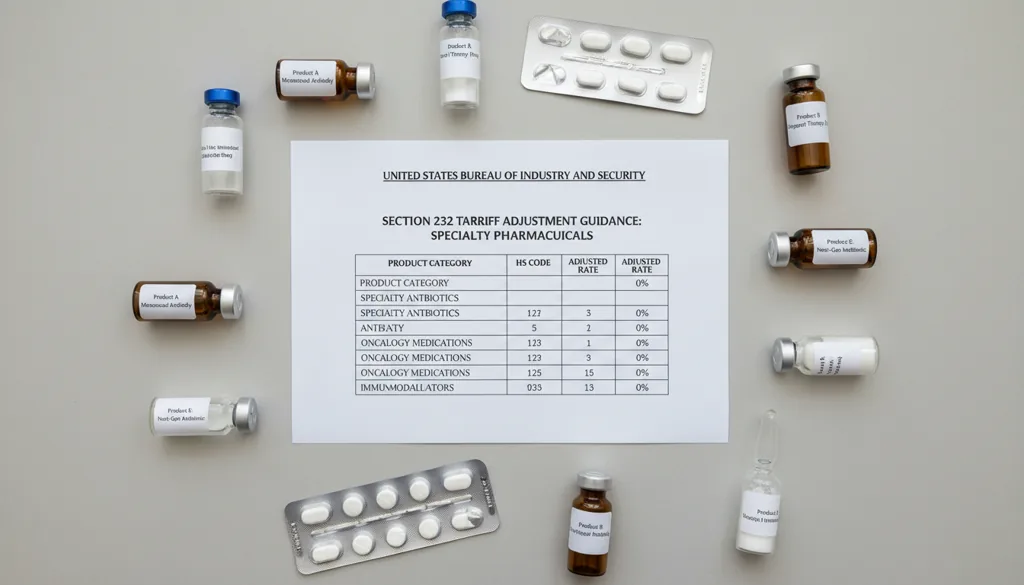
United States Department of Commerce’s Bureau of Industry and Security identified specialty pharmaceuticals eligible for a 0% Section 232 tariff rate ahead of the September 29, 2026 effective date.
The U.S. Bureau of Industry and Security (BIS) on Sept. 23, 2026 named the specialty medicines that can enter at a 0% Section 232 tariff from Sept. 29, 20261.
BIS is part of the Commerce Department. Its notice also names 19 trading partners whose specialty medicines qualify, sets up a way for companies to ask for the zero rate on health grounds, and corrects the tariff codes used at the border1.
In short, a patented medicine that would otherwise pay a 100% import tariff can pay nothing if it falls into one of the listed specialty groups. It must also come from a listed partner, or Commerce must agree in writing that the United States urgently needs it.
What did Proclamation 11020 put in place?
On April 2, 2026, the President signed Proclamation 11020, "Adjusting Imports of Pharmaceuticals and Pharmaceutical Ingredients Into the United States"2. It used Section 232 of the Trade Expansion Act of 1962. That law lets the President limit imports that threaten national security2.
Section 232 tariff on patented medicines, %
The proclamation set a 100% ad valorem duty, an extra import tax charged as a share of the goods’ value, on patented medicines and their ingredients listed in its Annex I2. The ingredients include active pharmaceutical ingredients (APIs), the substances that make a medicine work, and the key starting materials used to make them2.
The tariff took effect on July 31, 2026 for the companies listed in Annex III of the proclamation. For all other companies it took effect on Sept. 29, 20262. It applies to goods entered for consumption, or taken out of a bonded warehouse for sale, on or after those dates2.
Lower rates apply in some cases. Products of Japan, the European Union, the Republic of Korea, and Switzerland and Liechtenstein pay 15%, and products of the United Kingdom pay 10%2. Companies with onshoring plans approved by Commerce, meaning plans to move production to the United States, pay 20%. That rate rises to 100% on April 2, 20302.
Why did Washington tax imported medicines?
The Commerce Secretary found that imports of medicines and their ingredients "threaten to impair the national security" of the United States2. The President agreed with that finding2.
The proclamation gives figures for this. According to the Food and Drug Administration, about 53% of patented medicines sold in the United States in 2025 were made abroad2. Only 15% of patented APIs by volume were made at home for the U.S. market2.
The proclamation says this reliance could cut access to life-saving medicines if global supply chains break down2. It also says foreign government intervention has hurt the U.S. patented medicine industry2.
Which specialty medicines can get the 0% rate?
Clause 3(d) of the proclamation promised a zero rate for certain specialty medicines2. The new notice now defines each group. Commerce wrote the definitions with the Food and Drug Administration and the Agriculture Department’s Center for Veterinary Biologics1.
The groups are:
- Orphan drugs: medicines for rare diseases, where every approved use is for one or more rare diseases or conditions1.
- Nuclear medicines: radioactive drugs and radioactive biological products, including kits used to prepare them1.
- Plasma-derived therapies: biological products made from human whole blood or plasma1.
- Fertility drugs: medicines that treat infertility, including drugs for women who do not ovulate normally and want to become pregnant1.
- Cell therapy products: for example, cell-based cancer vaccines and stem cell products1.
- Gene therapy products: products that change how a gene works, or change living cells, to treat disease1.
- Antibody drug conjugates: a small-molecule drug joined to an antibody by a chemical link1.
- Medical countermeasures: drugs and biological products that diagnose, prevent or treat illness caused by chemical, biological, radiological or nuclear threats, including new infectious diseases1.
- Animal health products: medicines and vaccines for animals, but not animal devices or combination products1.
The definitions cover experimental drugs as well as drugs approved or authorized by the Food and Drug Administration1. They apply only to this tariff, and Commerce may change them later1.
Which countries qualify for the zero tariff?
Belonging to a specialty group is not enough on its own. The medicine must also meet one of two conditions1. Either it is a product of a partner with a current or planned "trade and security framework agreement" with the United States, or it meets an urgent U.S. health need1.
Two routes to the 0% rate
| Question | Listed jurisdiction | Urgent health need |
|---|---|---|
| Who qualifies | Products of 19 listed partners | Any origin, with Commerce approval |
| Application needed | No | Yes, one product per request |
| Who decides | List in the BIS notice | Commerce, with USTR and HHS |
The notice lists 19 eligible jurisdictions1:
- Argentina, Bangladesh, Cambodia, Ecuador and El Salvador
- the European Union, Guatemala, India, Indonesia and Japan
- Jordan, Malaysia, North Macedonia and the Republic of Korea
- Switzerland and Liechtenstein, Taiwan, Thailand, the United Kingdom and Vietnam
Commerce may change this list in a later notice1. A specialty medicine made in a listed country therefore pays no Section 232 tariff. The same medicine made in a country that is not listed pays the full rate, unless Commerce approves an urgent-health-need request.
How does a company ask for the health-need exemption?
Companies can ask Commerce to approve imports of the listed specialty medicines, or other specialty products, that meet an urgent U.S. health need1. Requests go by email to BIS, and BIS accepts them on an ongoing basis from Sept. 23, 20261. Each request may cover only one product1.
A request has three parts1:
- Company details: full legal name and address, and the name, title and contact details of the person sending it.
- Product details: the 10-digit tariff code where possible, the brand name or experimental drug application number, the active ingredient, the specialty group, the country of origin and of export, the importer of record and the maker’s name and address.
- The reason: why the import meets an urgent U.S. health need.
The reason can describe the disease the product treats and whether other treatments exist1. It can also give the number of U.S. patients who use the product, and say whether the product is sold in other countries1. Requests should cover only patented medicines and ingredients under the tariff codes in Annex I of the proclamation1.
How will Commerce and customs handle requests?
Commerce may ask for more papers or explanation1. It will consult the U.S. Trade Representative and the Department of Health and Human Services. It will then make a separate decision for each company and product1.
From request to zero tariff
Companies will hear the decision in writing1. Commerce will pass the relevant details to U.S. Customs and Border Protection (CBP), the border agency1. CBP will apply the zero rate when the importer files the entry summary, the customs declaration for the shipment, and may ask for more documents to check entries1.
Commerce says it will protect trade secrets and other confidential business information in requests to the fullest extent the law allows1. Only officials who need it to decide the request will see it1.
BIS explained why it moved fast. It said it needed time to receive and assess requests before Sept. 29, 20263. Without decisions before the 100% tariff applied, companies would not know what duty they owed, and supply chains could be disrupted3. The Office of Management and Budget approved the request form in an emergency procedure, and BIS will later publish a notice inviting comment on it for 60 days3.
What changes in the tariff codes from Sept. 29?
The notice makes five corrections to Annex I and one correction to Annex IV of the proclamation1. The changes apply to goods entered on or after 12:01 a.m. eastern time on Sept. 29, 20263.
The main changes are:
- Animal medicines: the definition of "generic pharmaceutical articles" now includes unpatented animal health products1. Generic medicines do not pay the Section 232 medicine tariffs at this time1.
- Research and trial goods: a new tariff heading, 9903.04.70, has a 0% rate1. Importers use it for medicines and ingredients meant only for clinical trials, research and development, or other non-commercial use1.
- Pharmaceutical articles: this term now covers only finished medicines, their APIs and the key starting materials for those APIs3.
- Other goods under the same codes: heading 9903.04.69 now clearly covers goods that are not finished medicines, APIs or key starting materials3.
- Updated codes: Annex I now includes tariff code changes made on July 1, 2026 by the U.S. committee that sets statistical tariff codes3.
In Annex IV, which lists goods subject to the zero rate, Commerce removed five codes that also appeared in Annex I. They are 2937.23.50, 3002.13.00, 3002.14.00, 3002.15.00 and 3004.49.003.
Who is affected by the specialty medicine rules?
Makers abroad of orphan drugs, nuclear medicines, plasma therapies, fertility drugs, cell and gene therapies, antibody drug conjugates, countermeasures and animal medicines are the first group. Those in the 19 listed jurisdictions can see their goods enter at 0%1. Those elsewhere must ask Commerce for a health-need approval, one product at a time1.
U.S. importers of record carry the duty. A specialty medicine from a country outside the list pays the full Section 232 rate until Commerce approves it. The importer must claim the zero rate correctly on the entry summary, and CBP may ask for proof1.
Customs brokers must use the new and corrected tariff headings from Sept. 29, 20263. That includes heading 9903.04.70 for trial and research shipments1.
Key points on the specialty medicine zero tariff
The table sums up the BIS notice and the proclamation it puts into effect.
| Question | Answer |
|---|---|
| What changed? | Specialty medicines defined for 0% Section 232 tariff |
| Who issued it? | Bureau of Industry and Security, Commerce Department |
| When was it published? | Sept. 23, 2026 |
| Which law does it apply? | Proclamation 11020 of April 2, 2026 |
| Normal tariff on patented medicines | 100% |
| Which goods qualify? | Orphan, nuclear, plasma, fertility, cell, gene, conjugate, countermeasure, animal medicines |
| Which origins qualify? | 19 listed jurisdictions, including the EU, India and Japan |
| Other route to 0% | Commerce approval for an urgent U.S. health need |
| How to apply | Email to BIS, one product per request |
| When can requests start? | Sept. 23, 2026, on an ongoing basis |
| New tariff heading | 9903.04.70, 0% for trials and research |
| When do the code changes apply? | Sept. 29, 2026 |
The 100% tariff has applied to most companies’ patented medicines since Sept. 29, 20262. From that date, a specialty medicine from one of the 19 listed jurisdictions, or one with a written Commerce approval, can clear customs at 0%1.
Sources
- ↩ Public Inspection Notice: Guidance and Procedures, Tariff Adjustments for Specialty Pharmaceuticals and Associated https://www.federalregister.gov/public-inspection/2026-19498/guidance-and-procedures-tariff-adjustments-for-specialty-pharmaceuticals-and-associated
- ↩ Adjusting Imports of Pharmaceuticals and Pharmaceutical Ingredients into the United States – The White House https://www.whitehouse.gov/presidential-actions/2026/04/adjusting-imports-of-pharmaceuticals-and-pharmaceutical-ingredients-into-the-united-states/
- ↩ Federal Register, Volume 91 Issue 183 (Wednesday, September 23, 2026) https://www.govinfo.gov/content/pkg/FR-2026-09-23/html/2026-19498.htm