
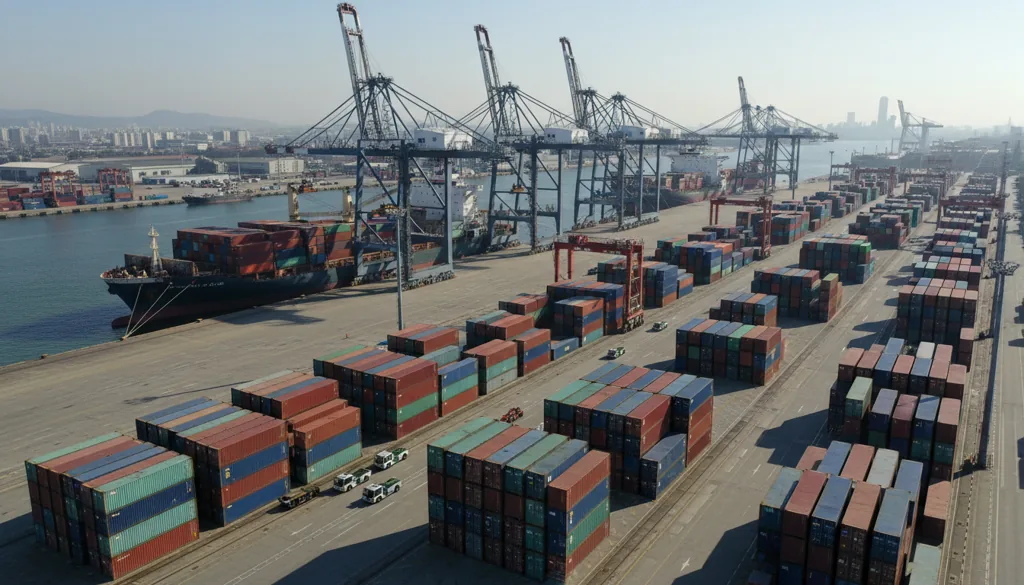
China agreed with the United States on a reciprocal tariff-reduction arrangement covering $30 billion worth of non-sensitive goods in each direction, announced on September 26, 2026.
China’s Ministry of Commerce said on Sept. 28, 2026, that China and the United States have agreed to cut tariffs on about $30 billion of each other’s goods, with the cuts to start once both sides finish their own legal steps.
The deal came out of the eighth round of trade talks, held in New York and Washington from Sept. 20 to 231. The ministry published the agreed lists of goods alongside its statement.
In short, each country will lower import taxes on a set list of goods from the other. For most goods on the lists, the extra tariffs each side added on the other will go away, but not on a fixed date yet.
Which goods get lower tariffs in China?
China will cut tariffs on about $30 billion of goods it buys from the United States1. The ministry names four main groups:
- farm products
- personal care products
- medical devices
- coal
The two tariff-cut lists
| Question | China cuts on US goods | US cuts on Chinese goods |
|---|---|---|
| Trade covered | About $30 billion | About $30 billion |
| Main goods | Farm products, personal care, medical devices, coal | Toys, appliances, baby products, gifts |
| Start date | After domestic legal steps | After domestic legal steps |
The published product list gives the full detail. The ministry’s statement names only these broad groups, so a shipment’s exact product must appear on China’s import product list to qualify.
The ministry said the cuts will help meet demand in China’s home market2. It also expects more trade in farm goods, energy, factory goods and consumer goods.
Which Chinese goods get lower US tariffs?
The United States will cut tariffs on about $30 billion of goods it buys from China1. The goods named are toys, household appliances, baby products, kitchen and bathroom products, and holiday gifts.
These are everyday consumer goods. Chinese makers and sellers of these goods to the US market stand to pay less at the US border once the cuts start.
The ministry said the deal will create better conditions for Chinese exports to the United States2. The two sides agreed to publish their lists together.
How big are the tariff cuts?
The $30 billion figure on each side is based on trade between the two countries in 20241. It measures how much trade the lists cover, not how much tax is saved.
Listed goods where all extra tariffs go, %
For more than 90% of the listed goods, all the extra tariffs each side added on the other will be removed2. These goods will then pay only the most-favoured-nation rate. That is the normal tariff a country charges goods from most of its trading partners.
For the remaining goods, under 10% of the lists, tariffs will be lowered but not fully cut back to the normal rate. The ministry’s statement does not give the new rates for these goods.
The ministry calls the arrangement reciprocal. This means each side gives the same size of tariff cut, in value, to the other1.
When will the lower tariffs start?
No start date has been set. Both countries will cut tariffs at the same time, after each completes its own domestic legal procedures1.
The cuts must also follow each country’s own laws and procedures2. Until then, shipments of listed goods still pay the tariffs in force today.
The ministry made its statement on Sept. 28, 2026. That date marks the deal, not the day tariffs fall at the border.
A China News Service article on the ministry’s trade remedy website said the deal will benefit people and companies in both countries once it takes effect3. It also noted that turning agreed ideas into action remains the main task.
What is the new China-US trade council?
In May 2026, the leaders of the two countries met in Beijing. They agreed to set up a government-to-government trade council1.
From Beijing meeting to tariff deal
At the September talks, the two sides agreed the council’s working rules. The council’s job is to improve two-way trade. It will discuss trade arrangements and problems that affect trade2.
The $30 billion tariff deal sits under this council. The ministry published four documents with its statement:
- the trade council’s working rules
- a paper on the duties under the $30 billion arrangement
- China’s list of US goods for lower tariffs
- the US list of Chinese goods for lower tariffs
The two product lists are the documents that decide whether a given shipment qualifies. The ministry also hopes the council will grow cooperation and shrink the list of problems between the two sides1.
What will the China-US farm working group do?
The two sides agreed to set up a farm working group under the trade council1. It will discuss rules, market access and trade concerns in agriculture.
Market access here means the conditions a country sets before foreign goods may be sold there. China said it will use the group to push the United States to address China’s concerns about farm trade2.
The China News Service article adds that the talks also set up a separate investment council. The two sides also held their first talks on artificial intelligence3. It said the two sides agreed to extend the Kuala Lumpur trade arrangement to Jan. 10, 2027, while they keep talking about it3.
The farm working group plans to hold its first meeting before the end of 20261.
Sources
- ↩ 商务部公布中美贸易理事会和“300亿对300亿”对等降税框架有关 …. — 2026 / art 010a3b55dd3544e09ba897c6f56c737f http://www.mofcom.gov.cn/syxwfb/art/2026/art_010a3b55dd3544e09ba897c6f56c737f.html
- ↩ 商务部公布中美贸易理事会和“300亿对300亿”对等降税框架有关 …. — 2026 / art 7f879be341ec4137a22f6d0360a5a291 https://www.mofcom.gov.cn/xwfb/rcxwfb/art/2026/art_7f879be341ec4137a22f6d0360a5a291.html
- ↩ (Economic Observer) Three keywords provide insight into the new trends in Sino-US economic and trade. https://cacs.mofcom.gov.cn/article/gnwjmdt/sb/zm/202609/189355.html