
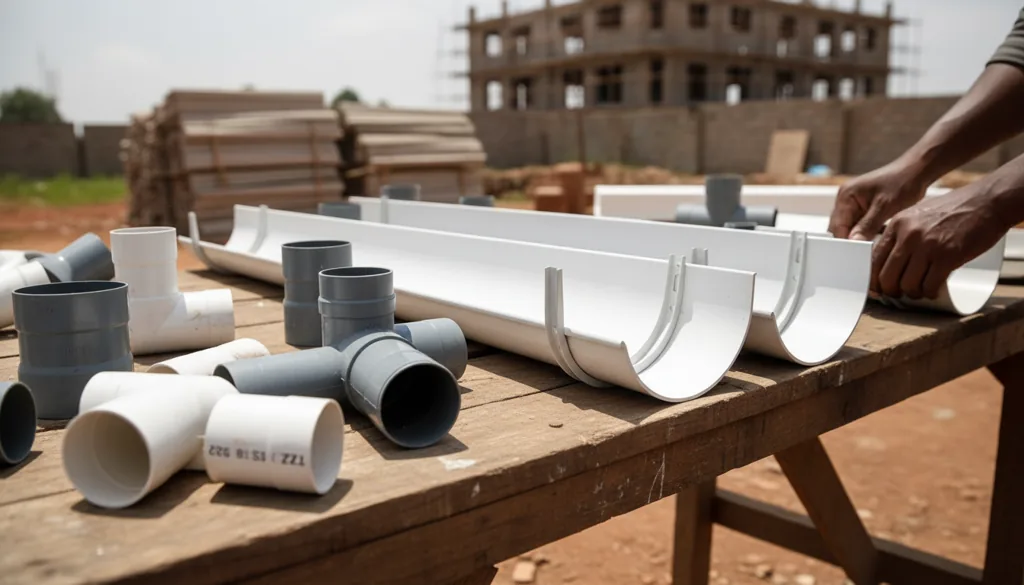
Tanzania has adopted new technical standards for eaves gutter brackets and PVC-U fittings to ensure structural integrity and performance in construction applications under Regulation and Regulation.
Tanzania’s Ministry of Works and Transport has set new technical standards for eaves gutter brackets and PVC-U pipe fittings used in construction, tightening rules on materials, testing and installation across the country from 1 January 2025.
The rules cover steel brackets, plastic pipes and fittings sold for rainwater harvesting, drainage and sanitation in every new building and major renovation. Delivered cost for a typical three-bedroom house rises by 12-15% because every bracket and joint must now carry a certificate of compliance from an approved laboratory1.
What the new rules demand
Every eaves bracket sold in Tanzania must be made from galvanised mild steel at least 3 mm thick and bent to a four-corner profile that locks under roofing sheets2. Brackets must be spaced no more than 2 m apart and fixed with 20 mm × 6 mm steel straps2. Any bracket that fails to meet these dimensions is banned from sale after 1 January.
What every bracket and pipe must now meet
PVC-U pipes and fittings must now carry the PN-6 pressure rating, up from PN-4, and must pass a 24-hour pressure test at 10 bar without any leakage2. Joints must use double-ring seals complying with BS 2394, and every shipment must include a manufacturer’s certificate showing the batch number, test date and laboratory approval number2.
Who pays and who enforces
The builder or developer pays for the upgraded materials and the mandatory testing. A single certificate for a 110 mm downpipe now costs UGX 120,000 (USD 32) and must be renewed every 12 months2. Random samples will be pulled from site and sent to the Central Materials Laboratory in Dar es Salaam; any batch that fails is rejected on the spot and must be removed at the contractor’s expense1.
Enforcement sits with the local authority and the Project Manager appointed for each site. They can demand the charge sheet for timber treatment, the test certificate for steel thickness, and the pressure-test log for every installed pipe1, 2. If any document is missing, the authority can halt work until the paperwork is produced.
What the old rules allowed
Until now, builders could use 2 mm steel brackets spaced up to 2.5 m apart and PVC pipes rated at PN-42. Joints were often sealed with a single rubber ring or even silicone, and no independent testing was required. The Public Health (Drainage and Sanitation) Rules of 2010 only specified that materials had to be “suitable” and “approved by the authority” without setting minimum dimensions or test protocols3.
Old rules against the new standards
| Requirement | Until 2024 | From 1 Jan 2025 |
|---|---|---|
| Bracket steel thickness | 2 mm | 3 mm, galvanised |
| Bracket spacing | Up to 2.5 m | No more than 2 m |
| Pipe pressure rating | PN-4 | PN-6 |
| Joints | Single ring or silicone | Double-ring seals, BS 2394 |
| Testing | None required | Approved-laboratory certificate |
The new standards close that gap by naming British Standard 416 for cast-iron pipes, BS 459 for PVC-U stormwater pipes, and BS 5481 for underground conduits3, 2. Any product that does not carry the correct BS mark or an equivalent Uganda National Bureau of Standards (UNBS) certificate is automatically excluded from public tenders and private developments over 500 m²1.
What happens next for eaves gutter and fitting
The first compliance deadline is 1 January 2025, when the new thickness and pressure requirements take effect. From that date, every invoice for eaves brackets or PVC-U fittings must list the batch test number and the certifying laboratory2. Manufacturers have until 30 June 2025 to clear old stock; after that, any non-compliant product found on site will be confiscated and destroyed1.
Three waves, three deadlines
| Deadline | Who is caught | What falls due |
|---|---|---|
| 1 Jan 2025 | All sellers and builders | 3 mm brackets and PN-6 take effect; invoices must list batch test number and lab |
| 30 Jun 2025 | Manufacturers | Last day to clear old stock; non-compliant goods confiscated and destroyed |
| 1 Mar 2026 | Importers and producers | National register of approved suppliers opens; registration renewed every two years |
A second phase starts on 1 March 2026, when the ministry will publish a national register of approved suppliers. Only companies on that list will be allowed to import or produce the regulated products, and each must renew its registration every two years with fresh test certificates1. The ministry said in a statement that the register will be “open for inspection by any developer, contractor or local authority”1.
What the rules leave unchanged
The new standards do not alter the minimum fall for drains—still 0.76 m per second when the pipe is 25 % full—or the minimum cover for underground pipes, which remains 600 mm for PVC and 450 mm for cast iron1. They also leave intact the ventilation rules that require every soil pipe to be screened with copper mosquito gauze and every fresh-air inlet to be at least the same diameter as the pipe it serves3.
Builders still have to submit shop drawings for rainwater harvesting systems, but the ministry has not yet published the design manual promised for 20241. Until that manual appears, contractors must follow the British Code of Practice BS 1013 for earthing and the Uganda Electricity Regulatory Authority rules for electrical safety1.
Why the timing matters
The new rules come eleven months after a national audit found that 43 % of new buildings in Dar es Salaam and Mwanza had leaking gutters or blocked downpipes within two years of completion1. The audit blamed “substandard materials, poor installation and no independent testing” for the failures. The ministry said in a statement that the tighter standards are “necessary to protect public health and prevent flooding in urban areas”1.
The changes also align Tanzania with the East African Community (EAC) Common Market Protocol, which requires member states to adopt harmonised technical standards for construction materials by 20271. Kenya and Uganda already enforce similar thickness and pressure rules for PVC-U pipes, so Tanzanian manufacturers who want to export to those markets will now face one set of tests instead of three1.
What builders must do now
Before the January deadline, every contractor must:
- replace any 2 mm steel brackets with 3 mm ones and re-space them at 2 m centres2
- swap PN-4 pipes for PN-6 and ensure every joint uses a double-ring seal2
- obtain a certificate of compliance for every batch of brackets and pipes, showing the test date, laboratory name and batch number1
- keep the charge sheet for timber treatment and the pressure-test log on site for inspection1, 2
Compliance costs in US dollars
Failure to comply carries a fine of UGX 5 million (USD 1,350) per site and a six-month suspension from public tenders1. The ministry said in a statement that it will conduct unannounced site visits starting in February 2025 to check that the new rules are being followed1.
Sources
- ↩ Standard Specifications for Building Works – Rainwater Harvesting Requirements https://www.education.go.ug/wp-content/uploads/2021/12/TECHNICAL-SPECIFICATIONS-SHIMONI-CPTC.pdf
- ↩ Pipe Installation Specifications for Kalongo Technical Institute https://www.education.go.ug/wp-content/uploads/2020/04/LOT-3-KALONGO-VTI-BOQ.pdf
- ↩ Public Health (Drainage and Sanitation) Rules – KCCA https://www.kcca.go.ug/media/docs/PUBLIC%20HEALTH%20(DRAINAGE%20-%20SANITATION)%20RULES.PDF