
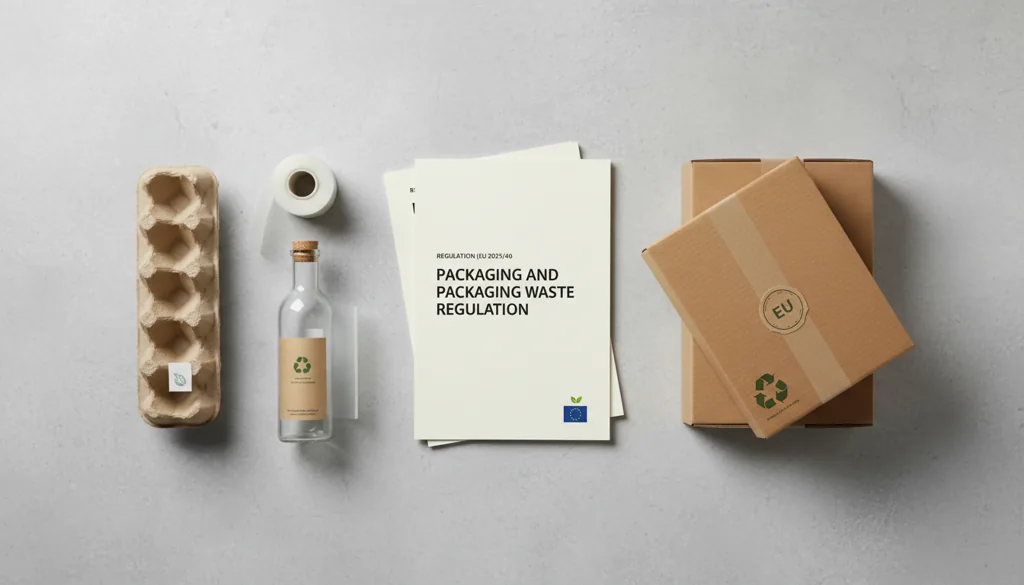
European Union’s new Packaging and Packaging Waste Regulation (Regulation (EU) 2025/40) introduces initial compliance obligations for businesses placing packaged goods on the EU market from August 12, 2026.
The European Union will require all companies selling packaged goods in its market to meet new sustainability rules from 12 August 2026, under a regulation that replaces decades-old waste laws with stricter standards on recyclability, hazardous substances and producer responsibility.
The Packaging and Packaging Waste Regulation (PPWR) covers everything from cardboard boxes to plastic trays, glass bottles and aluminium cans, whether made in the EU or imported. Every business that places packaging on the EU market—manufacturers, importers, distributors and retailers—must now prove their packaging meets the new requirements or risk having shipments rejected at the border.
The delivered cost of compliance will fall on the company selling the goods, not the consumer. For exporters outside the EU, that means redesigning packaging, sourcing new materials and keeping detailed records to keep access to a market of 450 million people.
What the new rules demand
From August, all packaging placed on the EU market must carry a EU Declaration of Conformity, a document that shows the packaging meets the regulation’s sustainability requirements1. Companies must also register in a producers’ registry and report data under extended producer responsibility (EPR) schemes, which make businesses financially responsible for the waste their packaging creates1.
Hazardous substance limits from day one
The regulation sets limits on hazardous substances in packaging. Food-contact packaging can no longer contain per- and polyfluoroalkyl substances (PFAS) above 25 parts per billion for any single PFAS, or 250 parts per billion for the sum of targeted PFAS2. Lead, cadmium, mercury and hexavalent chromium are capped at a combined 100 milligrams per kilogram in any packaging or component2. These restrictions apply from the first day the regulation takes effect.
Packaging must also be designed for recycling. By 2030, all packaging must be recyclable at scale, meaning it can be collected, sorted and recycled in practice, not just in theory3. The EU will introduce a system of recyclability performance grades in 2030, with stricter obligations following in 20383. Plastic packaging must also contain a minimum share of recycled content, with targets rising in 2030 and 20404.
Who must comply and what it costs
The regulation applies to every business that places packaging on the EU market, regardless of size or location. Manufacturers, importers, distributors and retailers are all covered, as are micro-enterprises, though the smallest companies face lighter requirements4. UK exporters, for example, must register with the national authority in the EU country where they sell their goods and provide data on packaging type, weight, recyclability and recycled content4.
Projected packaging waste growth by 2030 without intervention
The cost of compliance will vary by sector. For Sri Lankan exporters of tea, spices, seafood and processed foods, the regulation means reviewing packaging design, material selection, supplier traceability and certification processes5. Failure to adapt could lead to higher compliance costs, supply chain disruptions and loss of market access5. The EU estimates that packaging waste in the bloc would have grown by 19% by 2030 without intervention, while plastic packaging waste could have risen by 46%6.
Companies must also keep technical documentation for at least five years for single-use packaging and ten years for reusable packaging1. Importers are responsible for ensuring that manufacturers have conducted the required conformity assessments and that the necessary documentation is in place before the goods reach the EU market1. Distributors must verify that packaging carries the correct labelling and that manufacturers are registered in EPR systems1.
What changes on day one
The regulation enters into force on 12 August 2026, but not all requirements take effect at once. The first obligations focus on substance restrictions, recyclability and producer registration. From that date, food-contact packaging containing PFAS above the permitted limits can no longer be sold in the EU6. Companies must also begin keeping records to prove their packaging meets the new standards.
The obligations arrive in waves
| Date | Who is caught | What falls due |
|---|---|---|
| 12 Aug 2026 | All packaging on the EU market | PFAS limits enforced; record-keeping begins |
| 2028 | All packaged goods | Harmonised EU labelling for waste sorting |
| 2030 | Single-use formats; transport, e-commerce and beverage packaging | Bans where alternatives exist; reuse and refill targets; 5% waste prevention vs 2018 |
| 2035 | All packaging | 10% waste prevention vs 2018 |
| 2040 | All packaging | 15% waste prevention vs 2018 |
Other measures will follow in stages. From 2028, a harmonised labelling system will apply across the EU to make waste sorting easier and improve recycling rates6. From 2030, certain single-use packaging formats will be banned where more sustainable alternatives exist, such as small ketchup packets or mini shampoo bottles in hotels7. Reuse and refill targets for transport, e-commerce and beverage packaging will also take effect in 20308.
Waste prevention targets will be introduced in phases: a 5% reduction by 2030, 10% by 2035 and 15% by 2040, compared to 2018 levels8. The regulation also sets limits on empty space in packaging, requiring companies to reduce unnecessary packaging and improve efficiency in deliveries7.
How enforcement will work
EU member states will enforce the new rules, but the regulation includes safeguards to prevent trade disruptions. If a national authority finds non-compliant packaging, it must first give the company a chance to correct the issue before taking further action8. Only if the non-compliance persists can authorities prohibit, recall or withdraw the packaging from the market8.
The regulation also introduces new obligations for the hospitality and takeaway sectors. From 12 February 2027, restaurants, cafes and other food service operators must allow customers to use their own containers for beverages and takeout food, provided the containers are clean and suitable1. From 12 February 2028, these businesses will face additional requirements to reduce waste from off-premises consumption1.
The European Commission has published guidance documents and frequently asked questions to help businesses and member states understand the new rules9. National authorities are responsible for providing support and resources to companies, particularly small and medium-sized enterprises9.
What the regulation leaves unchanged
The PPWR replaces the 1994 Packaging and Packaging Waste Directive, which set less stringent requirements on recycling and waste prevention8. The new regulation maintains the directive’s broad definition of packaging—any item intended to contain, protect, handle, deliver or present products—but excludes items that form an integral part of a product and are disposed of with
New regulation, old directive
Sources
- ↩ Regulation (EU) 2025/40 (PPWR) https://lynx.legal/regulation-eu-2025-40-ppwr/
- ↩ PPWR Article 5 | Manage Packaging Substance Compliance https://tracextech.com/ppwr-article-5-packaging-substances/
- ↩ EU Packaging and Packaging Waste Regulation: Effectiveness and Key Provisions https://circulareconomy.europa.eu/platform/en/news-and-events/all-news/eu-packaging-and-packaging-waste-regulation-when-will-it-come-effect-and-what-does-it-cover
- ↩ EU PPWR – Packaging and Packaging Waste Regulation https://www.business.gov.uk/campaign/europe/european-union-eu-regulations/eu-packaging-and-packaging-waste-regulation-eu-ppwr/
- ↩ EU CIRCULAR Project Boosts Sri Lanka’s PPWR Compliance Readiness https://www.eeas.europa.eu/delegations/sri-lanka/european-union-funded-circular-project-strengthens-sri-lankas-readiness-eu-packaging-and-packaging_en
- ↩ New EU packaging rules come into effect from August 2026 https://environment.ec.europa.eu/news/new-eu-rules-packaging-enter-application-2026-08-11_en
- ↩ New EU Packaging Rules to Reduce Waste and Improve Recycling from 2026 https://commission.europa.eu/news-and-media/news/new-packaging-rules-less-waste-and-easier-recycling-2026-08-12_en
- ↩ Danish Representation at EU – Packaging and Packaging Waste Regulation (PPWR) https://denmark.representation.ec.europa.eu/document/download/b2cc9340-0f05-4c2a-90fc-99a4e78fb364_da?filename=packaging%20and%20packaging%20waste%20regulation%20ppwr-KH0126068ENN-1.pdf
- ↩ EU Packaging Waste Regulation 2025/40 https://environment.ec.europa.eu/topics/waste-and-recycling/packaging-waste_en