

 May 07,2026
  By Alice
HS code is the fundamental classification code for export and import products across national borders. The declaration of HS code, alternatively known as the commodity code or tariff code, is essential to ease the complicated global trade process. Declaring an accurate HS code for exporting items has become a requirement for exporters and importers. Now, we will learn what the HS code for export is, the list of HS codes for export, and why it is important, along with how to find the HS code for exporting items to another country.
What is the HS Code for Export?
The Harmonized System (HS) code is a standard identification system that uses a numerical method to identify physical products in international trade. This numerical nomenclature has been set up by the World Customs Organization (WCO) since 1988. This code has been regularly updated over a period of 5 years to facilitate the new items that have never been included in the system or other classification changes. The last updated HS code from WCO was in 2022 with some changes.
HS code consists of a 6-digit number as an internationally recognized identification code of exported or imported items. The 6-digit code of the HS code is made up of a 2-digit Chapter, 2-digit Heading, and 2-digit Subheading. More than 200 countries in the world use the 6-digit code for an initial credential before sending products across national borders. For exporting products, all international trade actors need to declare the extension of the HS code, or dubbed as the national variation of the HS code.
The national standard HS code has become mandatory based on local policy in the destination country for further tariff classification. Therefore, the exporter needs to understand the national variation of HS codes before exporting their items. Please note that an inaccuracy in the HS code for export will lead to severe consequences.
List HS Codes for Export from Countries
In addition to the HS code for importing products into the country, some countries have set up their own classification code for exported products leaving their country. This code is important for statistical purposes and a tool for the government to track the trade volume across sectors to develop trade policy.
Similar to the national variation code, the HS code for export or export classification code is mostly derived from the HS nomenclature. To get a better understanding of the HS code for export from the countries, we have assembled the list of national HS codes for export in several countries as follows.
1. HS Code for Export from the United States
In the United States, there is a code called Schedule B for exporting physical products outside the country. Unlike the Harmonized Tariff Schedule of the United States (HTSUS), Schedule B is overseen by the US Census Bureau to help collect export data. It is used exclusively for statistical analysis of exported physical goods and allows the United States government to monitor the export volume.
Schedule B is derived from the 6-digit HS code and consists of a 10-digit code. For finding this code, the US Census Bureau provides a comprehensive search engine to assist in classifying the Schedule B code. The accuracy of the Schedule B code will determine the streamlining of exportation products from the United States.
2. HS Code for Export from Australia
In Australia, there is an HS code for export called the Australian Harmonized Export Commodity Classification (AHECC). Similar to Schedule B, this code is basically the extension of the internationally recognized HS code from the WCO. AHECC comprises an 8-digit code, which uses a 6-digit number from the HS code and an additional 2-digit number as a supplement for trade statistics in Australia. Additionally, AHECC is administered by the Australian Bureau of Statistics (ABS) and is different from the Working Tariff, which was supervised by the Australian Border Force (ABF).
3. HS Code for Export from Canada
The exclusive HS code for exporting products from Canada is called the Canadian Export Classification (CEC) code. This code consists of 8-digit numbers and is managed by Statistics Canada to track the physical products being exported from Canada. Similar to other countries, the initial 6-digit numbers come from the international standard HS code, and there is a last 2-digit extension. This code seems identical to the HTS code in Canada, but the two codes are different, and the HTS code has a tendency to be more detailed.
4. HS Code for Export from India
For exporting products from India, there is a code called the ITC (Indian Trade Clarification) HS Code or HSN (Harmonized System of Nomenclature). This code actually has a dual function to determine the import products into India as well as assist the exportation of products from India to other countries. For export, this code is a classification to monitor trade volumes of all products exported from India. This 8-digit code was established by the Directorate General of Foreign Trade (DGFT) and derived from the international standard HS codes.
5. HS Code for Export from Brazil
In Brazil, the HS code for exports and imports is based on the standard from Mercosur, dubbed Mercosul Common Nomenclature (NCM). This structure of NCM follows the 6-digit global standard HS code with the extension of 2 digits code, and the full NCM is 8 digits. The 7th digit code is a classification of Mercosur member countries, and the 8th digit is the final description of the items. NCM has two functions: to determine tariff import into Brazil and produce trade statistics data for the Brazilian government to track the exported product.
| HS code for export | Digit number |
| Schedule B Code | 10 digit code |
| Australian Harmonized Export Commodity Classification (AHECC) | 8-digit code |
| Canadian Export Classification (CEC) Code | 8-digit code |
| ITC (Indian Trade Clarification) HS Code | 8-digit code |
| Mercosul Common Nomenclature (NCM) Code | 8-digit code |
How to Find HS Code for Export Products Overseas
Basically, the HS codes for export and import are similar to each other. All of them derived from the universal HS code developed by the WCO. Therefore, if we know how to find the HS code for import, then we know the HS code for export as well. In this section, we will give a step-by-step guide for you to find the HS code using a specific tool. One of the easiest ways to find HS codes is by using a third-party HS code finder, such as Export Genius and HSCodeMatch. Without more delay, this is the step-by-step instruction to find the HS code using HSCodeMatch.
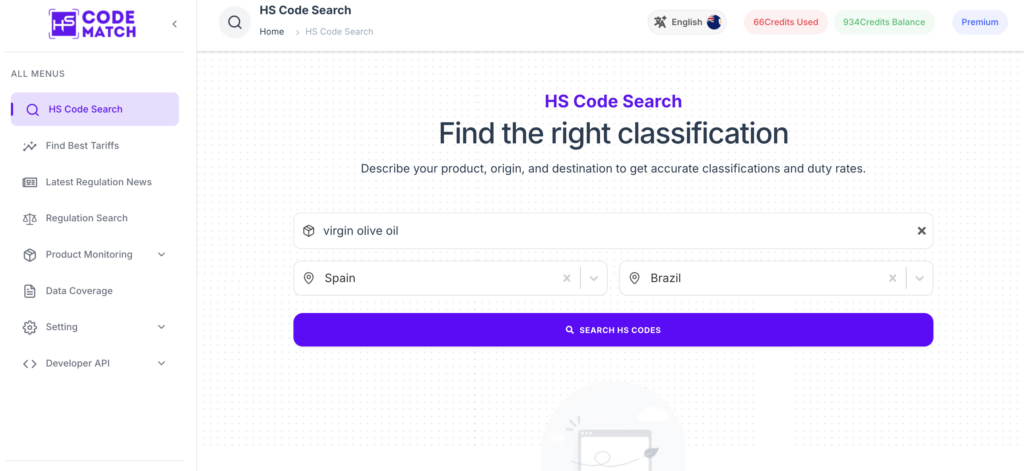
Step 1: Open the HSCodeMatch application and use the HS Code Search tool
You can directly access from this link: hscodematch.com and log in to the HSCodeMatch application. Then, choose the HS Code Search tool on the left side of the application. For this example, we can use the exportation of virgin olive oil from Spain to Brazil.
Step 2: Find the List of HS Codes for Virgin Olive Oil
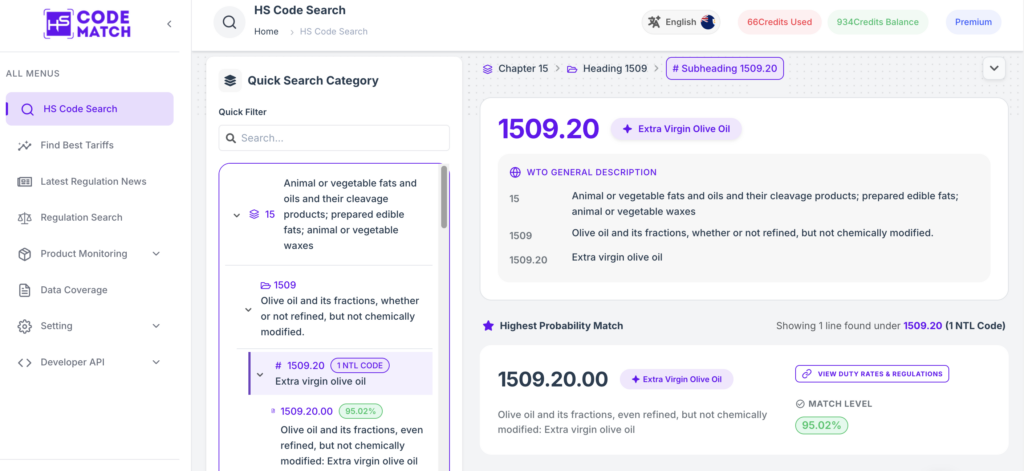
You can find the list of HS codes for virgin olive oil from Spain to Brazil. Then, click the HS code 15092000 in Brazil or click View Details.
Step 3: Find the tariff and regulations on HS Code Details
When you open the HS Code Details page, you can find the detailed explanation of the HS code for virgin olive oil under 15092000. You can also find the tariff rate for exporting virgin olive oil from Spain to Brazil.
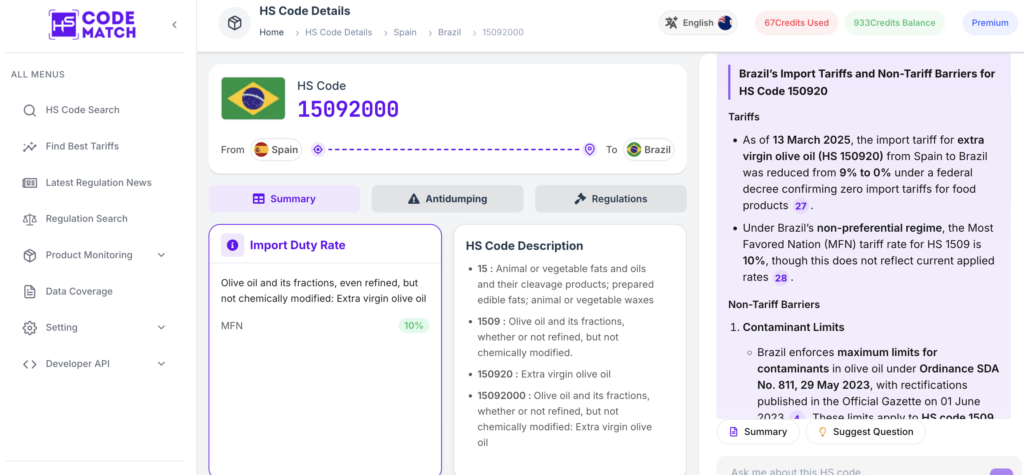
Step 4: Asking the AI Assistant for assistance with export and import regulations and tariffs in Brazil
On the right side of the HS Code Details, you can find the AI Assistant. If you find any bemusement regarding exporting virgin olive oil from Spain to Brazil, do not hesitate to ask the AI Assistant directly
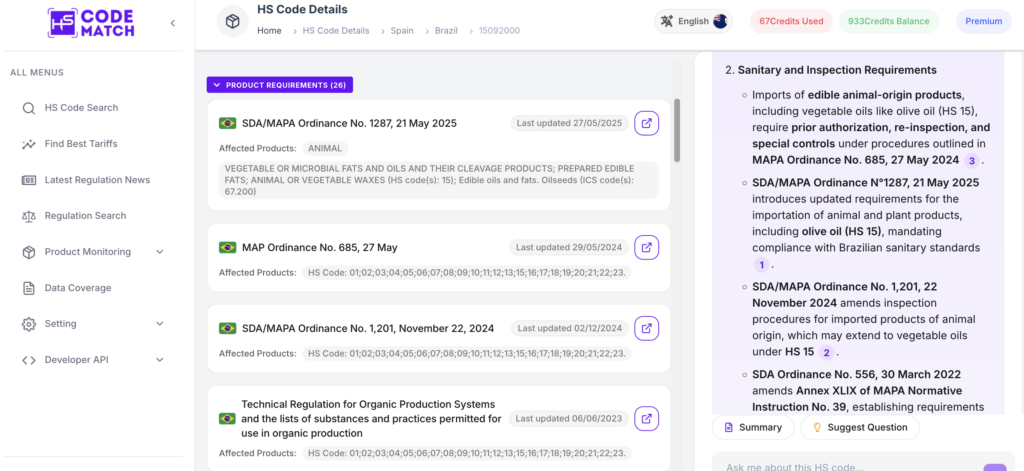
If you might doubt about the answer of the AI Assistant. We will provide several questions and answers from the AI Assistant on HSCodeMatch. Let’s find out how HSCodeMatch will help you to solve the problem through the AI Assistant below.
Does Brazil impose any non-tariff barriers (e.g., quotas, certifications) on olive oil imports?
As of today, Brazil still imposes non-tariff barriers on all olive oil products from other countries, including Spain. The non-tariff barriers include mandatory certification and sanitary requirements. Therefore, all olive oil products from other countries need to comply with the health regulations in Brazil, which are administered by the Ministry of Agriculture, Livestock, and Supply (MAPA). Before importing olive oil from Spain or other countries, the importers need to obtain an import license from MAPA. This process includes submitting documentation, such as a sanitary license from the country of origin, in this case, Spain. However, there is no quota for exporting olive oil from other countries into Brazil, and only administrative barriers. The following table depicts the detailed requirements for exporting virgin olive oil into Brazil.
| Requirement | Details |
| Import License | There is a mandatory pre-shipment approval from MAPA |
| Sanitary Certificate | This is the certificate from the authority in the origin country to support the compliance based on the Brazilian health standard. |
| Labeling Requirements | All products intended to be exported into Brazil need to be labeled in the Portuguese language, including the origin country, expiry, and other descriptions. |
What are the latest labeling requirements for importing olive oil into Brazil?
Brazil requires the olive oil products from other countries to meet the labeling requirement based on Normative Instruction No.1, of January 30, 2012. The olive oil products must display the olive oil categories, including extra virgin, virgin, and refined olive oil, or pomace olive oil. In addition, the Brazilian government requires a clear expiration date of the olive oil products as well as the country of origin of the aforementioned product. The olive oil products also need to have a percentage of components to be listed on the packaging, and they must meet the olive oil grades from the International Olive Council (IOC).
Which Brazilian agency issues the import license for olive oil?
The Brazilian agency that issued the import licenses for olive oil and other similar products is the Secretariat of Agriculture Defense (SDA) of the Ministry of Agriculture, Livestock, and Food Supply (MAPA). The import licence is a requirement in the Brazilian trade system to check the authorization of certain products before entering the country. The aims to guarantee the sanitary, phytosanitary, or technical regulation in the South American country. This is the list of other products that must obtain an import license in Brazil.
- Edible products from animals, such as meat, dairy, fish, poultry, and others.
- Organic products need to obtain the MAPA regulation for organic products.
- Aquatic animal meal needs to have zoosanitary certification.
Conclusion
Whether the HS code for export and import is similar, all of the initial codes are based on the universal standard HS code from the WCO. The difference is only situated in the extension of the HS code, which is developed by each country. HS code for export of products leaving a country is established only for statistical purposes to know the export of products and help the government to set trade policy. However, some countries have set the same HS code for export and import, but some countries structure them differently. The United States, Australia, and Canada have developed their own HS code for export products that are distinct from the HS codes for imports into their countries to assist in collecting export data.
Frequently Asked Questions (FAQs) about HS Code for Export Products Overseas
1. What is the HS code for importing virgin olive oil in Brazil?
HS code for importing virgin olive oil in Brazil is 15092000. This code comes from the Mercosur Common Nomenclature (NCM) and derives the 6-digit code from the general HS code under the WCO.
2. What is the tariff rate for exporting virgin olive oil from Spain to Brazil?
The general tariff rate for exporting virgin olive oil from Spain to Brazil is 10%. This tariff is under the Most Favoured Nation (MFN) or non-preferential regime, which means this tariff rate also applies to other countries as well, without Free Trade Agreements (FTAs).
3. What is the HS code for export products from India?
HS code for export products into or from India is the ITC HS Code. This is the standard exclusively in India to assist the identification of products based on applicable tariffs and regulations in India. At the same time, it serves as an identification code for the Indian government to track the exported products.
3. What is the structure of the HS code for export items from the United States?
The structure of the HS code for export in the United States, also known as Schedule B, is similar to the HTSUS. The difference between Schedule B and HSTUS is only the last 2 digits. Meanwhile, the initial 6-digit numbers derive from internationally recognized HS codes from the WCO.
5. What is the structure of the HS code for exporting a product in Australia?
The HS code for export in Australia is called the Australian Harmonized Export Commodity Classification (AHECC), and it comprises an 8-digit code. This code is an extension of the HS code from the WCO with a 2-digit extension code in the last part. Please note that AHECC is different than the Working Tariff for importing physical products in Australia.
Find and Match the Right HS Code for Your Products.
Try Our App