

 Apr 30,2026
  By Alice
Perfume is not merely a smell-good scent. It has transformed into a space of taste and luxury for centuries. Like many fashion elements, such as jewelry, it adds personality, impressions, and even value to the users. The better the scent, the more expensive the price, and automatically the higher status you can get from it. No wonder perfume is one of the most promising trade commodities. If you are interested in marketing your perfume brand globally, here is the HS code for perfume!
What is perfume exactly?
Perfume is an ancient discovery or innovation made by humans. It is made by extracting scents (essential oils) from organisms– mostly plants, but can also be derived from animal organs – and mix it with other ingredients such as solvent (alcohol or ethanol) and fixative agents (synthetic fragrances, resins, balsams). Making perfume requires a long and excruciating process, which explains its relatively high prices.
Producers may take years to do research and formulate the best combination to make perfect scents. This also includes the extraction process, which is time-consuming and, in the end, only produces small volumes. That also explains why the perfume production process is categorized as craftsmanship rather than a manufacturing industry. However, there are many businesses that benefit from the demand for affordable perfumes. This is why you need to understand and recognize the various types of fragrance or perfume in the market.
1. Parfum
Parfum is generally the most expensive type of perfume. It consists of 15–40 percent essential oil, which makes its scent last longer and linger stronger. Many claim it can last up to 8 hours. The producers and brands usually sell this in relatively small containers.
2. Eau de parfum
Essential oils percentage in Eau de Parfum is relatively lower compared to Parfum. It is about 10-20 percent per bottle and can last for about 4-5 hours. Same as perfume, this type of perfume is considered ideal for nighttime and cold weather.
3. Eau de Toilette
As it only consists of 4-10 percent of essential oils, the Eau de Toilette scent is much lighter than the previous two. The producers also generally pick fresher notes rather than the strong ones, which makes them ideal for daily usage.
4. Eau de Cologne
Eau de Cologne is one of the cheapest perfumes on the market. It also has a lighter scent as its essential oils consistency is pretty low (2-3 percent). Because of this trait, users are advised to reapply it 2-3 times a day whenever the scent starts to fade.
5. Eau Fraiche
This is another cheap option for perfume users who crave a fresh odor. The main difference between Eau Fraiche and other types of perfume is the existence of water in its solution. This gives it clean and light scents. The essential oil consistency is only 1-2 percent, making it the lowest in the market.
HS code for perfume: How to classify perfume based on the WCO regulation
Now, how do you find the HS code for perfume? Based on the World Customs Organization (WCO), perfume is regulated in Chapter 33. It covers essential oils and resinoids, perfumery, cosmetic or toilet preparations, and shampoo. This chapter mentions perfume and toilet waters (eau de toilette) literally within headings 3303 and subheadings 3303.00, meaning there are no specific details, such as main ingredients or volumes and consistency, that you need to consider when determining the right HS code for perfume.
There is one more intriguing take on this chapter, heading 3307. The headings mentioned potential types of perfume you may consider to trade, which are deodorant, bath salts, and room perfume. Check the table below to get a better overview of the HS code for perfumery.
| HS code | Products |
| 3303.00 | Perfume and toilet waters (all types, no further details mentioned) |
| 3307.20 | Deodorants or antiperspirant agents |
| 3307.30 | Perfumed or fragrance bath salts and other bath preparations |
| 3307.90 | Other preparations for perfuming or deodorizing rooms (not for religious purposes) |
Common mistakes
Despite being clear, you can make mistakes in determining the HS code for perfume. These are potential mistakes in declaring HS code for perfume and similar products that you need to pay attention to.
- The WCO chapter mentions essential oils and resinoids (heading 3301), and the HS code may vary based on the main materials. This may mislead you, but as long as you are trading perfume (a mix of solvent, fixatives, and essential oils), these headings are better not to become part of your considerations. However, the case will be different if you are considering selling the perfume or fragrance component separately.
- There is also an HS code for odoriferous substances (heading 3302), but it regulates the ones particularly made for food and beverages. You can easily ignore this.
- Despite mentioning HS code perfumery products for hair and makeup, this chapter does not mean to help you find the HS code for soaps. HS code for soaps, including the perfumed ones, falls under Chapter 34, particularly heading 3401.
Perfume trade main actors
Who are the main actors in the global perfume trade? Here is the overview of the perfume trade (HS code 330300) based on the world’s largest exporters and importers.
These are the top 5 exporters of perfume. France, Spain, and Italy, as the home for luxurious brands, predictably dominate the trade scene. It is interesting to see Singapore on the list, but it is now the main hub of Asian luxury products commerce, which explains its position.
| Country | Total Export Value (USD) |
| France | 8,623,735,980 |
| Spain | 4,608,350,511 |
| Italy | 2,689,998,476 |
| United States of America | 2,074,686,921 |
| Singapore | 1,568,170,300 |
Source: UN Comtrade data 2024 (accessed on 13th April 2026)
If you look closely below, the five main importers of perfume are also predictable. The countries listed below are widely recognized by their high purchasing power, particularly for luxurious products such as perfumes.
| Country | Total Import Value (USD) |
| United States of America | 5,560,244,139 |
| Germany | 2,015,293,765 |
| Spain | 1,481,596,177 |
| United Kingdom | 1,470,329,685 |
| Singapore | 1,306,096,227 |
Source: UN Comtrade data 2024 (accessed on 13th April 2026)
How to Find HS Code for Perfume
Finding the HS code for perfume might be an arduous effort for international business actors. In particular, finding the national variation of the HS code requires extra effort to further identify on national websites. This is a necessity to guarantee that the products are allowed to enter the destination country seamlessly.
In order to ease your effort in finding the accurate HS code, you need to use a third-party application, such as HSCodeMatch. It offers an easy way to find HS code, tariff, and the latest regulation automatically with an AI engine. Without further ado, let’s check the step-by-step guide for finding the HS code for perfume from France to Singapore.
Step 1: Open the HSCodeMatch application
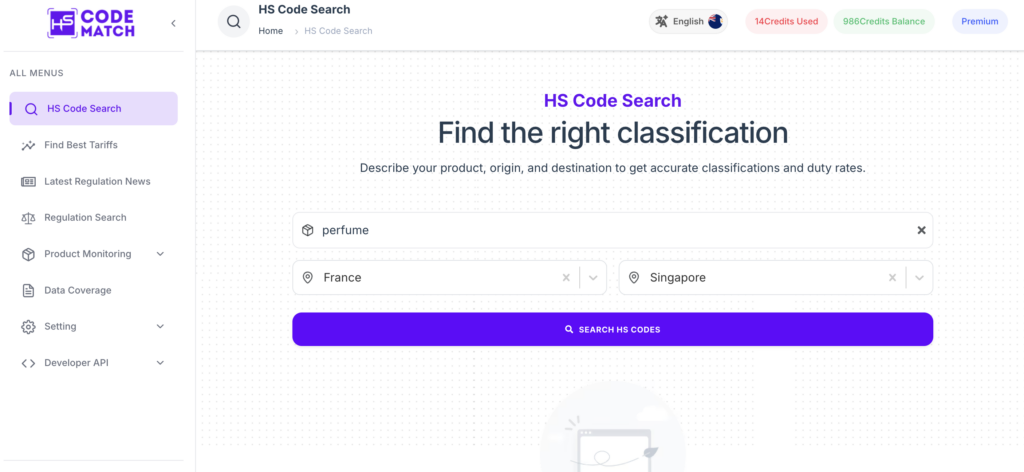
First things first, open the HSCodeMatch homepage through this link: hscodematch.com. Then, open your HSCodeMatch account and choose the HS Code Search tool. Setting the product name to “perfume,” the country of origin to France, and the destination country to Singapore.
Step 2: Find the list of HS codes for perfume
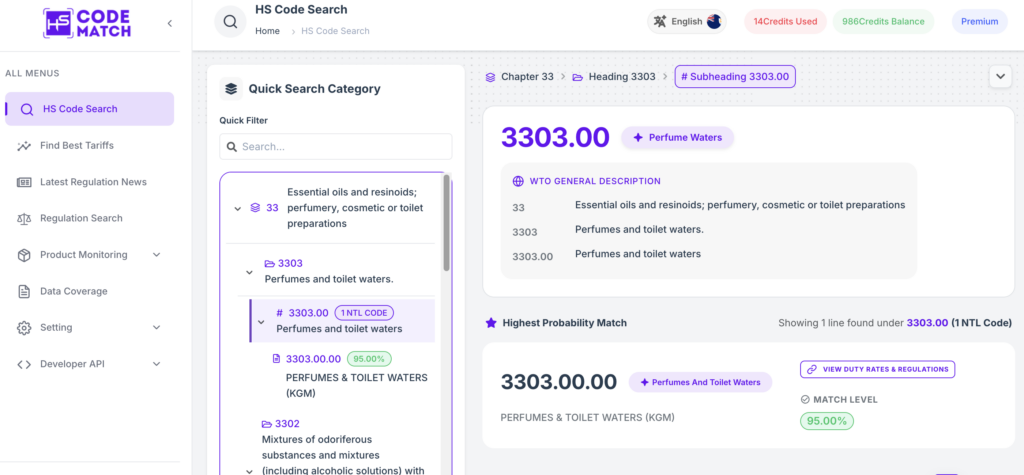
HSCodeMatch will identify the product’s name and show the most relevant national standard HS code for perfume in Singapore. Then, it automatically presents the list of HS codes, and the first row is the most relevant code.
Step 3: Check HS code description and tariff rate
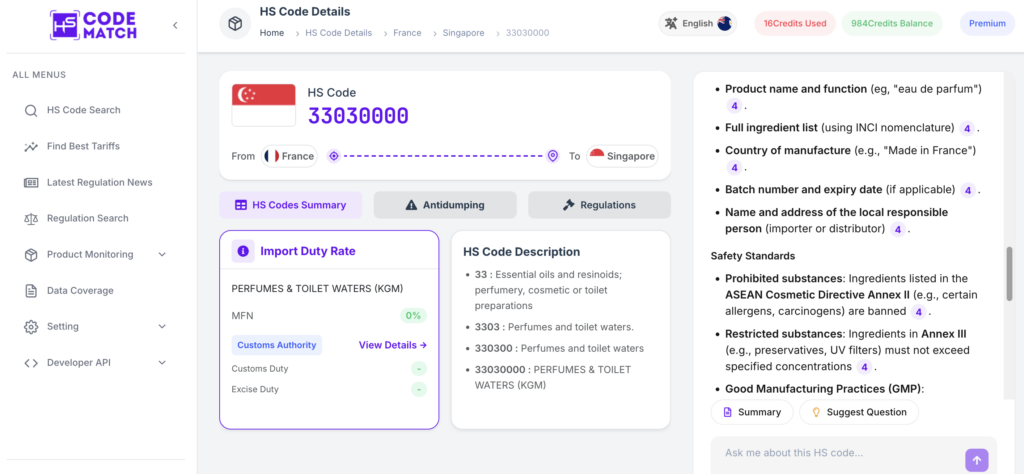
Choose the first row, HS code 33030000, or click View Details. Then, you will enter the HS Code Details page to check the HS code description and tariff rate for exporting perfume from France to Singapore.
Step 4: Find the regulation and chat with the AI Assistant
Not only tariff and HS code description, but HS Code Details also contains all regulations of perfume in France and Singapore. If you encounter any confusion, please ask directly with the AI Assistant on the right side of the page.
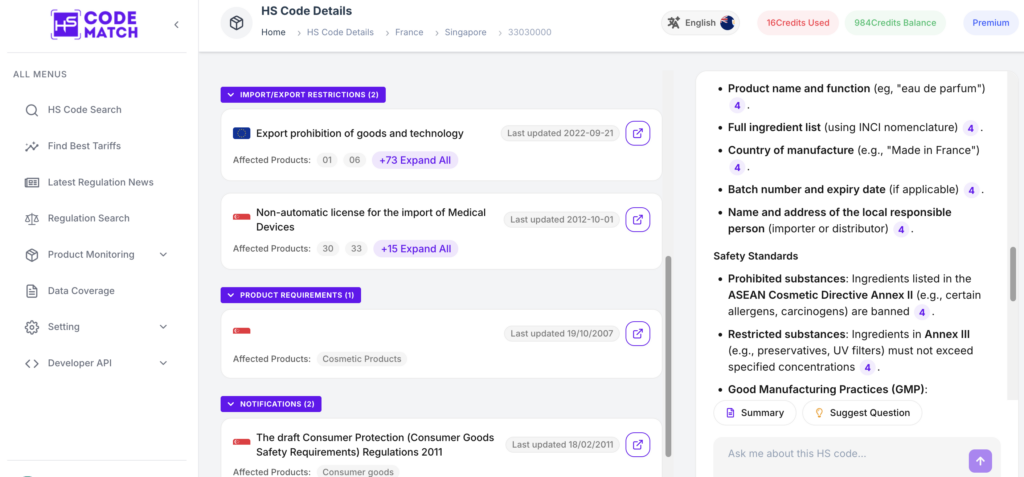
In order to help you use the AI Assistant, you can use the Suggest Questions button, and it will provide the most relevant questions. Below are examples of questions and answers from the AI Assistant regarding exporting perfume from France to Singapore.
Are there additional tariffs for exporting perfume under HS code 33030000 from France to Singapore?
No, there is no additional tariff for exporting perfume under HS code 330300 from France to Singapore. The tariff for exporting perfume under HS code 330300 in Singapore is 0%, and this rate is based on the EU-Singapore Free Trade Agreement (FTA). However, the general duty rate or Most Favoured Nation (MFN) also applies to all imported perfumes in Singapore. Thus no need to use an agreement to be eligible for tariff-free or 0%.
What are the labeling requirements for exporting perfumes under HS code 33030000 to Singapore?
Before exporting perfume, you need to know that Singapore is part of ASEAN and it follows the common regulation, called the ASEAN Harmonized Cosmetic Regulatory Scheme (AHCRS). This mandatory requirement also mentions the labeling requirement for perfume. The label must include the product’s name, function, ingredients, batch number, expiry date, manufacturing country, and company name, along with the full address to allow entry to Singapore. The label must be in English and must include the safety warning standard under the Consumer Protection Regulations. The following table is a summary of label requirements for perfume in Singapore.
| Requirement | Detail Description |
| Product name | This label must be clear and state the product |
| Function | A label for consumers to understand the function of perfume |
| Ingredient list | Label for depicting all of the ingredients in a perfume |
| Batch number | This label is useful for tracking the product |
| Expiry date | The expiry label must be easily visible |
| Manufacturing country | The country of origin of the virus |
| Responsible company details | Label details of the name and address of the company responsible for producing or distributing perfume. |
| Language | Must be in English |
What are the restricted ingredients in perfumes under Singapore’s cosmetic regulations?
As mentioned above, Singapore follows the common cosmetic regulation in ASEAN, namely the ASEAN Harmonized Cosmetic Regulatory Scheme (AHCRS). Therefore, some of the perfume ingredients are restricted from entering Singapore. Below are the restricted ingredients of perfume in Singapore.
- Substances under Annex II (AHCRS), including azo dyes, chloroform, and mercury.
- Substances under Annex III (AHCRS), including formaldehyde, hydroquinone, and certain UV filters.
- Substances under Annex IV (AHCRS), including the maximum permitted concentration of parabens and triclosan.
On the other hand, there are some testing requirements before a perfume can be marketed in Singapore. Below is the list of testing methods for perfume in Singapore.
- Gas chromatography-mass spectrometry (GC-MS): This is the test for finding the prohibited concentration of chemical materials and other limitations of substances in perfumery and cosmetic products.
- High-performance liquid chromatography (HPLC): This is the test to find the restricted component in perfumery or cosmetics from a liquid sample, such as UV filters, and others.
- Microbiological testing: This test is needed to find the preservative limits and comply with the local regulations.
- Stability testing: This test is used to identify the concentration of ingredients, and it must be under the minimum threshold.
Conclusion
Perfumery products are one of the hottest commodities in the global market. Known for intricate production methods, many associate perfumes with taste, luxury, and even socioeconomic class. It explains why many luxury brands develop a perfume line to complement their fashion collections. If you wonder what the right HS code for perfume is, it is 330300. There are no further details you need to worry about, whether it is the main ingredients, volume, or consistency. However, make sure you read the accurate definition of perfume.
Frequently Asked Questions (FAQ) about HS Code for Perfume
1. Why are perfume and essential oils different? Does the difference affect the HS code for perfume?
Component is the main different factor; essential oil is a highly concentrated plant extract. Meanwhile, perfume is a mix of solvents, fixatives, and essential oils. Both products are regulated by WCO in Chapter 33, but have separate HS codes. Essential oils fall under heading 3301, while perfume falls under heading 3303.
2. Why are perfumes and toilet waters mentioned separately in the WCO document?
It is mainly because in the perfumery industry, there are at least 5 main types of perfume based on the percentage of essential oil consistency. Perfume generally has the highest concentration of essential oil, while toilet water has a relatively much lower concentration.
3. What is the national standard HS code for perfume in Singapore?
The national variation of the HS code for perfume in Singapore is 33030000. This HS Subheading code is specifically created by Singaporean Customs for importing perfumes and toilet waters.
4. What is the tariff rate for exporting perfume in Singapore?
To import perfume in Singapore, there is no import tariff or 0% and it is applicable for all perfumes originating from all countries. This is because Singapore decides the tariff of perfume based on the Most Favoured Nation (MFN).
5. What is the HS code for perfume bath preparations?
The HS code for perfume, bath salts, and bath preparations is 3307.30. This type of perfume has a different Heading, but is still under the same Chapter.
Find and Match the Right HS Code for Your Products.
Try Our App