
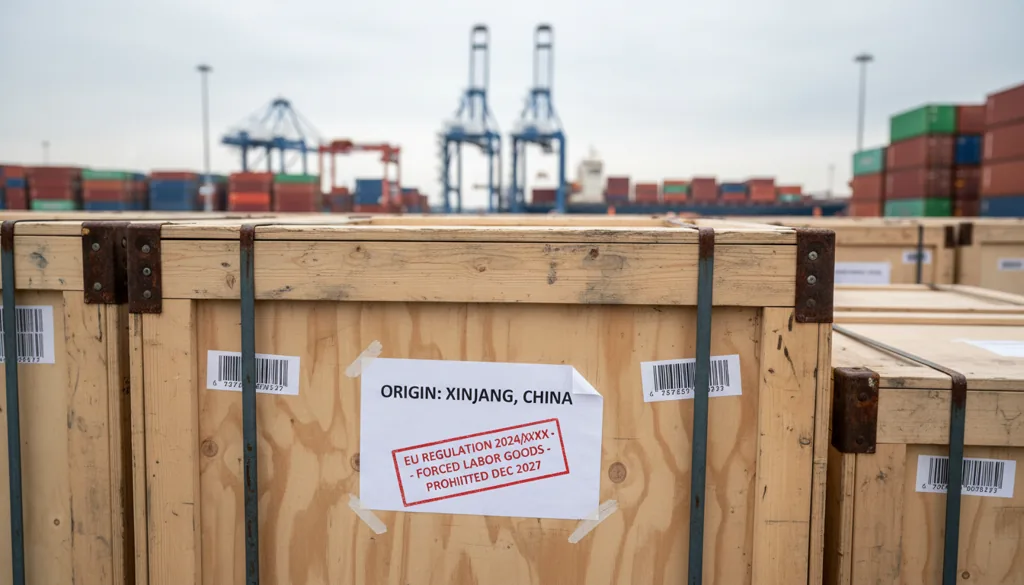
European Union will ban all goods made with forced labor from being placed on or exported to the EU market, with full application scheduled for December 2027.
The European Union will ban the sale in the EU, and the export from the EU, of any product made with forced labour, starting 14 December 2027.
The ban comes from Regulation (EU) 2024/3015, which the EU adopted on 19 November 20241. It covers goods from every sector and every country, including goods made inside the EU2.
In short, from December 2027 no product made with forced labour may be sold in or shipped out of the EU. If investigators prove forced labour, customs will stop the shipments at the border.
What does the forced labour ban cover?
The ban applies to all products, whatever their sector, type or origin2. It applies to imported goods and to goods made in the EU. It also applies when only one part of a product was made with forced labour.
The rule covers every stage of making a product. The EUR-Lex summary of the regulation lists production, manufacture, harvest, extraction and processing2. A shirt could be banned because of the cotton harvest, even if the sewing was fair.
Online sales are included. Goods sold at a distance, including online, fall under the ban if the offer targets buyers in the EU2. A seller outside the EU therefore cannot avoid the rule by selling through a website.
The Commission’s online portal describes forced labour as work people must do against their will1. These workers cannot freely refuse the work or leave it.
When does the EU forced labour rule start?
The Commission’s portal gives the key date: 14 December 20271. From that day, the regulation applies and enforcement begins. The European Parliament had said EU countries would start applying the law 3 years after it became final3.
European Parliament vote, April 23, 2024
The portal lists three steps in the timeline:
- 19 November 2024: the EU adopted the regulation.
- 30 June 2026: the Commission launched a preparation package and the portal.
- 14 December 2027: the regulation applies and enforcement begins.
The preparation period has already started for everyone involved1. EU countries also had a task before that. They had to tell the Commission which national authorities will run the investigations by 14 December 20252.
The law passed the European Parliament on April 23, 2024. The vote was 555 in favour, 6 against and 45 abstentions3. The EU Council then had to give its final formal approval.
Who will investigate forced labour products?
Investigations happen in two steps. At the end, the authority decides whether a specific product breaks the ban2. That decision is what stops the goods.
The work is split by location. The European Commission handles cases outside EU territory2. National authorities in each EU country handle cases on their own territory.
Investigators will use facts they can check. This information can come from international organisations, cooperating authorities and whistle-blowers, people who report wrongdoing from inside3. Investigators will also look at risk factors. These include how common state-imposed forced labour is in certain sectors and regions.
National authorities will work closely with customs and with market inspectors1. From 14 December 2027, a Single Information Submission Point will open1. This is an online channel where anyone can report suspected forced labour. Civil society groups can use it to send evidence and worker testimonies.
What happens to banned goods at the EU border?
A product found to be made with forced labour can no longer be sold in the EU, including online3. Customs will stop such shipments at the EU’s borders. This affects goods coming into the EU and goods leaving it.
What happens to forced labour goods
Companies must also deal with goods already on the market. Makers of banned goods must withdraw products from the market. They must then donate, recycle or destroy them3.
Companies that ignore a decision could be fined3. The documents on file do not give the size of these fines.
There is a way back. The goods may return to the EU market once the company removes forced labour from its supply chain3. The ban therefore targets the product and the way it was made, not the company forever.
What must small businesses do before December 2027?
Companies must make sure that forced labour products do not enter or leave the EU market1. The regulation does not say how. The portal says the method is up to each company. The rule applies to companies of every size.
What companies must do
During an investigation, a company may have to share information. Authorities can ask how it deals with forced labour risks in its supply chain1. When forced labour is confirmed, the company must follow the decision.
The Commission has published tools on its portal to help businesses prepare:
- The EU Forced Labour Regulation guidelines, which explain the duties.
- A risk database showing products and regions at risk.
- Traceability tools, which help track where parts come from.
- A list of national authorities to contact for support.
- An SME preparedness checklist for small and medium firms.
The checklist sets out key actions for smaller firms1. A company that knows each supplier behind its product can answer questions faster during an investigation. That record could help keep its shipments moving.
What training does the Commission offer on forced labour rules?
The Commission ran a launch webinar on 14 September 20261. It gave a general introduction to the regulation and the preparation package. Materials from the event are on the portal.
A second webinar followed on 16 September 20261. It focused on small and medium firms. It covered practical guidance and support tools.
The next fixed date in the documents is 14 December 2027. On that day, the ban becomes enforceable and the reporting channel opens1. After that, any shipment linked to forced labour can be stopped at the EU border.
Sources
- ↩ Forced Labour Regulation https://single-market-economy.ec.europa.eu/single-market/goods/forced-labour-regulation_en
- ↩ Ban on forced labour products on the EU market | EUR-Lex https://eur-lex.europa.eu/EN/legal-content/summary/ban-on-forced-labour-products-on-the-eu-market.html
- ↩ 0e03fc2c-51db-47b5-bb5d-2ff62515af85 https://www.europarl.europa.eu/news/en/press-room/20240419IPR20551/products-made-with-forced-labour-to-be-banned-from-eu-single-market