
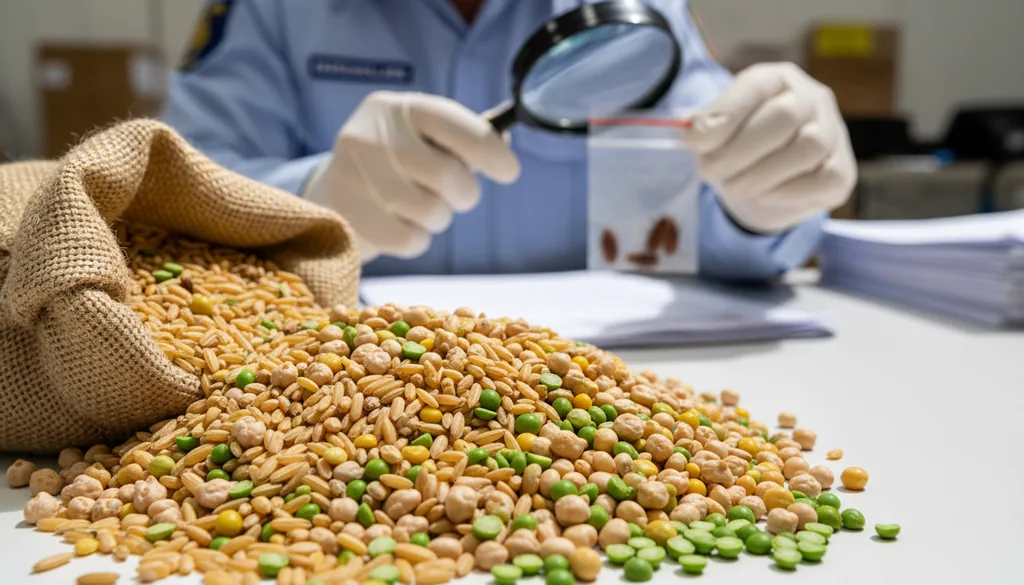
Australia has implemented emergency biosecurity measures targeting plant products at risk from the khapra beetle, including rice, chickpeas, soybeans, and peas, through enhanced inspections and import controls.
Australia has tightened biosecurity controls on plant imports to stop the khapra beetle, a pest that destroys stored grains, from reaching its farms. The new rules, which take effect on 30 April 2026, target shipments of rice, chickpeas, soybeans and peas from seven countries in Africa and Central Asia. Every shipment must now pass enhanced inspections before it can clear customs.
The delivered cost of those shipments will rise. Testing and treatment fees fall on the importer, and delays at the border can add weeks to supply chains. At the same time, Australia has removed Turkmenistan from the high-risk list after reviewing new evidence, so its exporters face lighter checks.
The beetle and the border
The khapra beetle feeds on stored grains and oilseeds, contaminating them with cast skins and faeces. A single infestation can ruin an entire silo, and the pest is hard to eradicate once it establishes itself. Australia has kept it out for decades, but rising trade with countries where the beetle is present has forced a rethink.
The scale of it
The new measures cover 1,463 tariff lines1. The heaviest burden falls on bulk commodities: milled rice (1006.30), dried chickpeas (0713.20), soybeans (1201.90) and dried peas (0713.10). Processed foods made from those ingredients are also caught if they contain more than 5 % by weight of the raw material2.
Who is on the list
Seven countries—Angola, Chad, Guinea, Jordan, Kazakhstan, Tajikistan and Tanzania—are now classified as “target-risk”2. Every shipment of the listed goods from those countries must carry a pre-issued import permit and a plant-health certificate that confirms the shipment was treated with methyl bromide or heat2. The treatment must be done in the country of origin, under supervision by its plant-health agency, and the certificate must state the exact method, temperature and duration2.
Target-risk and low-risk
Turkmenistan was originally on the list but has been removed after it provided additional surveillance data2. Its exporters now face the same lighter regime as other low-risk countries: random inspections and no mandatory treatment.
What the importer must do
The permit application must be filed at least 21 days before the shipment sails2. It must include the name of the exporter, the port of loading, the vessel, the container number, the treatment method and the expected date of arrival2. If the shipment arrives without the permit, it will be held at the first port of entry until the paperwork is complete or, if that takes more than 30 days, it will be destroyed at the importer’s expense1.
Clocks on the shipment, days
Once the shipment lands, biosecurity officers will open at least 5 % of the containers and take samples from every tenth bag2. If any live beetles or signs of infestation are found, the entire shipment must be fumigated again or sent back1. The importer pays for the inspection, the sampling, the storage and any re-treatment1.
What the rules replace
The new measures replace a patchwork of state-level orders that were inconsistent and often outdated. Under the old system, Queensland’s Biosecurity Act 2014 allowed local governments to declare pest quarantine areas, but the declarations were not harmonised with federal rules1. The new federal instrument overrides those local orders and sets the same requirements across every port1.
Old patchwork, new federal instrument
| Question | Old system | From 30 Apr 2026 |
|---|---|---|
| Rule source | State orders, e.g. Queensland Biosecurity Act 2014 | Federal instrument, same at every port |
| Country of origin | Trans-shipment could hide it | Permit must name growing country |
| Penalty for concealment | None stated | Fine up to A$1.1m (US$730,000; £570,000) |
The change also closes a loophole that allowed shipments to be split and re-consigned en route. Under the old rules, a container could be trans-shipped in Singapore or Dubai and the final certificate would not show the original country of origin. Now the permit must name the country where the goods were grown, and any attempt to conceal that information is a criminal offence punishable by a fine of up to A$1.1 million (US$730,000; £570,000)1.
The next review
The list of target-risk countries will be reviewed every 12 months2. The next review is due on 30 April 2027, and any country that can show it has eradicated the beetle or brought it under control can ask to be downgraded2. Until then, the seven countries on the list face the same regime, regardless of whether they have ever detected the pest.
The dates that bind
The timing of the change is awkward for traders. The new rules were first notified to the World Trade Organization in April 2025, but the final text was only published on 21 April 2026, nine days before they take effect2. That leaves little time for exporters to arrange treatment facilities or for importers to renegotiate contracts. The short notice also means that any shipment already on the water when the rules bite will be allowed to clear under the old regime, provided it arrives before 30 May 20262.
The volumes at stake are small—Australia imports only about 3,600 tonnes of the listed commodities from the seven countries each year2—but the effect on regional supply chains is disproportionate. Jordan, for example, ships almost all of its chickpea exports to Australia, and the new rules could force it to find new markets or absorb the extra cost. For Australia, the cost of keeping the beetle out is measured in higher prices for imported staples and longer lead times for food manufacturers. The alternative—an infestation that could cost the grain industry A$15 billion (US$10bn; £7.8bn) over ten years—is the reason the government has chosen to act now.
Sources
- ↩ Biosecurity Act 2014 – Queensland https://www.legislation.qld.gov.au/view/whole/html/inforce/2025-10-27/act-2014-007
- ↩ docs.wto.org — imrd / directdoc https://docs.wto.org/imrd/directdoc.asp?DDFDocuments/T/G/SPS/NAUS502A26.docx