
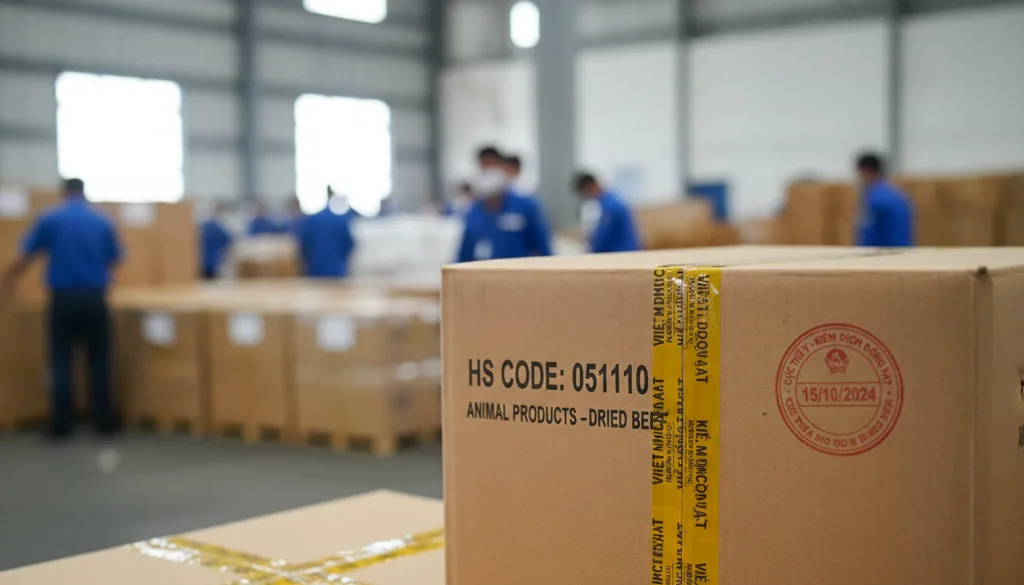
Viet Nam has issued draft quarantine regulations for animals and animal products, including terrestrial and aquatic species, to strengthen disease control and livestock health protection
Vietnam has published draft rules that will require every shipment of live animals, meat, fish and animal products to pass quarantine before it can enter the country.
The new measures, set out in a 50-page circular by the Ministry of Agriculture and Environment, cover 11 tariff chapters from live cattle to processed foods and animal hides. They take effect on 1 January 20271.
The delivered cost of every tonne inside the new rules will rise: importers must pay for testing, permits and any quarantine isolation the ministry orders. The ministry said in a statement that the changes are meant to stop animal diseases crossing the border and to bring Vietnam’s rules into line with international standards.
What the new rules cover
The draft circular lists 1,463 tariff lines that will need a pre-issued import permit1. They include live cattle, pigs and poultry; fresh, chilled and frozen meat; fish and crustaceans; dairy products; eggs; animal hides and skins; and animal genetic material such as semen and embryos.
Scope of the draft circular
Shipments of live animals must also carry a health certificate from the country of origin and a quarantine declaration signed by a government veterinarian1. Meat, fish and other animal products must be accompanied by a certificate of origin, a health certificate and a veterinary certificate issued by the exporting country’s competent authority1.
Exemptions are narrow. The ministry has published a separate list of low-risk products—mainly processed foods and pharmaceuticals—that will not need quarantine, but the list is short and the ministry can remove items from it at any time1.
How the process will work
Every shipment must be declared through Vietnam’s national single-window system at least five working days before it arrives1. The ministry’s border inspectors will then check the documents and decide whether to order physical inspection, laboratory testing or quarantine isolation.
From declaration to clearance
If the shipment passes, the inspector issues a quarantine certificate within one working day2. If it fails, the goods must be re-exported, destroyed or used for a purpose the ministry approves. The importer pays for all of it: storage, testing, destruction and any disinfection the ministry orders1.
Transit shipments are not exempt. Live animals and animal products moving through Vietnam must follow a fixed route and may not be unloaded3. Any waste or dead animals must be disposed of at a ministry-approved site, and the transporter must report any sign of disease to the nearest veterinary office immediately3.
What has changed from the old rules
The new circular replaces a patchwork of earlier measures that placed the same product in several categories at once. The ministry said the consolidation will cut red tape and make the rules the same across the country4.
Old rules and new, side by side
| Question | Old rules | New circular |
|---|---|---|
| How documents are filed | Paper, in person or by post | Single-window portal or identity app |
| How products are classified | Same product in several categories | One consolidated list nationwide |
| Level of inspection | Uniform for all shipments | Three risk tiers: high, medium, low |
One key change is the shift to electronic filing. Under the old rules, importers had to submit paper documents in person or by post; now they can file through the national single-window portal or a government identity app2. The ministry said the change will cut processing time and reduce opportunities for corruption.
Another change is the introduction of risk-based controls. The ministry will now classify countries and products into three risk tiers—high, medium and low—and adjust the level of inspection accordingly1. High-risk shipments will face full physical inspection and laboratory testing; low-risk ones may be cleared on documents alone.
Who the rules will hit hardest
The new measures will land most heavily on small importers and traders who bring in live animals or fresh meat. Those shipments are perishable, so any delay at the border can mean total loss. The ministry has not set a cap on how long quarantine isolation can last, so the risk of spoilage remains high.
Processors who rely on imported animal hides and skins will also feel the cost. The new rules require every hide to be tested for disease agents, and the ministry has not said whether it will accept test results from the country of origin or insist on retesting in Vietnam1.
Aquaculture exporters face a new hurdle: the draft circular requires every shipment of live fish and crustaceans to be accompanied by a disease-free zone certificate from the exporting country1. Many countries do not issue such certificates, so exporters may have to negotiate new agreements with their own authorities before they can sell to Vietnam.
What comes next for animal product
The draft circular is open for public comment until 15 September 20261. After that, the ministry will review the feedback and publish the final version, which will take effect on 1 January 2027.
Even before the rules bite, importers will have to prepare. The ministry has said it will publish detailed guidance on how to file electronically and what documents each product needs, but it has not given a date for that guidance1. Until it does, traders will have to rely on the draft text, which leaves key questions unanswered—such as how the ministry will allocate inspection slots at busy border posts.
The new rules are part of a wider push by Vietnam to tighten border controls. Earlier this year, the ministry issued stricter rules on plant-health certificates for imported seeds and grains, and it is drafting new measures on food additives and packaging materials5. Taken together, the changes signal that Vietnam is moving toward a more rigorous, risk-based approach to trade—one that will raise costs for importers but may also open new markets for Vietnamese exporters who can meet the higher standards.
Sources
- ↩ Draft Circular of the Minister of Agriculture and Environment Providing for the Quarantine of Animals and Animal Products https://docs.wto.org/imrd/directdoc.asp?DDFDocuments/T/G/SPS/NVNM190.docx
- ↩ Amendments and Supplements to Circular No. 01/2026/TT-BNNMT https://www.ppd.gov.vn/FileUpload/Documents/220618_22_2026_ttbnnmt_706059.pdf
- ↩ QD-BNNMT: Independence, Freedom, Hai Phong https://cdn.haiphong.gov.vn/gov-hpg/5892/tintuc/2026/5/qd-1878-ngay-22.5.2026-bnnmt-cong-bo-tthc-sua-doi-bo-sung-bai-bo-lvuc-cnty639154260106512809.pdf
- ↩ Consolidated Document 67/VBHN-BNNMT: Regulations on Quarantine of Terrestrial Animals and Animal Products https://xaydungchinhsach.chinhphu.vn/van-ban-hop-nhat-67-vbhn-bnnmt-quy-dinh-ve-kiem-dich-dong-vat-san-pham-dong-vat-tren-can-119260625162618604.htm
- ↩ Happiness Hanoi June 2026 Announcement http://www.spsvietnam.gov.vn/Data/File/Article/496B110B2F294317B17AB35BB1D03C4B.pdf