
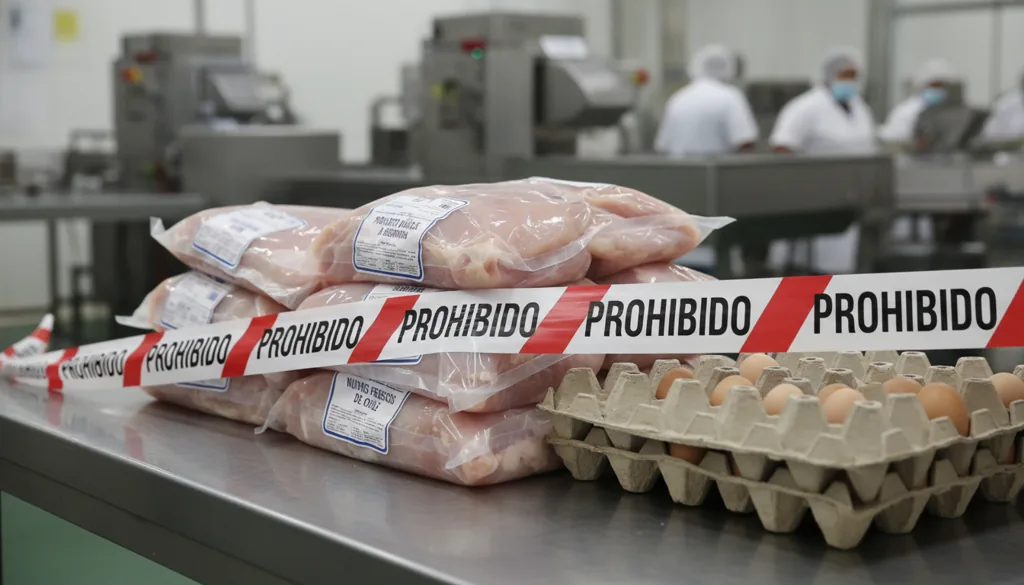
Uruguay has implemented temporary sanitary restrictions on Avian Products in response to high-pathogenicity avian influenza outbreaks in Argentina and Chile, suspending imports of live birds, hatching eggs, and poultry meat from both countries.
Uruguay has suspended all imports of live birds, hatching eggs and fresh poultry meat from Argentina and Chile after outbreaks of highly pathogenic avian influenza in both countries, a move that takes effect immediately and will remain in place until a new risk assessment is completed.
The ban covers 12 product categories, from day-old chicks to untreated feathers, and is the first time Uruguay has closed its border to poultry from Chile since the disease was detected there in March. Argentina’s suspension was lifted in May after a three-month pause, but the latest notification from Montevideo’s animal-health agency reinstates it with no fixed end date1.
The measure is designed to protect Uruguay’s status as a country free of the virus, a label that underpins its $150 m (£118 m; €138 m) annual poultry exports to markets such as China, the European Union and the Middle East. Every tonne of chicken meat that leaves the country must carry a plant-health certificate issued by the General Directorate of Livestock Services (DGSG), and any breach of the new rules could trigger a suspension of those export permits2.
What the ban covers and what it leaves open
The suspension applies to live birds, hatching eggs, table eggs, poultry semen, fresh meat, meat products, egg products and untreated feathers and down from both Argentina and Chile. Shipments of processed poultry meat and egg products that have undergone heat treatment sufficient to kill the virus are exempt, provided they meet the standards set out in the World Organisation for Animal Health (OIE) Terrestrial Code3.
What escapes the suspension
For fresh meat, only shipments produced before 24 February 2026 and kept separate from later batches will be allowed to enter. Importers must present proof of production date and a declaration that the goods have not been mixed with any material from affected zones3. Genetic material from approved compartments in Chile may still be imported if additional biosecurity measures are met, but no such exception has been granted for Argentina.
The DGSG has not set a deadline for the suspension. Instead, it will remain in force until the agency completes a new risk assessment, a process that typically takes between 60 and 90 days but can be extended if the epidemiological situation in either country worsens3.
Why the timing matters
The latest move comes less than three weeks after Uruguay lifted its own national health emergency for avian influenza, which had been in place since February when the virus was detected in wild birds in the coastal departments of Maldonado, Rocha and Canelones. The emergency was lifted on 28 April after 54 days without a new case, but the DGSG warned at the time that the risk of reintroduction “remains always present”4.
Clock on the outbreak, days
The agency has kept in place a series of biosecurity measures, including mandatory registration of all poultry movements, housing requirements for free-range birds, and enhanced cleaning protocols for cages and equipment used at livestock fairs and auctions. Any gathering of birds must now be notified to the DGSG at least 15 days in advance, and organisers must keep records of the origin and destination of every bird for two years5.
The new import bans from Argentina and Chile mark a return to the precautionary stance that Uruguay adopted in February 2026, when it first suspended poultry imports from Argentina after Buenos Aires reported its first commercial outbreak. That suspension was lifted on 6 May, only to be reimposed on 6 May 2026 after Argentina notified a second wave of cases1.
How the rules compare with earlier measures
Uruguay has used the same playbook before. In May 2025, when Brazil reported its first commercial outbreak of avian influenza, Montevideo suspended imports of live birds, eggs and fresh meat from its northern neighbour. That ban was later relaxed to allow heat-treated products and genetic material from approved compartments, a template that has now been applied to Chile6.
Three suspensions, one playbook
| Question | Argentina, 2026 | Chile, 2026 | Brazil, 2025 |
|---|---|---|---|
| Covered goods | Live birds, eggs, fresh meat | Live birds, eggs, fresh meat | Live birds, eggs, fresh meat |
| Heat-treated products | Exempt | Exempt | Later relaxed |
| Genetic material | No exception | Allowed from approved compartments | Later relaxed |
| End date | None fixed | None fixed | Partially lifted |
The DGSG has also shown it is willing to act quickly when its own export markets are at risk. In August 2026, China suspended imports from a Uruguayan beef plant after detecting residues of the veterinary drug imidocarb in two separate shipments. The plant remains barred from the Chinese market, and the DGSG has since tightened its monitoring of veterinary drug residues in all meat exports7.
What happens next for avian products
The DGSG has instructed its Sanitary Animal, Animal Industry and Veterinary Laboratories divisions to enforce the new rules and to report any attempts to circumvent them. The agency has also promised to publish updates on its website and in the official gazette as soon as either Argentina or Chile provides new epidemiological data that could trigger a review1.
For now, the suspension leaves Uruguay’s poultry sector in a holding pattern. Domestic production is expected to meet local demand, but any prolonged closure of the border with Argentina could push up prices for imported egg products and genetic material. The DGSG has not indicated whether it will consider regional quotas or temporary permits for essential imports, leaving traders with no alternative suppliers inside the Mercosur bloc6.
The next formal review is unlikely before late June, when the DGSG is scheduled to receive the first quarterly report from the Permanent Veterinary Committee of the Southern Cone, a regional body that tracks animal-health threats. Until then, the only way back into Uruguay for Argentine and Chilean poultry is a clean bill of health from the OIE and a new risk assessment that shows the virus is no longer circulating in commercial flocks.
Sources
- ↩ WTO SPS notification 26-02446 — Uruguay https://members.wto.org/crnattachments/2026/SPS/URY/26_02446_00_s.pdf
- ↩ Institutional Information – Section 07 (2015, Volume II, Part 2) https://www.opp.gub.uy/sites/default/files/documentos/2018-10/A%C3%B1o%202015.%20Tomo%20II.%20Parte%202.%20Informaci%C3%B3n%20institucional%20-%20Inciso%2007.pdf
- ↩ Suspensión temporal de importaciones de aves vivas de Chile por influenza aviar https://www.gub.uy/ministerio-ganaderia-agricultura-pesca/institucional/normativa/resolucion-n-90026-dgsg-se-suspende-temporalmente-importaciones-procedentes
- ↩ End of Avian Influenza Emergency in Uruguay https://www.gub.uy/ministerio-ganaderia-agricultura-pesca/comunicacion/noticias/se-levanta-emergencia-sanitaria-influenza-aviar-tras-50-dias-sin-nuevos-focos
- ↩ End of Avian Influenza Health Emergency Declaration https://www.gub.uy/ministerio-ganaderia-agricultura-pesca/resolucion98026
- ↩ MGAP Adjusts Poultry Import Suspension from Brazil Due to Avian Influenza Outbreak https://www.gub.uy/ministerio-ganaderia-agricultura-pesca/comunicacion/noticias/mgap-ajusta-suspension-importaciones-productos-avicolas-desde-brasil-brote
- ↩ Suspension temporal del Frigorífico Tacuarembó por hallazgo de imidocarb en exportaciones a China https://www.gub.uy/ministerio-ganaderia-agricultura-pesca/comunicacion/noticias/suspension-temporal-del-frigorifico-tacuarembo-para-exportar-china-refuerzo