
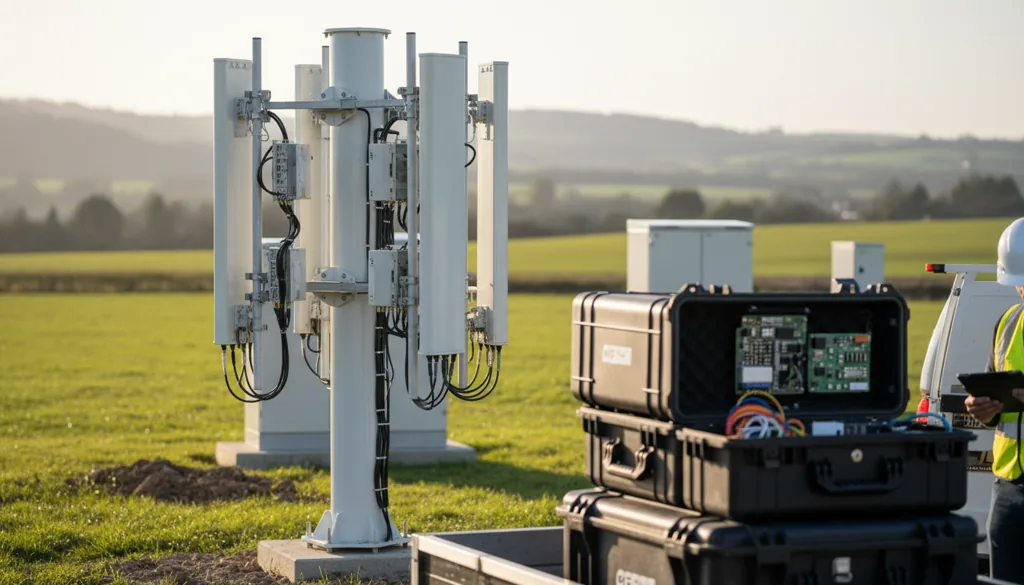
United States of America is expanding flexible use of the 3.7 to 4.2 GHz upper C-band spectrum to enhance spectrum utilization for next-generation wireless services and broadband communications
US Expands Spectrum for 5G and Satellite Services
New wireless licensees must reimburse satellite and aviation sectors to use the upper C-band.
Spectrum allocation
What changed
Competitive bidding required for at least 100 megahertz of spectrum in the 3.98–4.2 GHz band.
Reimbursement mandatory for incumbent Fixed Satellite Service operators for migration costs.
Rebates required for eligible aircraft owners to facilitate radio altimeter retrofits.
Coexistence measures established to protect radio altimeters in the 4.2–4.4 GHz band.
Who it affects
New wireless licensees must pay for incumbent migration and aircraft rebates.
Fixed Satellite Service operators are entitled to reimbursement for moving operations.
Aircraft owners can claim rebates to help cover altimeter retrofit costs.
What to do
Participate in competitive bidding for the 3.98–4.2 GHz spectrum.
Reimburse incumbent Fixed Satellite Service operators for reasonable migration costs.
Provide rebates to eligible aircraft owners for altimeter compliance.
Key dates
Summary
The question addresses the Federal Communications Commission’s (FCC) regulatory framework for expanding flexible terrestrial wireless use in the 3.7–4.2 GHz (C-band) spectrum, specifically the 3.98–4.2 GHz (Upper C-band) segment.
- Licensing & Auction Procedures: The FCC established a unified 3.7 GHz Service spanning 3.7–4.14 GHz and mandated competitive bidding for 160 MHz of Upper C-band spectrum, with a congressional deadline of 4 July 2027 for auctioning at least 100 MHz1.
- Performance Benchmarks: Licensees must meet population coverage milestones (45% within 2 years, 80% within 6 years of the Transition Deadline) or face accelerated deadlines or automatic license termination2.
- Coexistence & Cost Reimbursement: Technical rules prioritize coexistence with adjacent-band radio altimeters, while new licensees must reimburse Fixed Satellite Service (FSS) incumbents for migration costs and provide rebates to aircraft operators for radio altimeter retrofits1.
Jurisdiction(s): United States of America
**
Subject matters:** Spectrum Allocation — FCC auction and licensing rules for 3.7–4.2 GHz band; Performance Requirements — population coverage and transition deadlines for wireless licensees; Interference Mitigation — technical rules and cost-sharing obligations to protect adjacent-band operations
Regulation Analysis
The FCC’s Report and Order, Order of Proposed Modification, and Order on Reconsideration (FCC 26-46)1 expands flexible terrestrial wireless use in the 3.7–4.2 GHz band, with a focus on the 3.98–4.2 GHz (Upper C-band) segment. Key provisions include a 160 MHz allocation for terrestrial wireless, unified licensing under the 3.7 GHz Service, and performance benchmarks tied to population coverage. The rules are effective 29 September 2026, with corrections published in the Federal Register on 27 August 20263, 2.
1. Spectrum Allocation and Licensing
The FCC designated 160 MHz of the 3.98–4.2 GHz band for terrestrial flexible use, creating a single 3.7 GHz Service spanning 3.7–4.14 GHz1. Licenses are awarded via competitive bidding (auction), with Congress mandating the auction of at least 100 MHz by 4 July 2027 under the One Big Beautiful Bill Act1. The FCC largely adopted Lower C-band licensing rules for the Upper C-band but imposed stricter performance requirements1.
2. Performance Benchmarks and Compliance
Licensees must meet two population coverage milestones to retain their licenses:
- First Benchmark: Provide reliable signal coverage and service to ≥45% of the population in the license area within 2 years of the Transition Deadline2, 1.
- Second Benchmark: Expand coverage to ≥80% of the population within 6 years of the Transition Deadline2, 1.
Penalties for Non-Compliance:
- Failure to meet the first benchmark accelerates the second benchmark deadline by 1 year2.
- Failure to meet the second benchmark results in automatic license termination for the affected area without FCC action2.
Correction Note: The Federal Register correction (27 August 2026) clarified the benchmark timelines, replacing erroneous references to § 27.14(x)(3) with § 27.14(x)(4)3, 2.
3. Technical Rules and Coexistence
The FCC adopted Lower C-band technical rules for the Upper C-band, with modifications to ensure coexistence with adjacent-band radio altimeters (4.2–4.4 GHz)1. Key requirements include:
- Interference Mitigation: Licensees must comply with modified technical parameters to protect radio altimeters used in aviation1.
- Rebates for Aircraft Operators: New Upper C-band licensees must provide rebates to eligible aircraft owners/operators to facilitate FAA-mandated radio altimeter retrofits1.
4. Cost Reimbursement and Transition Incentives
- FSS Incumbent Reimbursement: New licensees must reimburse Fixed Satellite Service (FSS) operators for reasonable and necessary migration costs from the reconfigured Upper C-band, consistent with the FCC’s Emerging Technologies precedent1.
- Transition Incentives: Space station operators meeting clearing obligations by specified deadlines receive financial incentives1.
5. Rule Effective Dates and OMB Review
The rules are effective 29 September 2026, except for 13 provisions (e.g., § 27.14(x)(3), § 27.1412(b)) requiring OMB review under the Paperwork Reduction Act1. These provisions will take effect upon OMB approval, with the FCC publishing a separate Federal Register notice announcing their effective date1.
Key Requirements Summary Table
| Regulation | Key Requirement | Deadline/Threshold | Authority |
|---|---|---|---|
| 3.7 GHz Service Licensing | Unified licensing for 3.7–4.14 GHz; 160 MHz allocated for Upper C-band flexible use1. | Auction of ≥100 MHz by 4 July 20271. | FCC (47 CFR Part 27) |
| First Performance Benchmark | Coverage and service to ≥45% of population in license area2. | 2 years post-Transition Deadline2. | 47 CFR § 27.14(x)(4) |
| Second Performance Benchmark | Coverage and service to ≥80% of population in license area2. | 6 years post-Transition Deadline2. | 47 CFR § 27.14(x)(4) |
| FSS Cost Reimbursement | Reimburse FSS incumbents for migration costs1. | As specified in license terms1. | FCC (Emerging Technologies) |
| Radio Altimeter Rebates | Provide rebates to aircraft operators for FAA-mandated retrofits1. | As specified in license terms1. | FCC (47 CFR Part 27) |
Summary Answer
The FCC’s Upper C-Band Order (FCC 26-46)1 expands flexible terrestrial wireless use in the 3.7–4.2 GHz band, allocating 160 MHz of the 3.98–4.2 GHz segment for auction by 4 July 20271. Licensees must meet population coverage benchmarks (45% within 2 years, 80% within 6 years of the Transition Deadline) or face penalties, including automatic license termination2. Technical rules prioritize coexistence with radio altimeters, while new licensees must reimburse FSS incumbents and provide rebates to aircraft operators1. The rules are effective 29 September 2026, with select provisions pending OMB review1. Corrections to benchmark timelines were published on 27 August 20263, 2.
Sources
- ↩ Upper C-Band (3.98-4.2 GHz); Expanding Flexible Use of the 3.7 to 4.2 GHz Band https://docs.wto.org/imrd/directdoc.asp?DDFDocuments/T/G/TBTN25/USA2252A1.docx
- ↩ WTO TBT notification 26-04459 — United States of America https://members.wto.org/crnattachments/2026/TBT/USA/26_04459_00_e.pdf
- ↩ Upper C-Band (3.98-4.2 GHz); Expanding Flexible Use of the 3.7 to 4.2 GHz Band https://docs.wto.org/imrd/directdoc.asp?DDFDocuments/T/G/TBTN25/USA2252A1C1.docx