
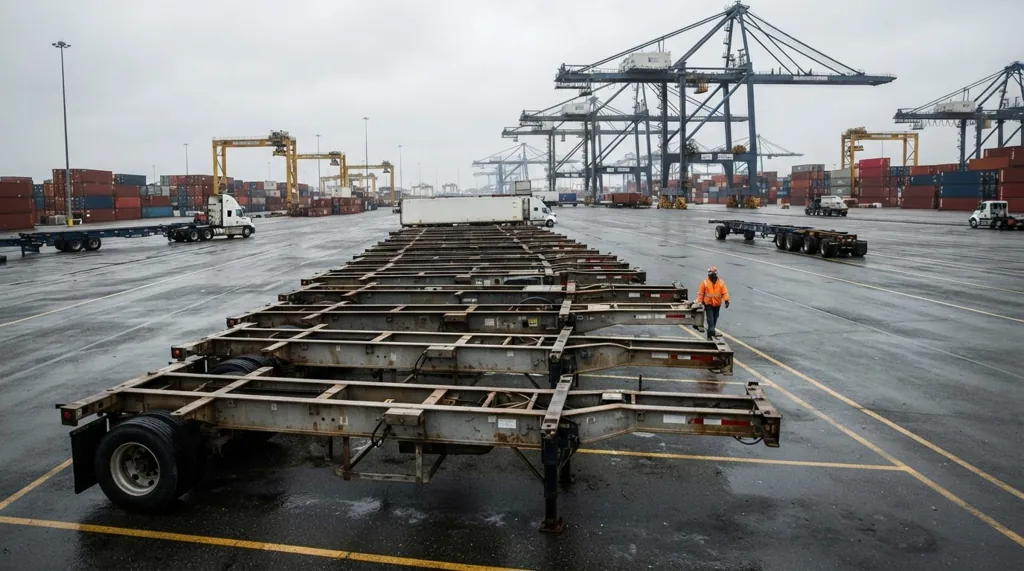
United States keeps anti-dumping and anti-subsidy duties on Chinese container chassis and their main parts, effective Nov. 2, 2026.
The U.S. Department of Commerce has kept its anti-dumping and anti-subsidy duties on Chinese container chassis and their parts, effective Nov. 2, 20261.
Commerce published the decision in the Federal Register on Nov. 13, 2026, after a first five-year review of the two duty orders1. The International Trade Commission (ITC), the U.S. agency that judges harm to American industry, agreed the duties are still needed2.
In short, nothing changes at the border for a chassis shipment from China. Importers must keep paying the same duty deposits as before, and the duties stay for at least another five-year cycle.
What did Commerce decide on Chinese chassis?
Commerce ordered the continuation of two orders on chassis and subassemblies from China1. The first is an anti-dumping duty, an extra import tax on goods sold in the United States below their normal price. The second is a countervailing duty, an extra import tax that offsets subsidies a foreign government gives its producers.
Both Commerce and the ITC found that ending the orders would likely bring back dumping, subsidies and serious harm to U.S. makers1. Under U.S. trade law, those two findings together mean the orders stay in place.
The notice was signed on Nov. 10, 2026, by Scot Fullerton, Commerce’s acting deputy assistant secretary for anti-dumping and countervailing duty operations1. The anti-dumping case number is A-570-135 and the countervailing duty case number is C-570-1361.
Why do the chassis duties exist at all?
The duties began in 2021. Commerce published the countervailing duty order on May 10, 20213. It published the anti-dumping duty order on July 8, 20214.
From the 2021 orders to the 2026 review
U.S. law requires a review of every such order after five years. This is called a sunset review, a check on whether the duties should end or continue. Commerce started the first sunset review of both chassis orders on April 1, 20261. The ITC started its own review on the same day2.
Who asked to keep the duties on chassis?
A group of U.S. chassis makers took part in the review. In the anti-dumping review, the group was the Coalition of American Chassis Manufacturers4. Its members were listed as:
- Cheetah Chassis Corporation
- Hercules Enterprises, LLC
- Pitts Enterprises, Inc.
- Pratt Industries, Inc.
- Stoughton Trailers, LLC
The coalition filed its notice to take part on April 16, 20264. It then sent a full response to Commerce on May 1, 20264. In the subsidy review, the domestic parties also included Pratt Intermodal Chassis3.
No Chinese producer or exporter sent a full response in either review4. The Chinese government did not respond in the subsidy review either3. Because only one side took part, Commerce ran a shorter expedited review of 120 days for each order3.
How high could the duties be without the orders?
In a sunset review, Commerce estimates the rates likely to return if the duties ended. It then tells the ITC those rates1.
Rates Commerce expects if the duties ended, %
For dumping, Commerce found that Chinese chassis would likely be sold at margins up to 188.05%4. A dumping margin is the gap between the U.S. price and the normal price. Commerce published this result on Aug. 4, 20264.
For subsidies, Commerce found a likely subsidy rate of 44.32% of the goods’ value3. That rate applies to the CIMC group, named as Qingdao CIMC Special Vehicles Co., Ltd. and Dongguan CIMC Vehicle Co., Ltd., with their linked companies3. The same 44.32% rate applies to all other Chinese producers and exporters3. Commerce published this result on July 29, 20263.
These are the rates Commerce expects without the orders. They are not new deposit rates. The deposit rate for each shipment is still the rate in force on the day it enters the United States1.
What did the ITC find about U.S. chassis makers?
The ITC decided on July 6, 2026, to run expedited reviews2. It completed its decision on Oct. 29, 20262.
The commission found that ending the duties would likely bring back material injury, meaning serious harm, to a U.S. industry within a reasonably foreseeable time2. Commissioner Samuel T. Negatu did not take part2. The ITC published its decision in the Federal Register on Nov. 2, 20262.
The ITC’s full reasons are in a report called USITC Publication 5806, dated October 20262. The ITC investigation numbers are 701-TA-657 and 731-TA-15372.
Which chassis and parts do the duties cover?
The orders cover chassis built to carry shipping containers or other loads by road, by rail, or on roll-on/roll-off ships1. They apply whether the chassis is finished or unfinished, assembled or unassembled, and coated or uncoated1. The number of axles does not matter1.
What the chassis orders cover
| Item | Covered? |
|---|---|
| Finished or unfinished chassis | Yes, for road, rail or roll-on/roll-off ships |
| Frames, running gear, landing gear, connecting assemblies | Yes, each counts as an unfinished chassis |
| Single parts sold on their own | No, unless entered with or for a chassis |
| Dry van, refrigerated and flatbed trailers | No, excluded |
| Chassis processed in a third country | Yes, still covered |
A typical chassis is a rectangular framed trailer with suspension, axles, wheels and tires, brakes, lights and a coupling for a truck1. It also has locks, such as twistlocks or slide pins, that hold the container in place1.
The orders also cover these subassemblies, or major parts1:
- Chassis frames or frame sections, including kingpin assemblies, bolsters, goosenecks, drop assemblies, extension parts and rear impact guards.
- Running gear or axle assemblies that attach to the frame, with or without suspension, brakes, axles, wheels and tires.
- Landing gear assemblies that hold up the chassis when no truck is attached.
- Connecting assemblies such as pintle hooks or B-trains, which link a chassis to a converter dolly or another chassis.
Importing any one of these subassemblies counts as importing an unfinished chassis1. Customs therefore treats it as covered goods.
Which goods stay outside the chassis duties?
Single parts sold on their own are not covered1. For example, a hub, a brake or a tire shipped alone is outside the orders. But the same parts are covered when they enter with a chassis or are meant to be assembled with one1.
Three types of trailer are excluded1:
- Dry van trailers, with a fully closed cargo box built into the trailer.
- Refrigerated van trailers, with an insulated closed box for use with a cooling unit.
- Flatbed or platform trailers, with a flat or stepped deck fixed to the frame.
Extra work does not take a chassis out of the orders. Cutting, drilling, painting, coating or assembly, in China or in another country, leaves the product covered1. Adding other parts does not remove it either1.
Which tariff codes apply to chassis imports?
The goods usually enter under these Harmonized Tariff Schedule of the United States (HTSUS) codes1:
- 8716.39.0090
- 8716.90.5060
- 8716.90.5010, used for some finished and unfinished chassis
The codes are a guide only. The written product description in the orders decides what is covered1. A shipment under a different code can still owe the duties if it matches the description.
What changes for importers and Chinese makers?
U.S. Customs and Border Protection (CBP), the border agency, will keep collecting duty deposits1. Commerce will instruct CBP to collect anti-dumping and countervailing duty cash deposits on all covered imports1. The rate is the one in force at the time each shipment enters1.
For importers, this means the cost of a Chinese chassis stays high. A U.S. buyer of chassis from China keeps paying both deposits at entry. Importers of the listed subassemblies also stay liable, even when they plan to finish the chassis in the United States.
For Chinese makers, the U.S. market stays costly. Moving final work to a third country does not help, because processing elsewhere does not remove a chassis from the orders1.
For U.S. chassis makers, the duties keep protection against lower-priced imports for another review period.
When is the next review of the chassis duties?
The continuation took effect on Nov. 2, 20261. That is the day the ITC published its decision2.
Commerce plans to start the next five-year reviews before the fifth anniversary of the ITC’s latest decision1. It will begin them no later than 30 days before that anniversary1. Until then, the orders stay in force.
Commerce also reminded parties with access to confidential case papers to return or destroy them1.
Key points on the Chinese chassis duties
The table below sums up the decision.
| Question | Answer |
|---|---|
| What changed? | Duties on Chinese chassis continue |
| Who decided? | U.S. Department of Commerce, with the ITC |
| Which goods? | Container chassis and their subassemblies |
| Which duties? | Anti-dumping and countervailing duties |
| Likely dumping margin | Up to 188.05% |
| Likely subsidy rate | 44.32% |
| Effective date | Nov. 2, 2026 |
| Notice published | Nov. 13, 2026 |
| Main tariff codes | 8716.39.0090, 8716.90.5060, 8716.90.5010 |
| What is excluded? | Single parts alone, dry van, refrigerated and flatbed trailers |
| Who collects deposits? | U.S. Customs and Border Protection |
| Next review | Starts no later than 30 days before fifth anniversary |
Chassis from China and their main parts will keep paying anti-dumping and countervailing deposits at the U.S. border from Nov. 2, 2026. The next review is due to start before the fifth anniversary of the ITC’s decision1.
Sources
- ↩ Federal Register :: Certain Chassis and Subassemblies Thereof From the People’s Republic of China: Continuation of Antidumping Duty and Countervailing Duty Orders https://www.federalregister.gov/documents/2026/11/13/2026-23177/certain-chassis-and-subassemblies-thereof-from-the-peoples-republic-of-china-continuation-of
- ↩ Federal Register :: Chassis and Subassemblies From China; Determinations https://www.federalregister.gov/documents/2026/11/02/2026-22342/chassis-and-subassemblies-from-china-determinations
- ↩ Federal Register :: Certain Chassis and Subassemblies Thereof From the People’s Republic of China: Final Results of the Expedited First Sunset Review of the Countervailing Duty Order https://www.federalregister.gov/documents/2026/07/29/2026-15232/certain-chassis-and-subassemblies-thereof-from-the-peoples-republic-of-china-final-results-of-the
- ↩ Federal Register :: Chassis and Subassemblies Thereof From the People’s Republic of China: Final Results of the Expedited First Sunset Review of the Antidumping Duty Order https://www.federalregister.gov/documents/2026/08/04/2026-15748/chassis-and-subassemblies-thereof-from-the-peoples-republic-of-china-final-results-of-the-expedited