
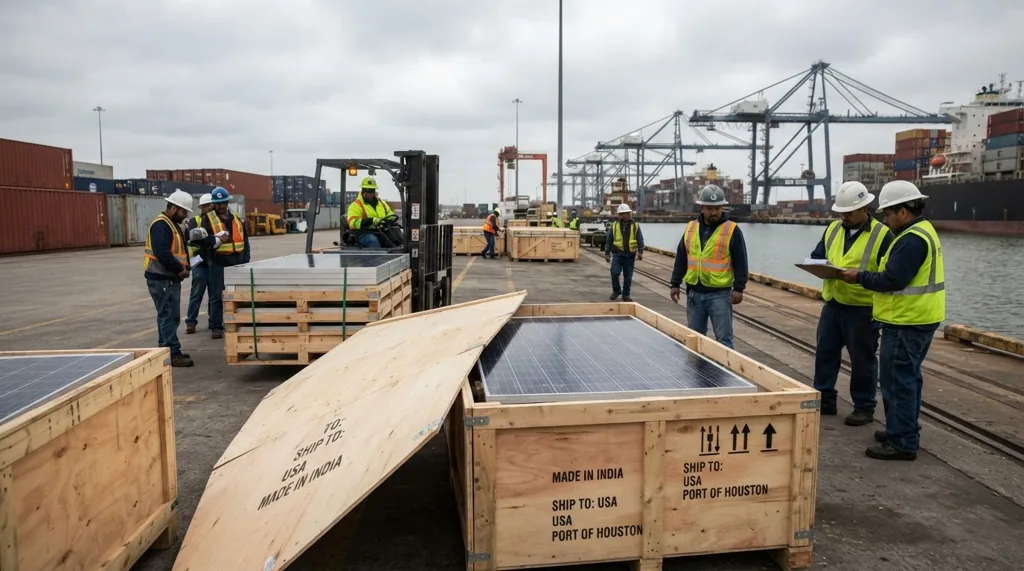
United States orders anti-dumping and anti-subsidy duties on solar cells and panels from India, Indonesia and Laos from Nov. 9, 2026.
The U.S. Department of Commerce has ordered anti-dumping and anti-subsidy duties on solar cells and panels from India, Indonesia and Laos from Nov. 9.
The two orders were signed on Nov. 4, 2026, and are scheduled to appear in the Federal Register on Nov. 9, 20261. They apply from the day they are published2.
In short, an importer bringing these solar cells or panels into the United States must pay two large cash deposits at the border. Rates run from about 65% to over 170% of the goods’ value, depending on the country and the maker.
This is a later step in a case the site reported in September. That story covered the final subsidy finding for Laos alone. The new orders turn the findings for all three countries into duties that customs collects.
What do the solar cell orders do?
Commerce issued two separate orders on the same goods. The first is a countervailing duty order, an extra import tax that offsets government subsidies paid to foreign makers2. The second is an anti-dumping order, an extra import tax on goods sold below their normal price in the United States3.
Both orders cover crystalline silicon solar cells from the three countries, whether or not they are built into modules3. Commerce calls these goods "solar cells" for short in both notices2.
Commerce will direct U.S. Customs and Border Protection (CBP), the border agency, to collect cash deposits on each entry2. The deposit is paid at the same time as normal customs duties. The final duty is fixed later, when Commerce sends further instructions to customs.
Why did Commerce act on these solar imports?
The orders rest on two sets of findings. On Sept. 16, 2026, Commerce published final findings that the goods were subsidized and sold below fair value2. A ruling that goods are sold below fair value is the legal test for dumping.
The second finding came from the U.S. International Trade Commission (USITC), an independent agency that judges harm to American industry. On Oct. 14, 2026, it found that a U.S. industry is materially injured by these imports4. Five commissioners voted in favor, and one did not take part4.
The commission formally notified Commerce of its findings on Nov. 2, 20263. Under U.S. law, Commerce can issue an order only after both agencies find against the imports. The commission’s news release said Commerce would now issue both orders4.
The complaint came from the Alliance for American Solar Manufacturing and Trade, a group of U.S. producers3. Commerce examined subsidies paid during the whole of 20245.
How high are the anti-subsidy duties?
The anti-subsidy deposit rates are set as a share of the goods’ value. Several rates are very high because Commerce used "adverse inferences." This means it relied on the worst available facts when a company or government did not fully cooperate2.
Anti-subsidy deposit rates, % of value
The rates by country and company are2:
- India: 126.09% for Mundra Solar Energy Limited, Mundra Solar PV Limited and all other makers.
- Indonesia: 173.70% for PT Blue Sky Solar Indonesia.
- Indonesia: 73.20% for PT REC Solar Energy Indonesia and all other makers.
- Laos: 153.67% for Vietnam Sunergy Joint Stock Company.
- Laos: 82.03% for Solarspace Technology (Laos) Sole Co. Ltd. and all other makers.
The "all others" rate covers every producer or exporter not named in the table2. A buyer of Indian cells therefore faces the same 126.09% subsidy deposit from any supplier.
For Laos, the final rate is higher than the preliminary one. In February 2026, Commerce had set a provisional rate of 80.67% for Laotian makers5.
How high are the anti-dumping duties?
The anti-dumping order lists a dumping margin and, for India and Laos, a lower cash deposit rate. The deposit is reduced to avoid charging twice for the same subsidy3. Commerce calls this an adjustment for "subsidy offsets."
Deposits for most makers, by country
| Deposit | India | Indonesia | Laos |
|---|---|---|---|
| Anti-subsidy | 126.09% | 73.20% | 82.03% |
| Anti-dumping | 107.17% | 94.36% | 65.36% |
The anti-dumping rates are3:
- India: 123.04% margin, 107.17% deposit for Mundra Solar PV, Mundra Solar Energy, Kowa Company, Premier Energies Photovoltaic and all others.
- Indonesia: 94.36% for PT Blue Sky Solar Indonesia, PT REC Solar Energy Indonesia and all others.
- Laos: 65.76% margin, 65.36% deposit for Solarspace and the Laos-wide rate.
The Laos table names four export routes for Solarspace goods3. They run through Solarspace’s Hong Kong arm, JA Solar Vietnam, and two Trina Solar companies, one of them in Thailand. The same rate applies to each route.
A shipment from one of these countries normally carries both deposits. An Indonesian panel from PT REC, for example, carries a 73.20% subsidy deposit and a 94.36% dumping deposit2, 3.
Why was the Laos dumping rate corrected?
The anti-dumping notice also amends the final dumping finding for Laos. On Sept. 16, 2026, the U.S. producers’ group claimed that Commerce had made calculation errors3.
Commerce agreed on Oct. 13, 2026, that one claim was a genuine error3. It had removed a separate U.S. safeguard tariff, known as section 201 duties, from all of Solarspace’s U.S. sales. It should have removed it only from sales that actually paid that tariff.
Commerce rejected a second claim about Solarspace sales through two Trina Solar companies3. It said that point was a choice of method, not an error. The correction changed Solarspace’s margin, and so also changed the Laos-wide rate based on it3.
Which solar goods are covered and which are not?
The orders cover crystalline silicon solar cells at least 20 micrometers thick, and the modules, laminates and panels made from them2. They also cover cells built into other products, such as building materials with solar cells inside.
Parts count too. Goods shipped as parts or kits for panels assembled after import are covered if they meet the product description3.
Several goods are left out. The main exclusions are:
- Thin-film solar products made from amorphous silicon, cadmium telluride or copper indium gallium selenide2.
- Small cells built into consumer goods, no larger than 10,000 square millimeters in total, where the good uses the power itself and is not a power generator2.
- Small off-grid panels of 100 watts or less, with a glass cover, set connectors and retail packaging3.
- Portable off-grid panels of 200 watts or less, with a handle, kickstands and a wire of at least 3 meters3.
- Panels for hydropanels, devices that turn water vapor into drinking water, within set size and power limits2.
Each exclusion has a detailed list of physical features. A panel must meet every listed feature to be excluded.
Which past imports will customs charge?
The orders reach back to entries made during the earlier provisional period. For subsidies, customs can assess duties on entries from Feb. 26, 2026, the date of the preliminary findings2. For dumping, the start date is April 28, 20263.
Key dates in the solar case
There is a gap in each case. Provisional subsidy measures can last only four months, so they ended on June 25, 20262. Entries made from June 26 until the day before the commission’s final ruling is published will be cleared without subsidy duties2.
The provisional dumping measures were extended to six months at the request of exporters3. They ended on Oct. 24, 2026. Entries from Oct. 25 until the day before that publication will be cleared without dumping duties3.
What happens to imports from Indonesia before February?
Commerce found "critical circumstances" for some makers in all three countries2. This term means a sudden surge of imports just before the duties started. If both agencies agree, duties can apply up to 90 days earlier2.
The commission agreed only for Indonesia4. As a result, subsidy duties will reach back to Indonesian entries made on or after Nov. 28, 20252. This covers PT Blue Sky Solar Indonesia and all other Indonesian makers.
For India and Laos, the commission found no critical circumstances4. Commerce will therefore refund the subsidy deposits on entries from Nov. 28, 2025, to Feb. 25, 20262. Customs will also release those entries from the hold on final settlement.
What comes next for solar importers?
Customs will resume holding entries and collecting deposits from the date the commission’s final ruling is published in the Federal Register2. The holds stay in place until further notice.
The commission will publish its full report, USITC Publication 5804, by Nov. 23, 20264. The report will set out its reasons and the facts gathered in the case.
Companies that want to be told of future scope rulings or anti-evasion cases can join a service list. They must apply within 30 days of publication of the orders3.
Key points on the India, Indonesia and Laos solar orders
The table sums up the two orders.
| Question | Answer |
|---|---|
| What changed? | Final anti-dumping and anti-subsidy orders |
| Who issued them? | U.S. Department of Commerce |
| Which goods? | Crystalline silicon solar cells and panels |
| Which countries? | India, Indonesia and Laos |
| Highest subsidy rate | 173.70%, PT Blue Sky Solar Indonesia |
| India deposits | 126.09% subsidy, 107.17% dumping |
| Laos deposits | 82.03% subsidy, 65.36% dumping for most makers |
| Main exclusion | Thin-film solar products |
| Who pays? | U.S. importers, as cash deposits |
| Signed | Nov. 4, 2026 |
| Publication | Nov. 9, 2026 |
| Next date | Commission report by Nov. 23, 2026 |
From publication on Nov. 9, 2026, every covered solar shipment from these three countries carries both deposits at the U.S. border1. For many makers, the two deposits together exceed the value of the goods.
Sources
- ↩ Federal Register :: Public Inspection: Antidumping or Countervailing Duty Investigations, Orders, or Reviews: Crystalline Silicon Photovoltaic Cells, Whether or Not Assembled Into Modules from India, Indonesia, and the Lao People’s Democratic Republic https://www.federalregister.gov/public-inspection/2026-22824/antidumping-or-countervailing-duty-investigations-orders-or-reviews-crystalline-silicon-photovoltaic
- ↩ 2026-22824.pdf https://public-inspection.federalregister.gov/2026-22824.pdf
- ↩ 2026-22825.pdf https://public-inspection.federalregister.gov/2026-22825.pdf
- ↩ Crystalline Silicon Photovoltaic Cells, Whether or Not Assembled Into Modules, from India, Indonesia, and Laos Injure U.S. Industry, Says USITC [UPDATED] | United States International Trade Commission https://www.usitc.gov/press_room/news_release/2026/er1014_69351.htm
- ↩ Federal Register :: Crystalline Silicon Photovoltaic Cells, Whether or Not Assembled Into Modules From the Lao People’s Democratic Republic: Preliminary Affirmative Countervailing Duty Determination, Preliminary Negative Critical Circumstances Determination, and Alignment of Final Determination With Final Antidumping Duty Determination https://www.federalregister.gov/documents/2026/02/26/2026-03897/crystalline-silicon-photovoltaic-cells-whether-or-not-assembled-into-modules-from-the-lao-peoples