
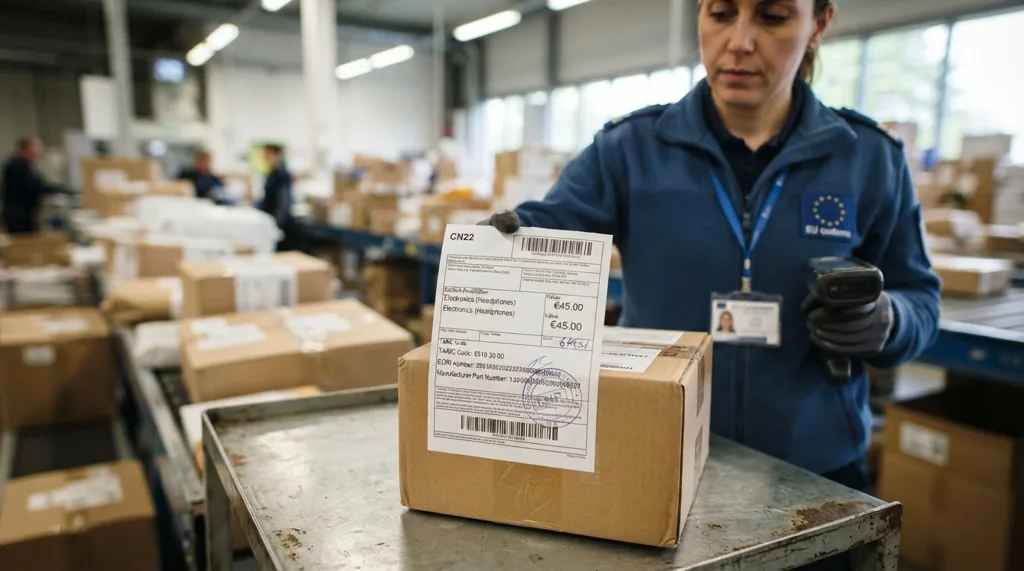
European Union customs declarations for goods sold online to EU buyers must include three product codes from 1 November 2026.
The European Commission made product codes compulsory in customs declarations for online sales shipped to EU buyers from 1 November 2026.
The codes are called product identifiers (PIDs). Each one points customs to the exact product inside a parcel, not just its type1.
In short, a parcel sold online to an EU buyer now needs three codes for each product on its customs declaration. A barcode number, the maker’s model number and the seller’s listing number travel with the goods, and customs uses them to find unsafe products.
What changed on 1 November for online parcels?
From 1 November 2026, product identifiers must be declared to customs for goods sold in distance sales to buyers in the EU, notably consumers1. A distance sale is an online or mail-order sale where the seller ships goods from outside the EU to a private buyer inside it.
The Directorate-General for Taxation and Customs Union, the European Commission’s customs department, announced the step on 3 November 20261. It said the requirement is now mandatory and is enforced1.
Since 1 July 2026, firms could already give the codes on a voluntary basis, without penalties1. That trial period has ended. A declaration for an online sale without the codes no longer meets the rules.
Which law requires the product codes?
The legal basis is Commission Delegated Regulation (EU) 2026/1022 of 30 June 20262. It amends the main rulebook that sets out the data customs declarations must contain, Delegated Regulation (EU) 2015/24462.
The regulation applies in general from 1 July 20262. But it sets a later date for the product code parts of its annex. Those parts apply from 1 November 2026, and firms could provide the data voluntarily from 1 July 20262.
The regulation explains its aim in one line. It says new definitions and requirements on product identifiers are needed "to improve controls on goods sold in distance sales of imported goods"2.
To limit changes to national computer systems, the codes go into an existing box of the declaration. That box is the data element called "Supporting Document"2. Customs offices therefore do not need a new field to receive them.
What are the three product codes?
The regulation defines a product identifier as a unique code of letters and numbers. It is assigned to a specific model, batch or article, at any packaging level2. The code must allow precise identification and tracing at every stage, from the offer for sale to after the sale2.
The three codes each product needs
| Code | What it is |
|---|---|
| Merchant product identifier (M-PID) | Seller’s or platform’s listing reference |
| Maker’s own reference (NS-PID) | Model, part or style number, no international format |
| Barcode number (S-PID) | International standard, such as EAN, UPC or ISBN |
| No barcode | Declare a specific exemption code |
For each product in the customs declaration, three identifiers must be given1:
- Merchant product identifier (M-PID): the product’s reference on the website, marketplace or platform that sells it. The seller or platform sets it, such as the number on the product page, and it is unique on that platform1.
- Maker’s own reference (NS-PID): the non-standardised manufacturer product identifier. It is the maker’s model, part or style number and does not follow an international format1.
- Barcode number (S-PID): the standardised manufacturer product identifier. It follows an international standard and is usually printed as a barcode, such as an EAN, UPC or ISBN number1.
The barcode code identifies the exact product worldwide and can usually be checked in public1. The maker’s reference links the product to its maker and model. Customs can then find the same product on different platforms1.
What if a product has no barcode?
Some goods carry no standard barcode. In that case, the declaration must say so using a specific exemption code1. The exemption code tells customs that the missing barcode is not an error.
The other two codes still apply. Every online listing has a page reference, and most makers give their goods a model or part number. The Commission says the codes usually exist already1.
Why did the EU make the codes compulsory?
The Commission points to joint checks by customs. Customs authorities of all 27 member states worked with market surveillance authorities, the bodies that check product safety1. Their checks showed that many low-value goods bought online from outside the EU break EU product and safety rules1.
The figures are stark. Targeted inspections across the EU in 2025 covered cosmetics, personal protective equipment, food supplements, toys and electronics3. Over 60% of checked products failed EU standards, for reasons such as missing labels, forbidden ingredients or absent safety documents3.
The volume is also large. In 2025 alone, almost 5.9 billion low-value items were shipped directly from outside the EU to consumers in the EU3.
Tariff codes and product descriptions only tell customs what kind of good is in a parcel. Product codes let customs identify the specific product1. When one product is found unsafe, customs can apply that result to all similar products. This works even when other sellers or other platforms sell them1.
The Commission says this helps keep unsafe products away from EU buyers. It also says the step gives fairer competition to EU businesses that follow EU rules1.
Who must provide the codes at the border?
The declarant reports the codes in the customs declaration1. The declarant is the person who lodges the declaration. The Commission names two examples: the holder of an Import One Stop Shop (IOSS) number, the EU scheme for collecting VAT on online sales, or a customs representative1.
Who has to act
The codes come from further up the supply chain. Online platforms and manufacturers pass them on to the declarant1. In most cases, the codes already appear in product listings, on invoices or on packaging1. The Commission says no new data needs to be created1.
For each group, the change looks like this:
- Online sellers and platforms must pass their listing number and the maker’s codes to whoever files the declaration.
- Manufacturers abroad supply model numbers and barcodes that follow their goods.
- Declarants, such as IOSS holders and customs brokers, must enter all three codes for each product.
- EU buyers gain, in the Commission’s words, more protection from unsafe goods1.
A declaration without the codes leaves customs unable to link a parcel to a known unsafe product. Since 1 November, it also falls short of the data rules.
How do the codes fit with the €3 parcel duty?
The product codes are part of a wider change to how the EU taxes and checks small online parcels. Council Regulation (EU) 2026/382 of 11 February 2026 removed the old duty exemption for consignments worth up to €1504.
Charges per item on online parcels, EUR
In its place, a temporary €3 customs duty per item applies from 1 July 20263. It covers goods in consignments worth up to €150 sold in distance sales3. The duty runs until 1 July 2028, after which normal customs duties apply depending on the type of good3.
The duty is charged per item, not per parcel. An item means goods in a consignment with the same tariff classification and description2. The Commission gives an example: a parcel of 5 T-shirts pays €3, while 1 T-shirt plus 1 watch pays €63.
Delegated Regulation 2026/1022 carries both changes. Its full title links it to the €3 duty on distance sales of goods worth up to €1502. The product codes are the part of it that started later2.
The Commission’s guidance for member states and trade, in its version of 5 October 2026, also covers a second charge4. This is the Union handling fee, a fee for the customs work of processing each item4. The guidance puts it at €2 per item and says it is expected to apply from 1 November 20264. The act fixing that amount was still under scrutiny when the guidance was written4.
Which goods and declarations are covered?
The requirement applies to goods sold in distance sales1. That means sales by a seller, including an online platform acting as the seller, to a customer in the EU, with the goods shipped from outside the EU4.
The €3 duty applies whichever customs declaration is used for these goods2. EU rules name three types for such goods. The H7 declaration is a short form for consignments worth up to €1502. The H6 declaration is used by postal operators, and the H1 declaration is the standard import form2.
The guidance says the €3 duty does not depend on the country of origin. It applies equally whatever country the goods come from and whichever logistics firm moves them3.
Some goods escape the €3 duty. Goods that qualify for lower duties under trade agreements or customs union deals are excluded, as long as their VAT was not collected through IOSS and they are declared on the H1 form3.
What comes next after November 2026?
The product codes are a first step. More detailed product data requirements will follow once the EU Customs Data Hub for e-commerce is in place1. The Commission gives July 2028 for that stage1.
Product codes and e-commerce customs, step by step
| Date | What happens |
|---|---|
| 1 July 2026 | €3 duty starts, product codes voluntary |
| 1 November 2026 | Product codes mandatory and enforced |
| 1 December 2027 | Commission assesses Data Hub readiness |
| 1 July 2028 | Customs Data Hub, €3 duty ends |
The Data Hub is a planned central EU customs database. The Commission expects it to streamline e-commerce imports from 1 July 20283. The €3 duty is due to end on that same date3.
Under Regulation 2026/382, the Commission must assess by 1 December 2027 whether the Data Hub will really work by 1 July 20284. If it will not, the Commission may propose extending the temporary duty4.
The Commission’s guidance is a living document3. It is not legally binding, and the texts published in the Official Journal of the EU take precedence4.
Key points on EU e-commerce product identifiers
The main facts of the new rule are below.
| Question | Answer |
|---|---|
| What changed? | Product codes now required in customs declarations |
| Who issued it? | European Commission |
| Legal act | Delegated Regulation (EU) 2026/1022 |
| Which goods? | Goods sold in distance sales to EU buyers |
| Codes needed | Seller’s listing number, maker’s reference, barcode number |
| No barcode? | Declare a specific exemption code |
| Who files the codes? | The declarant, such as an IOSS holder or customs representative |
| Who supplies them? | Online platforms and manufacturers |
| Voluntary from | 1 July 2026 |
| Mandatory from | 1 November 2026 |
| Next stage | Fuller product data with the Customs Data Hub, July 2028 |
From 1 November 2026, each online sale shipped into the EU must carry its product codes on the customs declaration1. The next fixed date is 1 December 2027, when the Commission must judge whether the Customs Data Hub will be ready by 1 July 20284.
Sources
- ↩ Product identifiers for e-commerce imports mandatory from 1 November 2026 – Taxation and Customs Union https://taxation-customs.ec.europa.eu/news/product-identifiers-e-commerce-imports-mandatory-1-november-2026-2026-11-03_en
- ↩ Delegated regulation – EU – 2026/1022 – EN – EUR-Lex https://eur-lex.europa.eu/eli/reg_del/2026/1022/oj/eng
- ↩ Guidance and legal text on temporary flat fee on low-value imports which will apply until 1 July 2028 – Taxation and Customs Union https://taxation-customs.ec.europa.eu/news/guidance-and-legal-text-temporary-flat-fee-low-value-imports-which-will-apply-until-1-july-2028-2026-06-08_en
- ↩ 053e5b4e-f0be-4f20-9a23-3e3b659a6676_en https://taxation-customs.ec.europa.eu/document/download/053e5b4e-f0be-4f20-9a23-3e3b659a6676_en?filename=Customs%20Guidance%20on%20EUR%203%20customs%20duty.pdf