
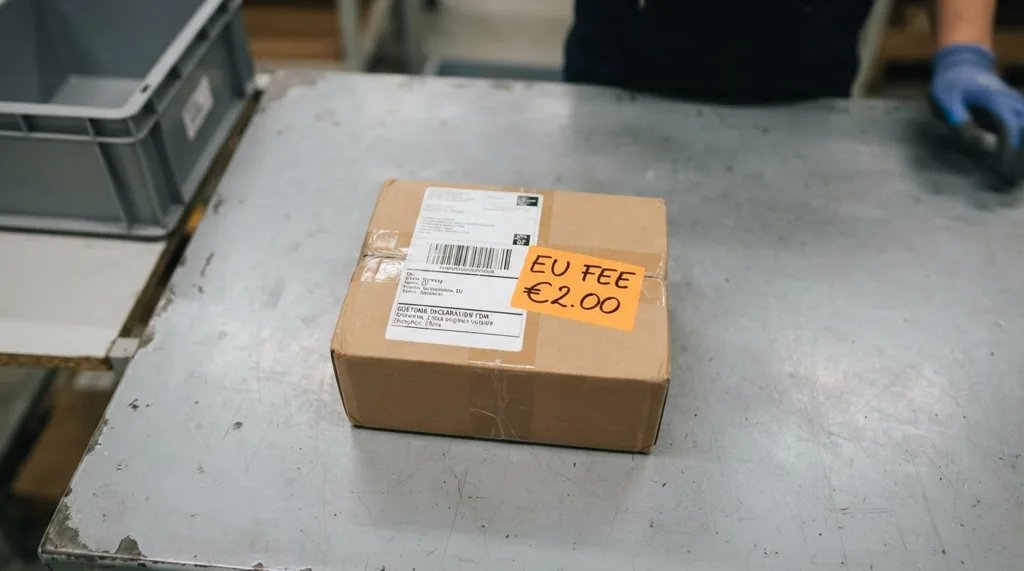
European Union customs will charge a EUR 2 fee per item on goods sold online from outside the EU from 1 November 2026.
The European Commission has set a fee of EUR 2 per item on goods bought online from outside the EU, starting 1 November 2026.
The fee is called the Union handling fee. Commission Delegated Regulation (EU) 2026/2152 fixes its amount, and it appeared in the Official Journal of the European Union on Oct. 22, 20261.
In short, every online sale shipped into the EU from abroad will pay customs EUR 2 for each item from November. This applies to cheap parcels and to expensive ones. It comes on top of the EUR 3 customs duty that has applied to low-value parcels since 1 July 20262.
What does the EUR 2 handling fee cover?
The Delegated Regulation has only two articles. Article 1 says the Union handling fee is EUR 2 per item1. Article 2 says the regulation entered into force on the day of publication and applies from 1 November 20261.
The fee itself was created by a larger law. This is Regulation (EU) 2026/2108 of Sept. 16, 2026, which sets up a new Union Customs Code, the EU’s main customs law, and a new EU Customs Authority1. Article 20(2) of that law creates the fee, and Article 20(10) lets the Commission set its amount1.
The fee pays for a service. Customs collects it for handling a request to release goods for free circulation, which means clearing them for sale and use inside the EU1. It applies only when the goods were sold in a distance sale to a customer in the EU1.
Why did the Commission set the fee at EUR 2?
The customs law says the fee must match the approximate cost of the work customs does. That work includes checking data, risk analysis, controls and the related equipment and IT systems1. It also includes services from the new EU Customs Authority1.
The Commission based the amount on a first cost report for the period 2026 to 20281. The report estimates costs for EU countries and for the Commission in customs digital systems. It also counts the share of customs staff who clear, check and audit goods sold at a distance1.
Some costs were left out. The report does not count control equipment paid for only from national budgets1. It also leaves out most work by market surveillance authorities, the agencies that check product safety1. The Commission calls its estimate moderate because it rests on careful assumptions, and it also projected future parcel volumes1. On this basis, it found EUR 2 per item to be in line with the cost of supervising these goods1.
Why is the EU charging online imports more?
The Commission points to the growth of online shopping from abroad. In 2025, 5.9 billion low-value items were imported into the EU, four times the number in 20223. More than 90% of those items came from China, according to the Commission’s customs reform page3.
The Commission says this mass of small parcels has put customs under strain3. It adds that many of the products fail EU rules and standards and are unsafe for buyers3. The new customs law itself names the limited capacity of customs to handle the rising volume of online imports as a weakness4.
The Commission’s reform page describes the fee as a way to cover the rising costs of customs work3. Those costs come from the digital systems and staff used to release goods. They include data checks, risk analysis and document and physical checks when needed3.
Which shipments will pay the handling fee?
The fee applies to a distance sale. The customs law uses the EU’s VAT definition of the term2. A distance sale is a sale where the seller ships goods from outside the EU to a customer in an EU country, and the customer is not a VAT-registered business2.
When a sale counts as a distance sale
| Condition | What it means |
|---|---|
| Seller | A business, including platforms counted as the seller |
| Buyer | In the EU customs area, including the Canary Islands |
| Goods | Outside the EU at the time of sale |
| Shipping | By the seller or on the seller’s behalf |
The Commission’s guidance for EU countries and traders, dated Oct. 5, 2026, lists four conditions for a distance sale2:
- A business sells the goods. This includes online platforms that count as the seller under VAT law2.
- The buyer is in the EU customs area. This includes places outside the EU VAT area, such as the Canary Islands, the Aland Islands and the Channel Islands2.
- The goods are outside the EU at the time of the sale2.
- The seller ships the goods, or someone ships them on the seller’s behalf2.
Customs can spot a distance sale in the customs declaration. When the declaration has no VAT number for the import VAT, customs takes this as a sign of a distance sale2. A valid Import One Stop Shop (IOSS) number, from the EU’s online VAT scheme, also shows that the goods were sold this way2.
Do expensive parcels pay the EUR 2 fee too?
Yes. The fee has no value limit, unlike the EUR 3 duty2. The guidance says goods in parcels worth more than EUR 150 also pay the fee, as long as they were sold at a distance2.
EUR 3 duty and EUR 2 fee compared
| Question | EUR 3 customs duty | EUR 2 handling fee |
|---|---|---|
| Charged per | Item | Item |
| Value limit | Parcels up to EUR 150 | None |
| Start | 1 July 2026 | 1 November 2026 |
| End | 1 July 2028 | No end date |
The fee is a fixed amount. It is not a percentage of the price2. A cheap item and a costly one each pay the same EUR 2 when sold online from abroad.
The fee is also permanent. The EUR 3 duty runs only until 1 July 2028, but the guidance says the handling fee has no end date2. Customs will not pay it back. The guidance calls the fee non-refundable2.
How are items counted for the EUR 2 fee?
The fee is charged per item, in the same way as the EUR 3 duty2. For that duty, Ireland’s tax and customs agency, Revenue, explains that each distinct type of product in a package counts as one item5.
Handling fee for Revenue’s example parcels, EUR
Revenue gives these examples for the EUR 3 duty5:
- A notepad, a pen and a keyring are three items.
- A silk blouse and a cotton T-shirt are two items.
- Two identical cotton T-shirts are one item.
Because the fee follows the same rule, the same parcels would pay EUR 6, EUR 4 and EUR 2 in handling fees. A parcel worth EUR 150 or less pays both charges. The three-item parcel would therefore owe EUR 9 in duty and EUR 6 in fees.
Which sales are outside the handling fee?
Some purchases do not count as distance sales. When the customer picks up the goods, the sale is not a distance sale2. The same applies when the customer arranges transport without any help from the seller2.
The seller does count as shipping the goods in several cases. These include when the seller hires a carrier, charges the buyer for transport, or promotes a delivery service2. They also include cases where the seller is partly responsible for delivery2. New means of transport, and goods supplied after installation or assembly, are outside distance sales2.
Ordinary business imports are not covered. The fee applies only to distance sales to customers who are not VAT-registered businesses2.
Who pays the handling fee at the border?
Under the new rules, the consumer no longer carries the duty and the paperwork. Platforms, sellers or carriers in the sale take on that role3. Non-EU online platforms and sellers are responsible for customs formalities and payments for the goods they sell into the EU3.
The customs law creates a new role, the importer for distance sales. This makes a business, not the consumer, the importer in some online sales from outside the EU4. That business must follow customs law and keep records showing it did so4.
Rule breaking has a cost. The Commission says penalties include fines, the loss of some customs benefits and even limits on access3. Customs systems are being updated too. The EU added a new tax type code, F00, for the fee in customs declarations2.
When do the handling fee rules start?
The new customs law entered into force on Sept. 20, 20262. Most of it applies from Sept. 21, 20272. Some parts started early, including the definitions of distance sale and item, from Sept. 20, 20262.
Handling fee dates
The customs law says the fee applies 10 days after its amount is set by a delegated act1. The Commission adopted the Delegated Regulation on Sept. 21, 2026, and published it on Oct. 22, 20261. It fixed the start date at 1 November 20261.
Two later dates matter. From 1 July 2028, goods sold from a customs warehouse for distance sales will pay a lower fee2. The same day, the EU Customs Data Hub, a single digital system for customs data, becomes mandatory for online sales3.
What happens next with the EUR 2 fee?
The amount can change. The Commission must write a cost report every two years1. This lets it review the fee and adjust it to match the costs customs faces1.
The Commission will also review the amount by a new delegated act before the end of the EU’s current long-term budget2. That review will set the lower fee for items sold from customs warehouses for distance sales2.
The EUR 3 duty has its own timetable. The Commission must assess by Dec. 1, 2027 whether the Customs Data Hub will work by 1 July 20282. If not, it may propose to keep the temporary duty for longer2.
Key points on the EU handling fee
The table below sums up the fee.
| Question | Answer |
|---|---|
| What changed? | New Union handling fee on online imports |
| Who set it? | European Commission |
| Legal act | Delegated Regulation (EU) 2026/2152 |
| Amount | EUR 2 per item |
| Which goods? | Goods sold at a distance from outside the EU |
| Value limit? | None, parcels above EUR 150 pay too |
| How items are counted | Each distinct product type |
| Who pays? | Platforms, sellers or carriers, not consumers |
| Refundable? | No |
| Published | Oct. 22, 2026 |
| Start date | 1 November 2026 |
| Next date | Lower warehouse fee from 1 July 2028 |
From 1 November 2026, each distinct item in an online sale from outside the EU will cost EUR 2 more at customs. For a parcel worth EUR 150 or less, the fee and the EUR 3 duty together come to EUR 5 per item.
Sources
- ↩ Delegated regulation – EU – 2026/2152 – EN – EUR-Lex https://eur-lex.europa.eu/eli/reg_del/2026/2152/oj/eng
- ↩ 053e5b4e-f0be-4f20-9a23-3e3b659a6676_en https://taxation-customs.ec.europa.eu/document/download/053e5b4e-f0be-4f20-9a23-3e3b659a6676_en?filename=Customs%20Guidance%20on%20EUR%203%20customs%20duty.pdf
- ↩ EU Customs Reform – Taxation and Customs Union – European Commission https://taxation-customs.ec.europa.eu/customs/eu-customs-reform_en
- ↩ Regulation – EU – 2026/2108 – EN – EUR-Lex https://eur-lex.europa.eu/eli/reg/2026/2108/oj/eng
- ↩ Removal of the De Minimis Relief for Low Value Consignments – 1 July 2026 https://www.revenue.ie/en/customs/individuals/relief-low-value-consignments/index.aspx