

 May 05,2026
  By Alice
Foreign trade is unquestionably a complex process. This is not as simple as sending a product to another area within a country because the international border is strictly protected by the respective authorities. One of the processes is identifying products using a specific combination of code numbers called the Harmonized Standard (HS) code. It may sound simple, but the accuracy of the HS code is critical for ensuring the product enters another national border seamlessly. Not only HS code, but there are other similar codes called commodity codes, which some of us do not even hear about. This article will discuss the difference between HS code and commodity code, along with the abbreviation of similar codes, namely TARIC code, CN code, and Intrastat code, as well as guide you to find all codes simply and quickly.
What is the meaning of the HS code?
HS code or Harmonized Standard code is a nomenclature administered by the World Customs Organization (WCO) for identifying traded goods. HS code is recognized all over the world as a standard interpretation to identify products or goods to make them recognizable by the customs authorities. Hence, the declaration of HS code is a must for all parties who need to transfer goods from one country to another.
The functions of the HS code are exclusively for the identification of goods to align with the local regulations in a specific country. The 6-digit codes are essential for customs to define the tariff rates, duties, and taxes for all products coming from other countries. Without a declaration of HS code, the customs officer cannot determine the trade restrictions and preferential tariff under the Free Trade Agreements (FTAs).
What is the meaning of the Commodity Code?
Commodity codes are quite similar to HS codes and are sometimes considered synonyms, but the difference lies only in their length. The commodity code is constructed using the fundamental structure of the HS code. Thus, commodity codes are additional numbers added to the internationally recognized HS code. Instead of only a 6-digit code, this code is commonly longer with more than 6 digits.
The commodity code, also known as the tariff code, has a similar function to the HS code for the classification of imported products. However, the commodity code is basically a further categorization of the HS code based on the local regulation in a specific country. The terms of the commodity code are used widely in the European Union and the United Kingdom. Meanwhile, the popular name of the commodity code in the United States is HTSUS, which stands for Harmonized Tariff Schedule of the United States.
What is the definition of CN Code?
Commodity codes have many types based on the applicable import regulations in the destination country. As explained above, one of the examples is HTSUS for importing goods entering the United States territory. This code is administered by the US Customs and Border Protection (CBP) and consists of a 10-digit number.
In the European Union, on the other hand, there are several commodity codes. One of them is the CN code, also identified as the Combined Nomenclature (CN) code. This code is a required code developed and managed by the Directorate of Taxation and Customs Union (DG TAXUD) under the European Commission.
The declaration of the CN code is an integral part of the import and export process from all non-EU countries to one of the EU member countries and vice versa. This code is applied to determine the Common Customs Tariff (CCT) in the EU, and is essential for trade statistics in the European bloc. In essence, the CN code is the additional 2-digit code behind the general HS code for specific products, and the full set of CN codes is 8 digits.
What is the definition of TARIC Code?
The other commodity code in the EU is the TARIC code, an abbreviation of the French sentence Tarif Intégré Communautaire, which means the Integrated Tariff of the European Union in English. TARIC code is a comprehensive database to integrate the policy from the Common Customs Tariff in the EU. Not only for customs, but this database also includes the legislation about the agricultural and commercial sectors in the EU.
In fact, the TARIC code is a commodity code derived from the CN code and serves as further classification of products with an additional 2-digit unique code. Thus, the full set of TARIC code typically is 10 digits, and for some goods, it can be extended with more than 10 digits. TARIC code is used exclusively for importing goods and is an obligation before the products are allowed to circulate in the EU countries.
What is Intrastat Code?
Intrastat code is a compulsory code for exporting or importing products within the EU member countries, particularly in Belgium, the Netherlands, and Luxembourg, or called Benelux. This code is the same as the CN code or commodity code in the EU. Intrastat code is solely used for statistical purposes by national statistical agencies in EU member countries and by Eurostat, the EU’s statistical agency.
The Intrastat or CN code is required for Intrastat declaration before sending goods within the EU. Intrastat declaration only becomes mandatory for businesses if the goods exceed the specific threshold. The intrastat declaration is basically a tool to track and publish public market and trade data within the EU. The companies also need this data to analyse commercial market trends.
What is the Commodity Code in the United Kingdom?
The United Kingdom (UK) and the European Union basically have similar commodity codes and tariff systems because the United Kingdom was part of the European Union. However, post Brexit, the United Kingdom has developed its own national standard for classifying goods and tariff rates, as well as taxes in 2020. The name of the new standard tariff classification is the UK Global Tariff (UKGT). Similar to the classification in other countries, the taxes depend on where the products come from.
Commodity codes in the EU are similar to those of UKGT, which also has an 8 to 10-digit code. However, the classification of taxes is different because the UK and the EU have different regulations. Not only for classifying taxes and tariff rates, but the UKGT also plays a critical role in identifying the regulations between the country of origin and the UK, including preferential tariffs based on the Free Trade Agreements (FTAs).
Side-by-side comparison of HS code, CN Code, TARIC Code, and Intrastat Code in the EU
To give you clarity about HS code and commodity code, we will explain a side-by-side comparison of the codes. The following table will elucidate the difference among the HS code, CN code, Intrastat code, and TARIC code. For example, we can use the tariff classification code for handmade wooden furniture in the kitchen.
| Type of Code | Description |
| HS Code | 6 digit (9403.40) |
| CN Code | 8 digit (9403.40.10) |
| Intrastat Code | 8 digit (9403.40.10) |
| TARIC Code | 10 digit (9403.40.10.10) |
| UK Global Tariff Code | 8 to 10 digit (9403.40.10.10) |
How to Find HS Code vs Commodity Code
After understanding the explanation about HS code vs commodity code, including CN code, TARIC, and Intrastat code. We must know the declaration of the HS code, and the commodity code is a key to the success of international businesses. Without an accurate HS code or commodity code, the products cannot be circulated in the destination country. Even if it can, it must undergo the penalties, such as fines, seizure, or additional requirements, before being released to the market.
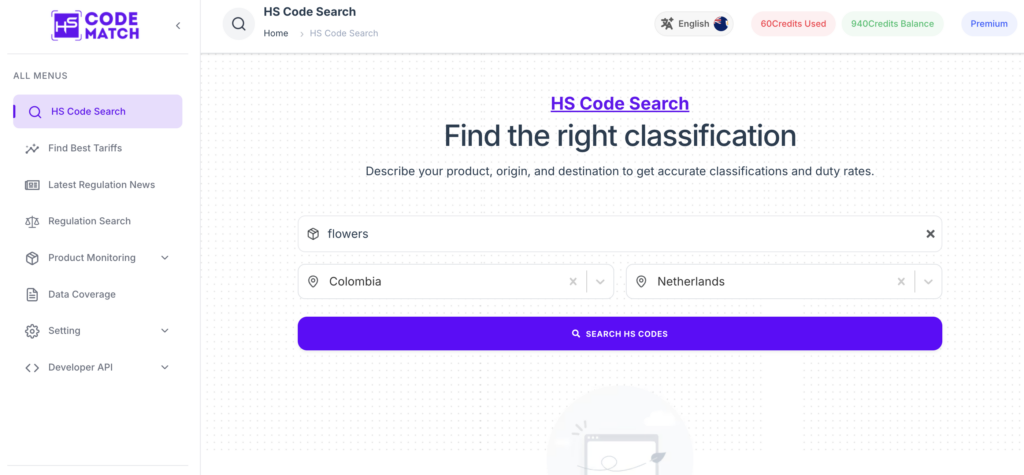
No wonder that all international business parties must understand the product classification based on the General Rules of Interpretation of Harmonized Code (GRI). Instead of using the manual method, some applications offer an automatic finder for HS codes and commodity codes. One of the applications is called HSCodeMatch. Without further ado, check a step-by-step example on how HSCodeMatch can easily find the HS code for flowers other than roses from Colombia to the Netherlands.
Step 1: Open the HSCodeMatch application
Open the HSCodeMatch application through the homepage link here: hscodematch.com or directly access the app link here: https://app.hscodematch.com/. Then, choose the HS Code Search and set the flowers as products and choose the country of origin, Colombia, and the Netherlands as the destination country.
Step 2: Find the highest percentage HS code
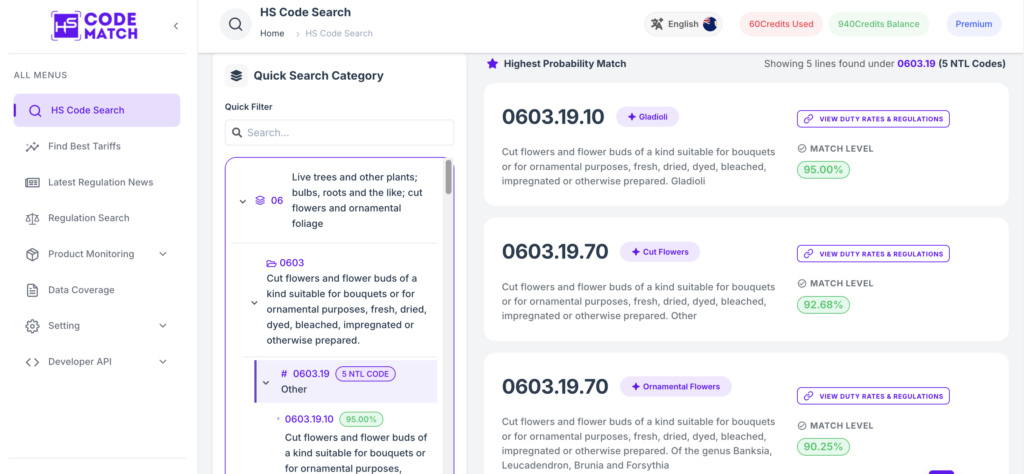
In a second, the HSCodeMatch will give the most recommended HS code with the highest percentage in the first row. Then, click the first row for HS code or commodity code 0603197090 in the Netherlands.
Step 3: Find the tariff rate and latest regulations
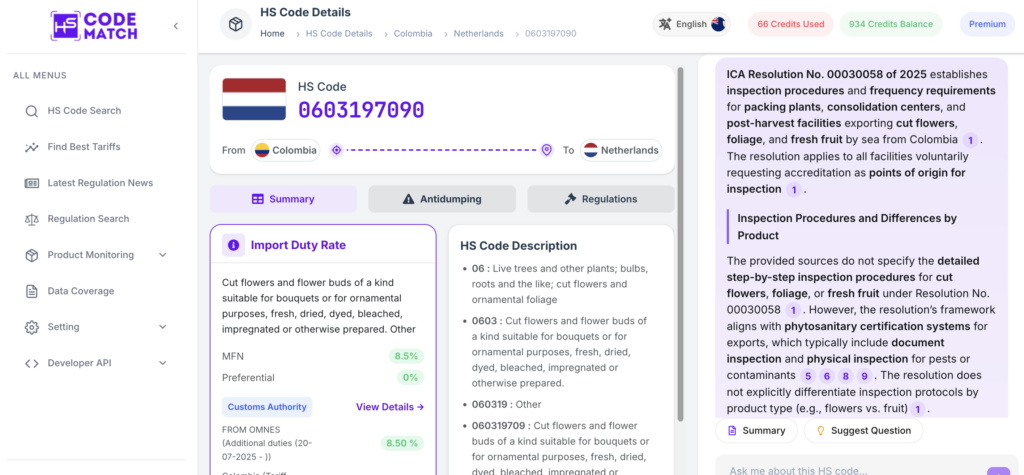
Find the HS Code Summary, along with the details of the tariff rate on the HS Code Details page. Please check whether it is the most relevant HS code for your products before exporting flowers from Colombia to the Netherlands.
Step 4: Use the AI Chatbot Assistant on HSCodeMatch
You can check the antidumping and countervailing duties, as well as other regulations, next to the HS Code Summary. Please use the AI Assistant if you find any confusion in finding the latest regulations or procedures for exporting flowers from Colombia to the Netherlands.
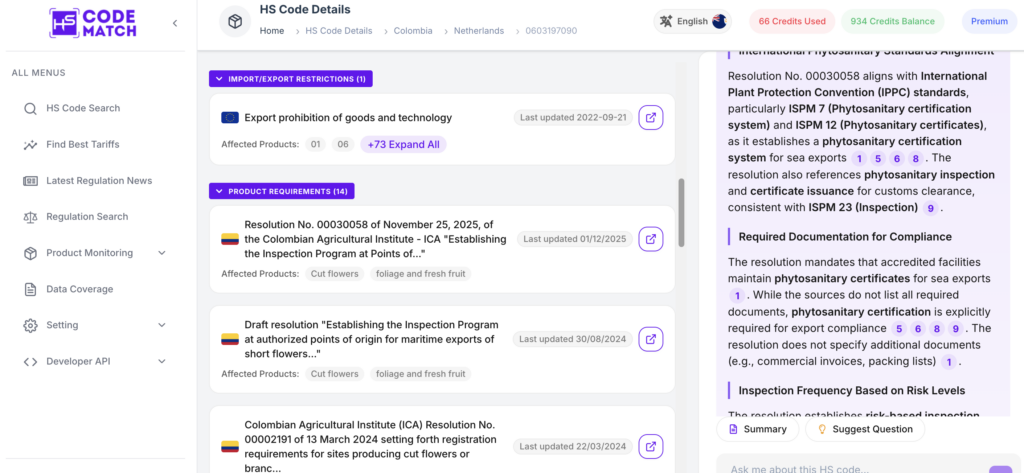
If you encounter confusion, you can ask a suggestion question on the AI Assistant. Then, it will provide the relevant suggestion for you. Below are examples of questions and answers from the AI Assistant on HSCodeMatch regarding the export of flowers from Colombia to the Netherlands.
Are there any additional tariffs for exporting flowers under HS code 0603197090 from Colombia to the Netherlands?
For exporting flowers under the HS code or commodity code 0603197090 from Colombia to the Netherlands, you can benefit from 0% under the preferential tariff based on the CAN-EU Free Trade Agreement (FTA). If the product is not eligible for the FTA regime, the Most Favoured Nation (MFN) tariff to export flowers to the Netherlands is 8.5%. No need to worry because no additional tariff or other hidden tariff applies to the products under this code.
| Tariff Type | Rate | Applicable Country | FTA Code | Effective Date |
| Preferred for Colombian products | 0% | Tariff preference | D1207350 | 01-08-2013 |
| Non-preferential or MFN | 8.5% | Additional Tariff | R2512270 | 20-07-2025 |
| Supplementary unit | p/st | Supplementary unit | R1517541 | 01-01-2016 |
What documents are required to claim the 0% preferential tariff for flowers under HS code 0603197090?
In order to claim the preferential tariff 0% for exporting flowers from Colombia to the Netherlands, importers must submit documents. Below are the documents required for claiming a preferential tariff under the CAN-EU FTA.
| Document | Requirement |
| Certificate of Origin | This document must be from the Colombian government that declares the flowers are originating from Colombia based on the CAN-EU FTA rules. |
| Commercial Invoice | This document requires a detailed description of products, including HS code (0603197090), origination, and value of the flowers. |
| Bill of Lading/Airway Bill | Must provide the declaration of evidence for shipping companies to transport the products from Colombia to the Netherlands. |
| Proof of Direct Shipment | This document shows that the flowers are directly from Colombia to the EU without transhipment in a non-FTA country. This excludes the customs control. |
| Import Declaration | The declaration must be submitted to the EU customs and give a reference regarding FTA. This is important to make the products eligible to preferential treatment. |
Which Colombian authorities can issue the Certificate of Origin for flowers?
For exporting flowers from Colombia to EU countries, including the Netherlands, you must be accompanied by the certificate of origin (COO) from the Colombian authority. The official authority issuing the COO for flowers is Instituto Colombiano Agropecuario (ICA). In addition, the Analdex (Asociacion Nacional de Comercio Exterior) and ProColombia can help exporters obtain the COO documents for many types of products. ICA is the regulatory body in Colombia that specifically oversees phytosanitary certification, export registration, and compliance with the international trade standard for agricultural products. Other regulatory bodies related to the export and import process of the flowers are the Ministry of Agriculture and Rural Development (MInAgricultura) and the National Directorate of Taxes and Customs (DIAN).
What specific phytosanitary requirements must Colombian production sites meet to obtain ICA registration for exporting cut flowers or ornamental branches under Resolution No. 063625?
In order to export a product of cut flowers or ornamental branches from Colombia, all of the producers need to obtain ICA (Instituci Colombiana Agropecuaria) registration based on Resolution No. 063625. This requirement is developed to comply with the phytosanitary standards and ensure that all flowers from Colombia do not contain pests or other plant diseases before sending them to the international market.
On the other hand, there is a pest risk assessment (PRA) before registering the flowers with the ICA. The PRA is based on Resolution No. 01277 of 2004, and the PRA process can be found below.
- The first process is the identification of the common pests or plant diseases associated with cut flowers or ornamental branches.
- Evaluation or assessment of pest entry, establishment, and all of the spread risks before exporting to the destination markets.
- Define the measurement to mitigate the risks of contamination of pests or plant disease, including treatments, inspection, and analysis. This measure to guarantee that the flowers meet the acceptable standard in the destination country.
- After all of the mitigation measures have been done, the next step is to submit the formal documentation of the PRA report to ICA. Then ICA will analyse the document and standard before approval.
Are there any exemptions or simplified registration processes for small-scale flower producers?
Yes, based on the ICA Resolution No. 00002191 of 13 March 2024, small-scale flower producers in Colombia are eligible for an exemption from registration. In this case, a small-scale flower producer is the producer who has less than 1 hectare for producing cut flowers or ornamental branches. However, it is exclusively applicable to all of the flower products marketed in Colombia. For flower products intended for export, all need to undergo registration with the ICA. Thus, whether it is small or large flower producers, all need to register with the ICA before exporting their products to other countries.
As mentioned, this regulation is established for phytosanitary requirements to guarantee that the flowers from Colombia are free from pests and plant diseases. If there are any pests or plant diseases in the destination country, the government of the recipient country will impose a ban on the flowers from Colombia as a whole. This not only affects one producer but all of the producers in Colombia.
Conclusion
In essence, the HS code and commodity code are similar. The commodity code is basically an additional code after the international standard HS code. They serve the same purposes as an identification number to simplify customs officers in a country to define the tariff rates and specific regulations. The different only in the structure and length of the code; the HS code is only a 6-digit code. On the other hand, the commodity code has more than 6-digit codes ranging from 8 to 12-digit numbers depending on each country’s regulations.
Frequently Asked Questions (FAQs) about HS Code vs Commodity Code
1. What is the key difference between the HS code vs the commodity code?
HS code vs commodity code is quite similar. The HS code is the international standard of product identification code, and the commodity code is the additional code derived from the HS code, valid in a specific country or region.
2. What are the commodity codes for exporting flowers to the EU countries, particularly the Netherlands?
Based on the search results from HSCodeMatch, the commodity codes for exporting flowers from Colombia to the Netherlands are 0603197090, 0603197020, 0603191000,
0603192000, 0603197010. You can further identify the best match codes for your products.
3. Does commodity code only valid in a certain region?
No, the commodity code is basically the additional code from the HS code. The name of the commodity code differs from one country to another. In the EU, the commodity code is called the CN code and TARIC code, and in the United States, the commodity code is named HTSUS.
4. Which application can you use as a reference to find an accurate commodity code?
In order to find HS code and commodity code, you can use the application from the government website, such as Access2Market in the EU. On the other hand, you can use a third-party application, such as HSCodeMatch, to find the accurate HS code and commodity code.
5. Why do we need an Intrastat declaration to export and import products within the EU?
An Interstat declaration is a requirement for all businesses in order to import products within the EU countries. This is a mandatory requirement; if the businesses do not declare Interstat, there will be penalties for not complying with the EU rules.
6. What is the Intrastat code? Does it use internationally?
Intrastat code is actually the same as the CN code. This code has a function only for exporting or importing products between two members of the EU countries. Therefore, the Intrastat code cannot be used for exporting to a country outside the EU, including the United Kingdom and the United States.
Find and Match the Right HS Code for Your Products.
Try Our App