
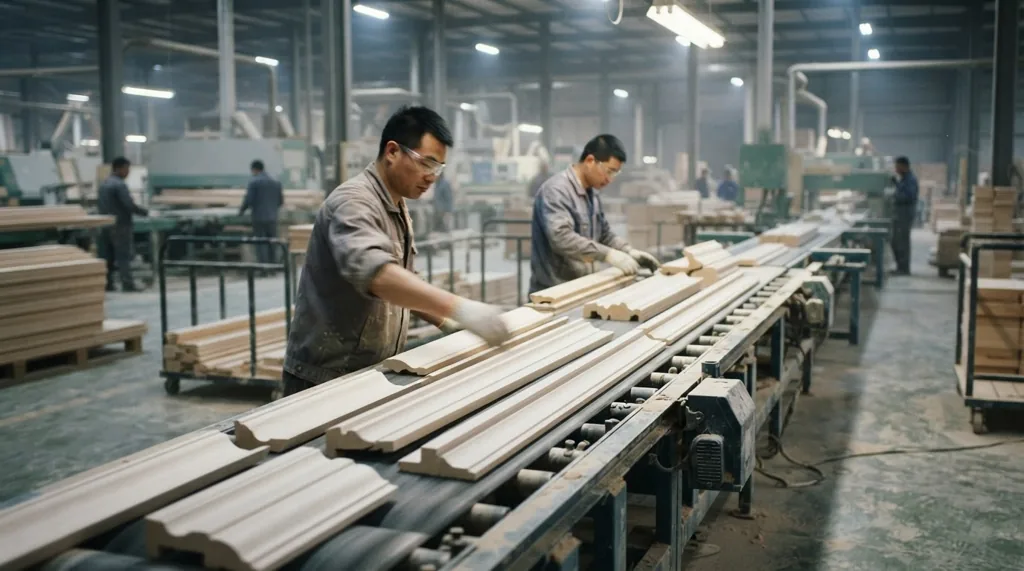
United States sets anti-subsidy duties of 147.88% on three Chinese millwork makers and 21.39% on 11 others from Nov. 12, 2026.
The U.S. Department of Commerce set new anti-subsidy duty rates on Chinese wood mouldings and millwork, applying from Nov. 12, 2026.
The new rates come from a yearly check of the duty order, called an administrative review, covering shipments made in 20241. Three Chinese companies now face a rate of 147.88%, and 11 other companies under review face 21.39%1.
In short, an American importer bringing in Chinese wood trim from these companies must now pay a much larger cash deposit at the border. For the three named companies, the deposit is worth about one and a half times the value of the goods.
What did Commerce decide on Chinese millwork?
The decision is a countervailing duty, an extra import tax that offsets subsidies a foreign government gives its producers. Commerce found that Chinese makers and exporters of wood mouldings and millwork received such subsidies from Jan. 1, 2024, to Dec. 31, 20241.
The notice was published in the Federal Register, the U.S. government’s official journal, on Nov. 12, 20261. Commerce signed it on Nov. 4, 20261. The rates are stated as a percentage of the value of the goods, known as "ad valorem" rates1.
This review is one part of a long-running case. Commerce first published the anti-dumping and countervailing duty orders on these goods on Feb. 16, 20212. An anti-dumping duty is a separate extra tax on goods sold abroad below their normal price.
Which Chinese companies does the review name?
Commerce set the same rate for three companies it examined closely. Each faces a subsidy rate of 147.88%1:
- Nanping Huatai Wood and Bamboo Co., Ltd.
- Fujian Yinfeng Imp & Exp Trading Co., Ltd.
- Fujian Hongjia Craft Products Co., Ltd.
Final subsidy duty rate for 2024, %
Commerce treats two more companies as part of the Yinfeng group, because they share owners3. These are Fujian Province Youxi City Mangrove Wood Machining Co., Ltd. and its Youxi Xicheng Branch3.
The review also covers 11 companies that Commerce did not examine one by one. They receive a rate of 21.39%1. The list in the notice is:
- Anji Huaxin Bamboo & Wood Products Co., Ltd.
- Bel Trade Wood Industrial Co.
- Bel Trade Wood Industrial Co., Ltd. Youxi Fujian
- Fotiou Frames Limited
- Fujian Jinquan Trade Co., Ltd., with Fujian Province Youxi County Baiyuan Wood Machining Co., Ltd.
- Fujian Wangbin Decorative Material Co., Ltd.
- Longquan Jiefeng Trade Co., Ltd., with Zhejiang Senya Board Industry Co., Ltd.
- Putian Yihong Wood Industry Co., Ltd.
- Sanming Lintong Trading Co., Ltd.
- Shuyang Kevin International Co., Ltd.
- Zhangzhou Wangjiamei Industry & Trade Co., Ltd.
Where two companies are listed together, Commerce has found in past reviews that they share owners3. It treats each pair as one company for this review.
Why is the rate so high for three companies?
The rate of 147.88% does not come from the companies’ own figures. Commerce relied on "facts available" and drew an "adverse inference"1. In plain words, when a company stops answering, Commerce fills the gaps with information that works against it.
The notice explains why. Commerce had planned to visit and check the companies’ answers, a step called verification1. But the companies withdrew from the review before that check, so no verification took place1.
The case history shows when this began. Commerce first picked Yinfeng and Huatai for close examination on May 2, 20254. Yinfeng withdrew its participation on June 26, 20254. Commerce added Hongjia as a third company on Aug. 5, 20254.
How did the rates change from the preliminary results?
Commerce published preliminary results on May 8, 2026, and invited comments1. The final rates are very different from those first figures.
Rates in May and in the final results
| Company | Preliminary, May 8, 2026 | Final, Nov. 12, 2026 |
|---|---|---|
| Hongjia | 49.65% | 147.88% |
| Huatai | 51.81% | 147.88% |
| Yinfeng | 200.00% | 147.88% |
| Other companies under review | 50.67% | 21.39% |
In May, Commerce based the rates for Hongjia and Huatai on their own data4. The preliminary rates were:
- Hongjia: 49.65% in the preliminary results.
- Huatai: 51.81% in the preliminary results.
- Yinfeng: 200.00% in the preliminary results.
- Other companies under review: 50.67% in the preliminary results.
In the final results, Hongjia and Huatai rose to 147.88% after they withdrew1. Yinfeng’s rate fell to the same 147.88%1. The comments Commerce answered included whether Yinfeng’s preliminary rate had a calculation error1.
How was the 21.39% rate for other companies set?
Normally, Commerce gives unexamined companies an average of the rates of the companies it examined closely1. But that average leaves out rates based only on "facts available"1.
In this review, every rate for the examined companies was based on facts available1. So Commerce could not use them. Instead, it kept the rate given to unexamined companies in the 2023 review1.
That 2023 review was published on Feb. 23, 20265. It set a rate of 21.39% for unexamined companies, an average of 26.51% for Zhejiang Senya Board and 20.32% for Yinfeng5. As a result, the 11 unexamined companies see no change from the earlier review’s rate.
Which wood products are covered?
The order covers wood mouldings and millwork products made of wood of any species, bamboo, or laminated veneer lumber (LVL), a board built from thin glued wood layers2. Products mixing wood with composite materials are covered when the composite makes up less than 50%2.
Covered goods include door frames and jambs, trim and casing sets2. The order also covers dowels, interior wall paneling, door rails and stiles, and decorative pieces such as rosettes and plinth blocks2. Blank pieces that are finger-jointed or edge-glued, meaning short pieces joined end to end or side by side, are also covered2.
Painting, priming, staining or wrapping in vinyl or paper does not take a product out of the order2. Simple cutting, drilling or trimming does not either2. Goods further processed in a third country in these ways are still covered2.
Which wood products are left out?
The order lists several products that it does not cover2:
- Finished and unfinished doors, and flooring.
- Countertops and butcher blocks imported as a full panel.
- Outdoor fencing, decking and siding that are not LVL or finger-jointed.
- Stair parts such as treads, risers, balusters and newel posts.
- Picture frame parts 3 feet long or shorter.
- Solid, finger-jointed or edge-glued lumber, under conditions.
What the millwork order covers and leaves out
| Item | Rule |
|---|---|
| Covered | Door frames and jambs, trim and casing sets |
| Left out | Finished and unfinished doors, and flooring |
| Left out | Stair parts such as treads and risers |
| Left out | Picture frame parts 3 feet long or shorter |
| Lumber exclusion | At least 1.5 inches thick, with grading stamp |
Finger-jointed or edge-glued lumber is left out only if it is at least 1.5 inches thick and stamped by an approved American grading agency2. Goods already covered by U.S. duty orders on Chinese hardwood plywood, wood flooring, wooden cabinets and wooden bedroom furniture are also left out2.
Which tariff codes do these goods use?
These goods mainly enter under codes in the Harmonized Tariff Schedule of the United States (HTSUS), the U.S. list of import codes2. The main codes fall under headings 4409.10, 4409.22 and 4409.292. Others include 4412.99.5115, 4412.99.9500, 4418.91.9095 and 4421.91.97802.
The codes are for convenience only. The written description of the goods decides what is covered, not the code2.
What changes at the U.S. border, and when?
U.S. Customs and Border Protection (CBP), the border agency, will collect the new cash deposits1. These apply to goods entered, or withdrawn from a warehouse, for sale in the United States on or after Nov. 12, 20261. A cash deposit is money paid at entry against the final duty bill.
The deposits stay in effect until further notice1. For Chinese companies not part of this review, CBP keeps collecting at each company’s most recent rate1.
For past shipments made in 2024, the final duty bill is a separate step. Commerce plans to send these instructions to CBP no earlier than 35 days after Nov. 12, 20261. If a party files a timely court case at the U.S. Court of International Trade, CBP will wait before settling those entries1. That wait lasts until the time to ask for a court order has passed, within 90 days of publication1.
Who pays, and what is next for millwork duties?
The U.S. importer of record pays the deposit when the goods enter. For a shipment from Huatai, Yinfeng or Hongjia, the deposit now exceeds the value of the goods. Shipments from the 11 other companies carry a deposit of 21.39% of value.
Key dates in the millwork case
The duty orders will last for years. On June 24, 2026, the U.S. International Trade Commission (ITC) found that ending them would likely harm U.S. producers again2. Commerce therefore kept both orders in force from that date2. It plans to start the next five-year review no later than 30 days before the fifth anniversary of the ITC’s decision2.
The anti-dumping duty order on the same goods continues alongside these subsidy duties2. Both duties can apply to one shipment.
Key points on Chinese millwork duties
The table sums up the final results of the 2024 subsidy review.
| Question | Answer |
|---|---|
| What changed? | New anti-subsidy duty rates |
| Who issued it? | U.S. Department of Commerce |
| Which goods? | Wood mouldings and millwork from China |
| Period reviewed | Jan. 1 to Dec. 31, 2024 |
| Rate for Huatai, Yinfeng and Hongjia | 147.88% |
| Rate for 11 other companies | 21.39% |
| Why so high? | Companies withdrew before verification |
| Who collects it? | U.S. Customs and Border Protection |
| Deposits start | Nov. 12, 2026 |
| Final bills for 2024 entries | No earlier than 35 days after Nov. 12, 2026 |
From Nov. 12, 2026, door frames, trim and other Chinese millwork from the three named companies carry a deposit of 147.88% at the U.S. border1. Commerce’s instructions on 2024 shipments can follow no earlier than 35 days later1.
Sources
- ↩ Federal Register :: Wood Mouldings and Millwork Products From the People’s Republic of China: Final Results of Countervailing Duty Administrative Review; 2024 https://www.federalregister.gov/documents/2026/11/12/2026-22950/wood-mouldings-and-millwork-products-from-the-peoples-republic-of-china-final-results-of-countervailing-duty-administrative-review
- ↩ Federal Register :: Wood Mouldings and Millwork Products From the People’s Republic of China: Continuation of Antidumping Duty Order and Countervailing Duty Order https://www.federalregister.gov/documents/2026/06/30/2026-13103/wood-mouldings-and-millwork-products-from-the-peoples-republic-of-china-continuation-of-antidumping
- ↩ 2026-22950.pdf https://public-inspection.federalregister.gov/2026-22950.pdf
- ↩ Federal Register :: Wood Mouldings and Millwork Products From the People’s Republic of China: Preliminary Results and Partial Rescission of Countervailing Duty Administrative Review; 2024 https://www.federalregister.gov/documents/2026/05/08/2026-09218/wood-mouldings-and-millwork-products-from-the-peoples-republic-of-china-preliminary-results-and
- ↩ Federal Register :: Wood Mouldings and Millwork Products From the People’s Republic of China: Final Results of Countervailing Duty Administrative Review; 2023 https://www.federalregister.gov/documents/2026/02/23/2026-03500/wood-mouldings-and-millwork-products-from-the-peoples-republic-of-china-final-results-of