
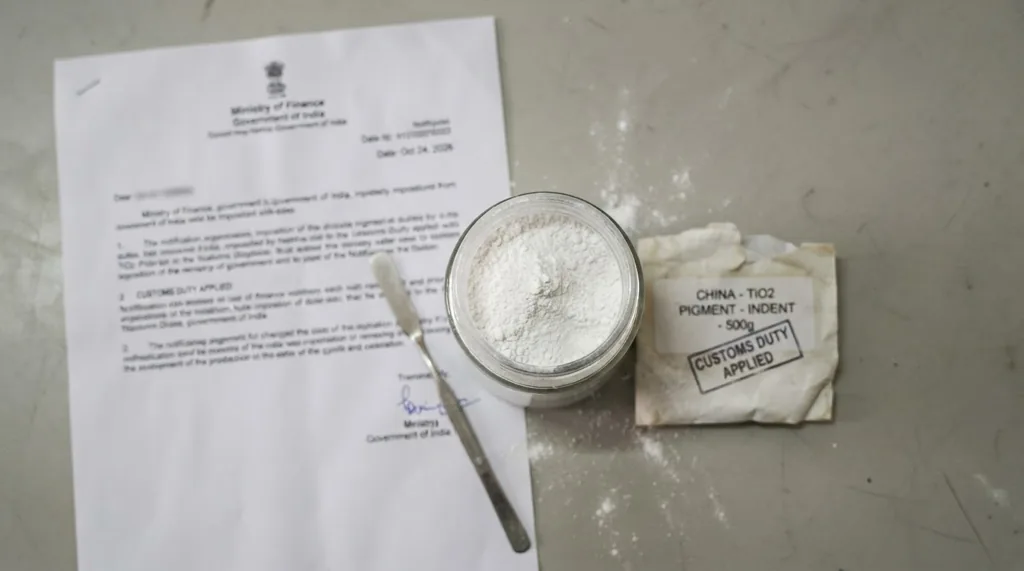
India imposed a duty of USD 460 to 681 per tonne on Chinese titanium dioxide on Oct. 24, 2026, for five years.
On Oct. 24, 2026, India’s Finance Ministry imposed a duty of USD 460 to 681 per tonne on Chinese titanium dioxide for five years.
The duty is set in Notification No. 26/2026-Customs (ADD)1. It is an anti-dumping duty, an extra import tax on goods sold abroad below their normal price. Titanium dioxide is a white powder, and the notification mentions its use in paint, textiles, cosmetics, food and medicines.
In short, a shipment of Chinese titanium dioxide entering India now pays a fixed extra charge for every tonne. The amount depends on which Chinese factory made it, and some uses, such as food and medicine, are left out.
What is changing for titanium dioxide from China?
The notification puts a duty on titanium dioxide that is made in China and shipped to India1. It also covers titanium dioxide made in China but shipped to India from another country. Goods that pass through China from a third country are caught too.
The titanium dioxide duty in brief
| Point | Rule |
|---|---|
| Instrument | Notification No. 26/2026-Customs (ADD), Oct. 24, 2026 |
| Goods | Titanium dioxide made in or shipped from China |
| Customs codes | 2823 00 10, 3206 11 10, 3206 11 90 |
| Rate | USD 460 to 681 per tonne, paid in rupees |
| Duration | Five years from Gazette publication |
The duty is a fixed sum for each tonne, not a share of the price. It ranges from USD 460 per tonne for the lowest-rate producers to USD 681 per tonne for everyone else1. Although the rates are set in US dollars, importers pay the duty in Indian rupees.
The duty applies for five years from publication in the Official Gazette, India’s official record of laws1. The government can revoke, replace or change it earlier.
Why did India act on Chinese titanium dioxide?
The duty follows final findings by the Directorate General of Trade Remedies (DGTR), the Commerce Ministry office that investigates unfair trade1. Those findings, file number 6/03/2024-DGTR, were dated and published on Aug. 3, 2026.
The DGTR reached three conclusions1:
- Dumped prices: titanium dioxide from China reached India below its normal value, and the gap was significant.
- Harm to Indian makers: the domestic industry suffered serious damage and faces the threat of more.
- Cause and effect: the cheap imports caused that damage.
On that basis, the DGTR recommended a duty to remove the harm to Indian producers. The Finance Ministry accepted the recommendation and used its powers under section 9A of the Customs Tariff Act, 1975.
How did a court case shape the new duty?
This is not the first finding in the case. The DGTR opened the investigation on March 28, 2024, and issued final findings on Feb. 12, 20252.
From court ruling to new duty
The case then went to court. The Indian Paint Association challenged the measure in the High Court of Calcutta, in case WPO No. 148 of 20251. The court gave its judgment on Sept. 22, 2025, and the matter was sent back to the DGTR for a fresh review.
The DGTR’s case page shows how that review moved forward2:
- Oct. 17, 2025: the DGTR issued a notice opening the remand review, the fresh look ordered by the court.
- Dec. 8, 2025: the DGTR held an oral hearing for the parties.
- May 12, 2026: the DGTR shared its draft conclusions with the parties in a disclosure statement.
- Aug. 3, 2026: the DGTR issued its new final findings.
The Oct. 24 notification is the last step in this chain. It turns the August findings into a duty that customs collects at the border1.
How much duty does each Chinese producer pay?
The notification sets different rates for different Chinese producers1. Producers that took part in the investigation get their own rates. Everyone else pays the highest one.
Anti-dumping duty by producer, USD per tonne
The rates per tonne are:
- USD 609: Anhui Gold Star Titanium Dioxide (Group) Co., Ltd., with Anhui Gold Star Titanium Dioxide Trading Co., Ltd.
- USD 563: Shandong Jinhai Titanium Resources Technology Co., Ltd., with Shandong Xianghai Titanium Co., Ltd.
- USD 460: LB Xiangyang Titanium Industry, LB Sichuan Titanium Industry, LB Lufeng Titanium Industry, LB Group and Henan Billions Advanced Material.
- USD 510: 12 named producers that cooperated but were not part of the sample examined in detail.
- USD 681: all other Chinese producers, and goods from other countries shipped from China.
The USD 510 rate covers 12 companies listed in the notification1. They include Pangang Group Titanium Industry, Chongqing Titanium Industry of Pangang Group, and Jiangxi Tikon Titanium Products (A Tronox Company). The list also names Yibin Tianyuan Haifeng Hetai, Kunming Donghao Titanium, Inter-China Chemical, and Anhui Annada Titanium Industry. The others are Shandong Doguide Group, Qiangjiang Fangyuan Titanium Industry, Jinan Yuxing Chemical, Ningbo Xinfu Titanium Dioxide and Shandong Dawn Titanium Industry.
Which titanium dioxide products are left out?
The duty does not cover titanium dioxide for six uses listed in the notification1. These exemptions matter most to food, medicine and cosmetics makers.
The excluded uses are:
- Food: titanium dioxide in food additives, such as food colouring.
- Medicines: titanium dioxide used in the film coating of tablets.
- Skin care: titanium dioxide in cosmetics and sunscreen lotions that absorb sunlight.
- Textiles: titanium dioxide used to make textiles and fibre, for self-cleaning, sun protection or a dull finish.
- Fibre: fibre-grade material blended into man-made fibre threads, and rutile grade for decorative paper made at the pulp stage.
- Very fine powder: nano or ultrafine titanium dioxide with particles below 100 nanometres, used in textiles and paint.
One limit is important for the textile trade. The textile exemption does not cover titanium dioxide used as a pigment for printing on cloth or garments1. That use pays the duty.
Which customs codes does the duty cover?
The notification lists three customs tariff codes: 2823 00 10, 3206 11 10 and 3206 11 901. These are entries in the First Schedule to the Customs Tariff Act, 1975.
However, the codes are only a guide. The notification says the product description decides whether duty applies, not the code1. A shipment entered under another code can still pay the duty if the goods match the description.
What papers does a shipment need for a lower rate?
A producer’s own rate does not apply automatically. The importer must show customs a valid commercial invoice with a signed declaration1.
An official of the company issuing the invoice must date and sign it, with their name and job title. The declaration certifies the quantity of goods sold for export to India. It also names the producer, with its address in China, and states that the information is complete and correct.
If the invoice lacks this declaration, customs charges the USD 681 rate for all other producers1. Customs can still run its own checks on the goods even when the declaration is present.
Who pays, and how is the duty calculated?
The importer pays the duty at the border, in Indian rupees1. Indian buyers of Chinese pigment for uses outside the exemptions, such as paint, will face higher costs.
The notification also sets how customs values the goods1. The landed value is the value customs sets under the Customs Act, 1962, plus customs duties. It leaves out duties under sections 3, 8B, 9 and 9A, the extra duties such as anti-dumping duty.
To turn dollars into rupees, customs uses the exchange rate set by the Finance Ministry1. The rate that counts is the one in force on the day the importer files the bill of entry, the main customs declaration for imports.
Has India taxed Chinese titanium dioxide before?
Yes. The DGTR’s records show an earlier investigation into titanium dioxide from China2. It opened on Jan. 16, 2003, with final findings on March 15, 2004.
A sunset review, a check on whether a duty should continue when it ends, followed later2. It opened on July 5, 2008, and closed with final findings on July 3, 2009.
Key points on India’s titanium dioxide duty
The table sums up the main facts of the notification.
| Question | Answer |
|---|---|
| What changed? | Anti-dumping duty on titanium dioxide |
| Who issued it? | India’s Ministry of Finance |
| Which instrument? | Notification No. 26/2026-Customs (ADD) |
| Date of notification | Oct. 24, 2026 |
| Which goods? | Titanium dioxide from China |
| Customs codes | 2823 00 10, 3206 11 10, 3206 11 90 |
| Rates per tonne | USD 460 to 681 |
| Rate without declaration | USD 681 per tonne |
| Main exemptions | Food, medicines, skin care, textiles, fibre, nano grades |
| Who must act? | Importers, with producers’ signed invoices |
| How long? | Five years from Gazette publication |
| Basis | DGTR final findings of Aug. 3, 2026 |
The duty applies for five years from its publication in the Official Gazette, unless the government changes it earlier1. Until then, every tonne of covered Chinese titanium dioxide pays between USD 460 and USD 681 at the Indian border.
Sources
- ↩ Explore https://taxinformation.cbic.gov.in/view-pdf/1010779/ENG/Notifications
- ↩ Anti-dumping investigation concerning imports of Titanium Dioxide originating in or exported from China PR-regd | Directorate General of Trade Remedies, MOCI, GOI https://www.dgtr.gov.in/en/anti-dumping-cases/anti-dumping-investigation-concerning-imports-titanium-dioxide-originating-or