
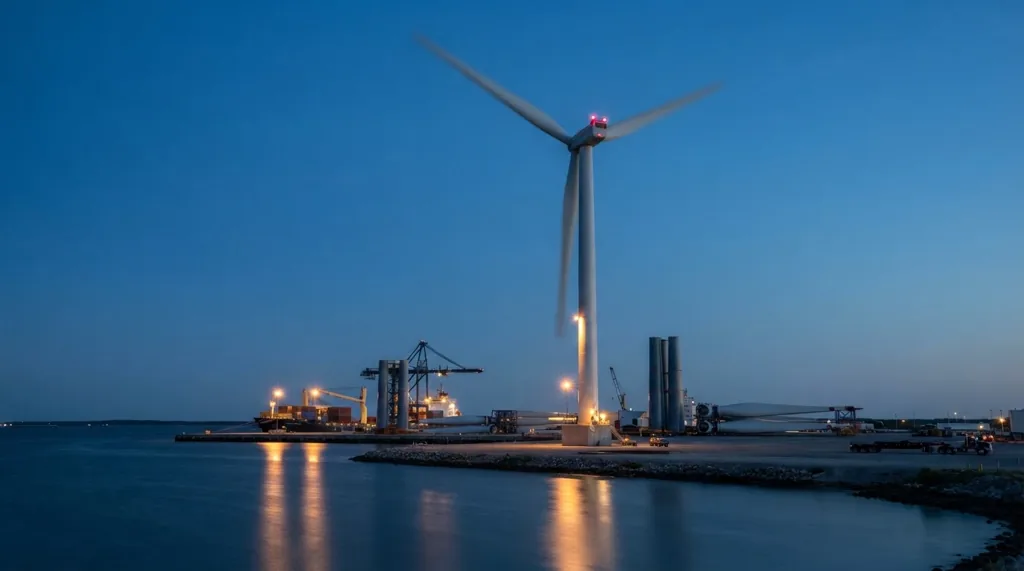
United States finds wind turbine imports threaten national security but orders trade talks, not new tariffs, from Oct. 22, 2026.
President Donald J. Trump signed a proclamation on Oct. 22, 2026 that finds imported wind turbines and their parts threaten United States national security1.
The order, Proclamation 11074, appeared in the Federal Register on Oct. 28, 20261. It ends a national security review that the Department of Commerce opened in August 20252. But it does not add a new tariff. Instead, it orders trade talks with foreign partners.
In short, a shipment of wind turbine parts pays the same duties at the border today as it did before Oct. 22. Parts made largely of steel, aluminum or copper still pay the existing metal tariffs, and talks may bring new limits later.
What does Proclamation 11074 change for wind turbine imports?
The proclamation uses Section 232 of the Trade Expansion Act of 19621. This law lets the President limit imports that threaten national security. It allows tariffs, quotas or agreements with other countries.
What Proclamation 11074 does
| Point | What the proclamation says |
|---|---|
| Legal basis | Section 232 of the Trade Expansion Act of 1962 |
| Goods | Wind turbines, parts, components and subcomponents |
| Finding | Imports threaten to harm national security |
| Action | Trade talks, not a new tariff |
| Metal tariffs | Steel, aluminum and copper tariffs unchanged |
| Next deadline | Update to the President within 180 days |
The President agreed with the Commerce Secretary that wind turbines and their components and subcomponents are imported under conditions that threaten to harm national security1. That finding is the legal step that allows action under the law.
The action chosen is negotiation, not a new tariff1. The Commerce Secretary and the United States Trade Representative, the official who leads trade talks, must jointly pursue agreements with foreign trading partners1. They choose which partners to talk to.
The proclamation states plainly that it does not change any existing Section 232 tariffs1. It names the tariffs on aluminum, steel and copper as staying in place. So no new duty line appears for wind turbines at the border from this order.
Why did the President act on wind turbines?
The proclamation repeats the findings of the Commerce Secretary’s report1. The report itself was not published with the order. The proclamation lists several reasons.
First, the Secretary found that wind energy is unreliable and intermittent, meaning it does not produce steady power1. Grid operators often rely on fast-starting fossil fuel generators to balance wind power. The report says this raises operating and repair costs1.
Second, the Secretary found cybersecurity risks in foreign parts1. The proclamation points to inverters, the equipment that turns power from a turbine into power the grid can use. It says most of these inverters are made outside the United States1. Networked inverters, it says, could let attackers take remote control of power generation.
Third, the Secretary found that turbines cause "clutter" on radar1. This can hide real targets and create false ones. The proclamation says it affects air traffic control, weather forecasts, homeland security and military radar.
Fourth, the Secretary found the country depends on imported parts1. Imports of wind turbine components have grown over the last decade. Domestic production of some parts, such as turbine blades, has not grown in a meaningful way, the report found1.
Which wind turbine goods are covered?
The proclamation covers wind turbines and their parts, components and subcomponents1. It does not list tariff codes for them. It also does not set out any goods that are excluded.
The Commerce investigation used the same broad scope: "wind turbines and their parts and components"2. Its notice also did not list product codes2.
The proclamation names inverters and blades as examples of concern1. Because no new tariff applies, no product list was needed for customs at this stage.
How do steel, aluminum and copper tariffs still apply?
Many wind turbine parts are made of large amounts of steel, aluminum or copper. The proclamation says these parts are already subject to earlier Section 232 metal tariffs1. It names three earlier orders:
- Proclamation 9704 of March 8, 2018, on aluminum imports1.
- Proclamation 9705 of March 8, 2018, on steel imports1.
- Proclamation 10962 of July 30, 2025, on copper imports1.
Tariff codes in the August 2025 steel and aluminum review
These earlier tariffs keep applying to wind turbine parts covered by them1. Proclamation 11074 does not raise or lower them.
The metal tariffs also reach "derivative" products, meaning finished goods made from the metal. In August 2025, the Bureau of Industry and Security (BIS), the Commerce agency that runs the Section 232 program, added 407 tariff codes to the steel and aluminum derivative list3. For those goods, the steel and aluminum tariff is charged on the value of the metal content only3. The rest of the product’s value pays the other tariffs that apply to it3. Those additions took effect on Aug. 18, 20253.
The same notice left out 60 tariff codes because other Section 232 cases were already looking at them3. It did not say which of those codes, if any, were wind turbine goods.
How did the wind turbine investigation start?
The Commerce Secretary opened the investigation on Aug. 13, 20252. BIS announced it in the Federal Register on Aug. 25, 2025 and asked the public for comments2. Comments were due by Sept. 9, 20252.
From investigation to proclamation
The notice asked for information on a list of questions2. These included:
- current and future US demand for wind turbines and parts;
- whether US factories can meet that demand;
- how much imports come from a small number of suppliers or countries;
- foreign government subsidies and unfairly low prices;
- the risk that foreign countries limit exports of parts;
- whether foreign-built turbines could be used as a weapon against the US;
- whether tariffs or quotas are needed to protect national security.
The notice raised tariffs and quotas as possible tools2. The President’s final choice, for now, was talks instead1.
The proclamation says the Secretary sent the report to the President within the 90 days before Oct. 22, 20261. The Secretary recommended "a range of actions"1. The proclamation does not list them.
Who is affected by the wind turbine decision?
Importers of wind turbines and parts face no new duty from this order. Their current costs at the border stay the same. This includes the metal tariffs on parts made of steel, aluminum or copper1.
Makers abroad and the governments of the countries where they work are the likely partners in the talks. The proclamation lets the Secretary and the Trade Representative choose "any foreign trading partner" they deem fit1. It does not name any country.
Wind farm builders and buyers in the United States still face uncertainty. The law lets the President take other steps if no agreement is reached within 180 days1. Steps could include tariffs, the proclamation says1. Buyers signing long contracts for imported parts may face higher costs if that happens.
When could tariffs on wind turbines come?
The proclamation sets one firm date. The Secretary and the Trade Representative must give the President at least one update on the talks within 180 days of Oct. 22, 20261. They must also report from time to time after that.
Section 232 lets the President act further if an agreement is not reached within 180 days, is not carried out, or does not work1. The proclamation says the President "may consider alternative remedies in the future" depending on the talks1.
The Secretary must also keep watching imports of wind turbines and their parts1. The Secretary must tell the President of any change that may call for more action1.
A separate law, Section 604 of the Trade Act of 1974, lets the President write such actions into the Harmonized Tariff Schedule, the US list of import duties1. Any future tariff would appear there.
Key points on the wind turbine Section 232 decision
The table below sums up what the proclamation does and what comes next.
| Question | Answer |
|---|---|
| What changed? | Wind turbine imports found to threaten national security |
| Who issued it? | President Donald J. Trump |
| What is the instrument? | Proclamation 11074 |
| When was it signed? | Oct. 22, 2026 |
| When was it published? | Oct. 28, 2026 |
| Which goods? | Wind turbines, parts, components and subcomponents |
| Is there a new tariff? | No, trade talks instead |
| Do metal tariffs still apply? | Yes, steel, aluminum and copper tariffs stay |
| Who leads the talks? | Commerce Secretary and Trade Representative |
| When did the investigation start? | Aug. 13, 2025 |
| Next deadline? | Update to the President within 180 days |
Shipments of wind turbines and parts clear customs today at the same rates as before. The next point to watch is the update on the talks, due within 180 days of Oct. 22, 2026, when the President may weigh other steps, including tariffs1.
Sources
- ↩ Federal Register :: Adjusting Imports of Wind Turbines and Their Parts and Components Into the United States https://www.federalregister.gov/documents/2026/10/28/2026-22049/adjusting-imports-of-wind-turbines-and-their-parts-and-components-into-the-united-states
- ↩ Federal Register :: Notice of Request for Public Comments on Section 232 National Security Investigation of Imports of Wind Turbines and Their Parts and Components https://www.federalregister.gov/documents/2025/08/25/2025-16191/notice-of-request-for-public-comments-on-section-232-national-security-investigation-of-imports-of
- ↩ Federal Register :: Adoption and Procedures of the Section 232 Steel and Aluminum Tariff Inclusions Process https://www.federalregister.gov/documents/2025/08/19/2025-15819/adoption-and-procedures-of-the-section-232-steel-and-aluminum-tariff-inclusions-process