
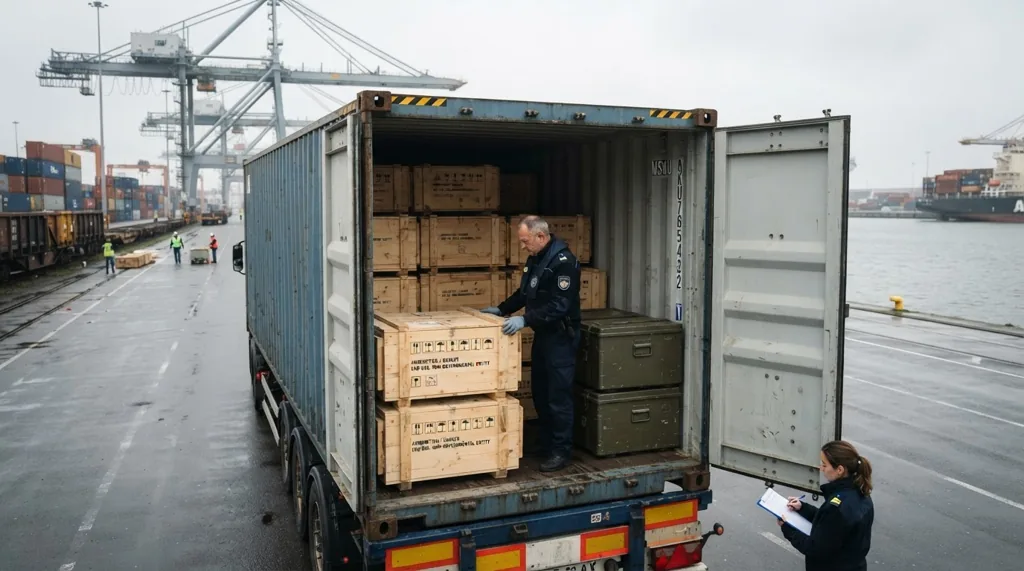
European Union rules ban selling arms, firearms and ammunition to non-government groups in the Democratic Republic of the Congo from Oct. 28, 2026.
From Oct. 28, 2026, the European Union (EU) Council bans arms, firearms and ammunition exports to non-government groups in the Congo.
The ban is set out in Council Regulation (EU) 2026/2374 of 26 October 2026, published in the EU’s Official Journal on Oct. 27, 20261. It amends Regulation (EC) No 1183/2005, the EU’s main sanctions law on the Democratic Republic of the Congo (DRC)1.
In short, an EU company may not sell or ship weapons, weapon parts or ammunition to any non-government group or person in the DRC. The ban covers goods made outside the EU too, and it also covers related services and payments.
What is the EU banning for the Congo?
The new rule makes it illegal to sell, supply, transfer or export certain goods to any non-governmental entity or person operating in the DRC1. The ban applies directly or indirectly, so shipping through a third country or a middleman is also covered1.
The Congo arms export ban at a glance
| Point | Rule |
|---|---|
| Buyers covered | Non-governmental entities or persons operating in the DRC |
| Goods covered | Common Military List goods, firearms, parts, essential components, ammunition |
| Origin | Whether the goods originate in the Union or not |
| Services covered | Technical assistance, brokering, financing, insurance |
| In force | Oct. 28, 2026 |
The goods fall into two groups:
- Military goods and technology listed in the Common Military List of the European Union, the EU’s official list of military equipment. Its latest version was published on March 13, 20261.
- Firearms, their parts and essential components, and ammunition, as defined in Regulation (EU) No 258/2012, the EU law on export permits for civilian firearms1.
The ban applies whether the goods originate in the Union or not1. A trader in the EU who resells a foreign-made rifle or cartridge is therefore caught in the same way as a maker.
Why does the regulation name firearms rules?
Regulation (EU) No 258/2012 sets up export permits, import rules and transit rules for firearms, their parts and ammunition1. It puts into effect part of a United Nations protocol against illegal making and trafficking of firearms1.
The new regulation does not change those permit rules. It borrows their definition of firearms, parts and ammunition to say which civilian weapons fall under the Congo ban1. So hunting rifles, sporting guns and their ammunition are inside the ban, as well as military equipment.
For an exporter, this means two sets of rules now apply together. The normal firearms export permit is still needed. On top of that, no permit can make a sale to a non-government buyer in the DRC legal, unless one of the exemptions below applies.
Which services and payments are also banned?
The ban reaches past the goods themselves. It is now forbidden to provide, directly or indirectly, technical assistance, brokering services or other services to non-government groups or persons in the DRC1. This covers services linked to military activities, or to the supply, making, repair and use of the banned goods1.
Money is covered as well. Financing or financial assistance linked to military activities, or to the sale of the banned goods, is forbidden for the same buyers1.
The regulation gives a long definition of "financing or financial assistance"1. It includes grants, loans, guarantees, letters of credit, supplier and buyer credits, and import or export advances1. It also includes all types of insurance, among them export credit insurance1.
Normal payment is not caught. Paying the agreed price for goods or services, on normal business terms, does not count as financing1.
Which shipments can still be approved?
National authorities in each EU country may approve some sales as an exemption1. The regulation lists four cases:
- Supplies for peacekeepers: goods and services only for the United Nations Organisation Stabilisation Mission in the DRC (MONUSCO), the UN peacekeeping force there, or the African Union Regional Task Force1.
- Protective clothing for personal use: flak jackets and military helmets that UN staff, media workers and aid workers take into the DRC temporarily1.
- Non-lethal military equipment: goods meant only for humanitarian or protective use, with related services and payments1.
- Sales cleared by the UN: other sales that the UN Security Council sanctions committee on the DRC has approved in advance1.
What no approval can cover
One firm limit applies to all four. No approval may be given for activities that have already taken place1. An exporter must get the approval before the goods leave, not after.
The Council’s matching decision, Council Decision (CFSP) 2026/2372, rewrites the same exemptions in the EU’s foreign policy law on the DRC2. For non-lethal equipment, that decision also names training among the services that can be approved2.
Why did the Council act now?
The regulation points to two UN Security Council resolutions1. On Dec. 20, 2022, Resolution 2667 removed a notice requirement linked to the UN arms embargo on non-government groups in the DRC1.
On June 29, 2026, Resolution 2825 changed the rules for naming people and groups who face UN sanctions1. The Council then amended its decision on the DRC to match2.
The regulation says EU-level action is needed so that the rules apply the same way in every member country1. The regulation also adds a new reason for listing people and groups1. Anyone who deliberately and gravely obstructs MONUSCO can now be listed, for example by blocking access, limiting movement or interfering with patrols1. The decision adds the same reason2. Listed people and groups have their money and other assets frozen under the existing law1.
What must businesses tell the authorities?
People and companies must give the national authority right away any information that helps the rules work1. This includes details of accounts and amounts frozen under the sanctions1. They must pass this information to the European Commission, directly or through their EU country, and must help the authority check it1.
Confidential talks between lawyers and their clients stay protected1. This protection also covers legal advice from other certified professionals, when it is linked to court cases under way or expected1.
National authorities must share information with each other and with the Commission without delay1. The regulation names customs authorities among them, under the new Union Customs Code law, Regulation (EU) 2026/21081. In practice, a customs office that spots a suspect shipment to the DRC can alert other EU countries quickly.
How will breaches be punished?
Each EU country must set its own penalties for breaking the rules, including criminal penalties where right1. The penalties must be effective, proportionate and dissuasive, and countries must also allow the profits of a breach to be seized1.
The regulation also bans taking part in schemes to get around the rules1. This applies when a person knowingly aims to dodge the ban1. It also applies when a person sees that a deal may dodge the ban and goes ahead anyway1. A trader cannot avoid blame by saying the evasion was not the main goal of the deal.
Who must follow the Congo arms ban?
The rules reach well beyond EU borders1. They apply:
- inside the EU and on board any aircraft or ship under an EU country’s control1;
- to any citizen of an EU country, wherever that person is1;
- to any company set up under the law of an EU country, inside or outside the EU1;
- to any company for business done wholly or partly within the EU1.
This list means a foreign subsidiary of an EU group, or a non-EU firm dealing through the EU, can fall under the ban.
When do the new Congo rules start?
The Council adopted both acts in Luxembourg on Oct. 26, 20261. The decision was published in the Official Journal on Oct. 27, 20262. The regulation appeared there on the same day1.
Key dates for the Congo rules
The decision took effect on the day it was published2. The regulation enters into force on the day after publication, which is Oct. 28, 20261. It is binding and applies directly in every EU country, with no national law needed1.
Next, each EU country must tell the Commission which national authorities handle the rules1. It must also send its penalty rules to the Commission without delay after the regulation enters into force1.
Key points on the EU Congo arms export ban
The table below sums up the main facts of the new regulation.
| Question | Answer |
|---|---|
| What changed? | Export ban on arms to non-government groups in the DRC |
| Who issued it? | Council of the European Union |
| Legal act | Council Regulation (EU) 2026/2374 |
| Which goods? | Military List goods, firearms, parts, ammunition |
| Origin of goods | EU-made and foreign-made goods alike |
| Banned services | Technical help, brokering, financing, insurance |
| Exemptions | Peacekeepers, protective clothing, non-lethal goods, UN-approved sales |
| Approval timing | Never for activities already done |
| Who must comply | EU citizens and EU-registered companies, anywhere |
| Published | Oct. 27, 2026 |
| In force | Oct. 28, 2026 |
| Next step | EU countries notify authorities and penalties |
From Oct. 28, 2026, any shipment of firearms, parts or ammunition to a non-government buyer in the DRC is illegal without an approved exemption1. EU countries must now send the Commission their penalty rules without delay1.
Sources
- ↩ L_202602374EN.000101.fmx.xml https://eur-lex.europa.eu/legal-content/EN/TXT/HTML/?uri=OJ:L_202602374
- ↩ Decision – EU – 2026/2372 – EN – EUR-Lex https://eur-lex.europa.eu/eli/dec/2026/2372/oj